
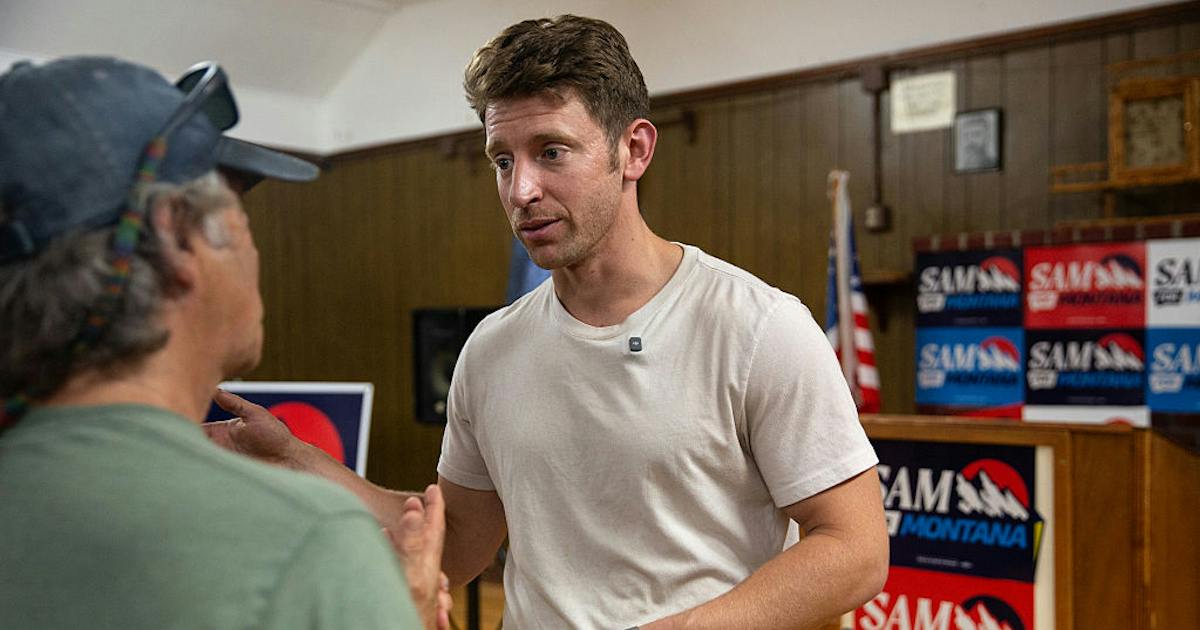
You’re reading The TNR Blue Book. Get daily scoops, strategy, and developments inside the liberal ideas factory delivered right to your inbox. Sign up for free.Inside Washington Western Montana, home to one of the country’s most competitive House races, is witnessing a test: In a bare-knuckles political brawl, which one wins—economic populism or the culture war? Supporters of Democratic candidate Sam Forstag, a smoke jumper who looks the part of a working-class Montanan, are betting it’s the former. But as Forstag taps into Montanans’ economic frustrations, his Republican opponent’s personal attacks are getting more aggressive.The race has drawn so much attention that President Donald Trump visited the state on Wednesday to campaign in Montana’s 1st congressional district with Forstag’s opponent, former conservative radio host Aaron Flint. “I’d be happy to take some time to sit down with him and share some stories about the pain this administration’s policies are causing people across this state,” Forstag said in a statement about Trump’s visit. “For better or worse, I look forward to passing bills for the president to sign into law once we win this race to help those Montanans. I’ll work with the president or whoever it takes to get that done.” Polling shows a tight race. Some polls show Flint up by one point, while others show Forstag up by three. The Cook Political Report in late September shifted the race from “likely Republican” to “lean Republican,” a move in Forstag’s favor.Tuesday’s debate between the two candidates got heated. Forstag and Flint are similar in many ways—both are young white men, both were student body president at the University of Montana, and both emphasize aspects of their careers (Flint is a veteran). But while Forstag focused on economic issues, Flint seemed more eager to portray Forstag as a radical on issues of gender and sexual orientation. “Phony Forstag, unfortunately he pretends to be this poor, blue-collar, working-class guy,” Flint said at one point in the debate. “He was a high-paid LGBTQ lobbyist from Portland who lobbied for all the crazy stuff.” At another point, Flint used a line that other Republicans, like Maine’s Paul LePage, have deployed so far this cycle: “common sense versus crazy.”Forstag was able to brush off Flint’s attacks, said state Representative Zooey Zephyr. “You know what they say: Don’t wrestle with pigs; you’ll wind up covered in mud,” she said about how Forstag handled Flint’s rhetoric. Zephyr, who is one of the state’s two transgender representatives, told The New Republic that anti-trans rhetoric isn’t the right strategy to win over Montanans. “In 2025, Montana was the only Republican-controlled state where half of Republicans joined us at times to vote down anti-trans legislation. We killed the majority of our anti-LGBTQ legislation. Only red state in the country to do that,” she said.“He hauls an axe and a chainsaw in his real day job,” said state Senator Ellie Boldman about Forstag, who spends the fire season jumping out of planes to fight wildfires in remote places. Forstag also served as a union leader and a lobbyist for the American Civil Liberties Union in the offseason. “His ability to keep the focus on everyday issues that really affect everyday Montanans and not some of the culture-war issues are what have been winning the day for Sam,” she added. And she, like Zephyr, thinks Montana’s voters aren’t going to buy Flint’s attempt to graft national identity politics onto this race. “In Montana, even Democrats have guns,” she said. “We voted for Donald Trump, and we also enshrined a woman’s right to choose in our constitution from ballot initiatives. We have a long history of rugged individualism.” Voters would rather hear a candidate address pocketbook issues than infringe on individual rights, she argued.And those pocketbook issues—like the cost of housing and fuel—have played a major role in the race, as they have across the country this cycle. “The lack of affordable housing is [issue] number one, two, and three that comes up almost without fail,” when Forstag talks to voters, said Brandon DeMars, Forstag’s campaign manager.During the debate, both candidates spoke about the need to make housing more affordable. Housing costs are a major crisis in the state, which has seen a boom in population in the years since the Covid-19 pandemic. New housing construction hasn’t caught up, and private equity buy-ups of existing housing units have made rent more expensive for everyone. Forstag argues that private equity firms shouldn’t be allowed to buy up mobile home parks, while Flint blamed the housing crisis on big government and inflation.Forstag’s debate performance, Zephyr said, showed why he might be able to pull off a win this year. “What makes Sam an exceptional candidate is he is very clear in telling the story of how these politicians have picked our pockets, telling the story of how the rich have gotten richer,” she said, “while people like him, and the state employees, and the public lands employees have lost their jobs and lost their ability to afford homes.”—Emma JanssenOutside WashingtonIn case you’ve missed the significant political scandal that’s been playing out in Massachusetts in recent weeks: Regulators this week finally canceled the nursing home licenses for the RegalCare company—one of the largest nursing home operators in the state—following late September reporting from The Boston Globe’s storied “Spotlight” team, which alleged an appalling degree of neglect of the elderly residents. Owner Eli Mirlis had already had his license revoked in New Jersey in 2018, and he had been the subject of a whistleblower complaint filed with the U.S. Court for the District of Massachusetts in 2020. (The case that resulted from this complaint—over Medicare and Medicaid fraud—was settled mere days before the Globe report was published.) Why all this didn’t result in a rapid investigation of the facilities is unclear. Patricia Jehlen and state Representative Thomas Stanley have sharply criticized Democratic Governor Maura Healey’s administration in recent weeks, particularly for having failed to implement a two-year-old law that requires the state to look at out-of-state complaints and other issues before approving new licenses. The Healey administration announced its intention to implement the new regulations shortly after the Globe report appeared and has defended Department of Public Health Commissioner Robbie Goldstein, despite the Globe’s Kay Lazar and Neena Hagen finding “little evidence of meaningful vetting of nursing home operators in the past few years, including their performance within Massachusetts.” The state reportedly hasn’t denied or canceled a license in at least seven years.RegalCare’s Massachusetts nursing homes will apparently continue operating with enhanced oversight while the company appeals the decision. Demand for skilled and long-term nursing facilities is projected to rise dramatically in coming years, with some estimates suggesting a greater than 75 percent increase in residents by 2030. So getting oversight sorted is rather urgent.Elsewhere:Don’t miss the Ohio Capital Journal’s piece about Cincinnati Public Schools’ “first-in-the-nation” program that offers a safe parking lot for families experiencing homelessness to sleep in their cars. Beneath the feel-good narrative lies a grim implicit indictment of the nation’s insufficient support for households facing precarity. The program, which was started in response to a noticeable uptick in unhoused students and families sleeping in cars, also helps get the families on a waiting list for a shelter spot and a hotel stay. However, it will cease operating for the season in November.—Heather Souvaine HornThe Ideas FactoryPublic Citizen released a new analysis that found that the majority of super PACs active this cycle are funded by a single wealthy donor or very small group—the watchdog offers Elon Musk, George Soros, Marc Andreessen, Ben Horowitz, and Richard Uihlein as examples. “Super PACs have created a parallel political system in which a handful of ultra-wealthy people can pour unlimited money into elections and gain an outsized role in determining which voices can be heard,” said organization co-president Robert Weissman in a press release.On Thursday at 1 p.m., the Roosevelt Institute will host an online “book club” conversation with Paul Osterman about his new book, Disposable Workers: The Transformation of Employment. The Roosevelt Institute’s principal economist, Michael Madowitz, will talk with Osterman about his study of the erosion of “stability and benefits” for twenty-first-century workers. —Heather Souvaine HornIn ClosingHere’s Why That’s B.S.Watch TNR’s Edith Olmsted unpack the speech in which Trump seemed to suggest it would be okay for Iran to nuke southern California.Political Trivia Question of the Day During World War II, a notable New York GOP congressman was credibly accused of having pro-Nazi sympathies. He was part of a trio of New Deal foes whom FDR liked to mock by repeating their names in a jocular way. Who was he? (Sign up for The TNR Blue Book to find the answer in tomorrow’s newsletter.)—Michael TomaskyYou’re reading The TNR Blue Book. Get daily scoops, strategy, and developments inside the liberal ideas factory delivered right to your inbox. Sign up for free.Inside Washington Minnesota leaders are decrying the raid on Representative Ilhan Omar’s D.C. home as a blatant attack on their state ahead of the midterms. “The purpose is to animate their base, which is incredibly demoralized and deflated because we are in a war no one wanted to be in” said Minnesota state Senator Erin Quade about why HSI agents, who work for Immigration and Customs Enforcement, raided Omar’s home just 22 days before Election Day. “Trump and his DOJ have a bizarre obsession with tearing down Minnesota, our leaders, and our communities,” Minnesota Senator Tina Smith said in a statement to The New Republic.Several Minnesotans who spoke to The New Republic see the raid on Omar’s home as a continuation of the Trump administration’s anti-Somali racism and xenophobia, which has long been a part of the president’s playbook. The raid came four days after President Donald Trump posted on Truth Social and urged Minnesotans to “fight back” against the Somali community. “It’s not just xenophobic,” said Jay Young, the senior policy director of civil rights and civil liberties at the nonprofit watchdog Common Cause, about the rhetoric coming from the Trump administration. “It’s tantamount to almost a race war.”In conversations with The New Republic on Tuesday, community leaders expressed concern about the electoral and political consequences of the raid, but some also spoke about their concern for Omar’s personal safety. “It was only months ago that a person attacked Ilhan during an event in Minneapolis,” said Minnesota state Representative Leigh Finke, who is the first openly transgender member of the state’s legislature. “These things are not abstract concepts in our lives. People want to kill us because of the things that are said by this administration.”Republicans have attacked Somali Americans for political ends before. In the aftermath of a number of statewide fraud cases, some of which involved Somali American perpetrators, the Trump administration began repeatedly referring to “Somali fraud,” despite the fact that the main perpetrator of one of the most prominent fraud cases was a white woman. In Minnesota’s Senate race, Lieutenant Governor Peggy Flanagan is running against Republican Michele Tafoya, who has attacked Flanagan over her role in state leadership during the fraud scandals. The goal of Trump’s rhetoric and the raid on Omar, Young said, “is to chill all of his political enemies, to let them know that this administration is not above weaponizing all of the power at its disposal.”Politicians, civil society groups, and everyday Minnesotans have rallied around Omar. On Monday night, Minneapolis residents and leaders held a rally in a city park to show support to the lawmaker, who has represented the city and some of its suburbs in the House since 2019.Attacks on Omar are likely to backfire in Minnesota. Quade described something truly surprising to anyone who has been following politics lately: On Monday, she was knocking on doors in the suburban district that she represents and said that every voter she spoke to cited concerns about ICE and Trump as their top priorities for the election. That’s a marked shift from recent months, she said, when affordability concerns were top of mind. Suburban voters are exactly the demographic that Tafoya needs to clinch a victory in the state.“It’s certainly stoking the same kind of unity feeling that people felt during Metro Surge more than it is anything else,” Quade said about the attacks on Omar and other Somali Americans. The best response to the attacks is to vote early, said Minnesota state Senator Omar Fateh in a statement to The New Republic. “We endured collectively Metro Surge, and we continue to be the target for this administration. And it’s because that you know we are everything that they can’t fathom,” she said. “We’re an inclusive, loving state where we care about our neighbors, even if they don’t look like us, even if they don’t pray like us.”—Emma JanssenOutside WashingtonA new poll shows Democrat James Talarico still ahead of Ken Paxton—but not by much. In results published by ReconMR on Tuesday, Talarico appears to be up four percentage points in Texas’s Senate race, with a +/- 4.4-point margin of error; the polling outfit’s senior research analyst Lindsay Hendren notes in a press release that Talarico has lost some ground, specifically in the San Antonio area since ReconMR’s September poll. Gina Hinojosa’s numbers also appear to be slipping: In September, she led Republican Governor Greg Abbott by four points, while the recent poll shows her trailing him by one point.The poll was conducted prior to new revelations about Paxton. Earlier this week, The Wall Street Journal reported that the candidate attended a New Year’s Eve party in Dubai in 2024 “with two fugitives from U.S. justice and a woman who wasn’t his wife.” That Paxton has had extramarital affairs is not news at this point, but the “fugitives” in question had been indicted for health care fraud and had donated to Paxton’s campaign funds. In response to the Journal’s query, Paxton senior adviser Nick Maddux said, “Ken Paxton has been politically persecuted for years, and every time, voters have seen through it and sent him back to office.” Paxton voters do seem unfazed by a remarkably long list of imbroglios. In ReconMR’s press release, Hendren offered a succinct assessment of where things go from here: “The race for Senate will come down to three things: turnout, turnout, turnout.”Elsewhere:If you missed The Guardian’s profile of JoAnna Mendoza’s campaign in Arizona’s 6th congressional district against two-term Congressman Juan Ciscomani, it’s worth your time. The opening anecdote: Tucson Mayor Regina Romero knocking on doors for Mendoza, who volunteered for Romero’s first mayoral campaign. There hasn’t been much public polling on this race in recent months.—Heather Souvaine HornThe Ideas FactoryOn Wednesday at 1 p.m., the Bipartisan Policy Center will host an online discussion about policies to reform the Food and Drug Administration—particularly adjustments to “processes that may safely deliver effective treatments to patients faster.” Speakers will include Zach Gaumer, Rohini Kosoglu, Andi Lipstein Fristedt, Ryan Long, Janet Woodcock, and Lauren Gardner.The Center for Biological Diversity, CU Maurice River, Hackensack Riverkeeper, Delaware Riverkeeper, New Jersey Conservation Foundation, and Project Terrapin on Tuesday petitioned New Jersey’s Department of Environmental Protection “to require simple bycatch-reduction devices on blue crab pots statewide” to keep turtles from being caught in the traps and drowning. The groups are particularly worried about the state’s diamondback terrapins, a vulnerable species inhabiting brackish coastal marshes and estuaries. Current regulations only require these protective devices to be used in around 5 percent of the relevant habitat, the groups estimate. Diamondbacks have previously been something of a bipartisan cause in the state: In 2016, Republican Governor Chris Christie signed a Democratic bill sponsored by then-Assemblymembers Bob Andrzejczak, Bruce Land, Eric Houghtaling, and Reed Gusciora (now mayor of Trenton) to ban hunting of the turtles and require the state to monitor diamondback terrapin populations.—Heather Souvaine HornIn ClosingBook of the Week: An American Problem: How the Country Built—and the Supreme Court Broke—the Voting Rights ActBy Michael G. Miller and Kevin T. MorrisTHE GIST: Miller and Morris tell the story of how the U.S. got the landmark achievement of the Civil Rights Movement—and how decades of conservative political and legal activism tore it down.PRAISE: “An American Problem is a must-read for scholars, practitioners, and anyone who cares about voting rights,” says University of California Berkeley professor Jake Grumbach.CRUISING THE INDEX: The book’s second half, which traces the aftermath of the fateful 2013 Shelby County v. Holder decision, which gutted the Voting Rights Act, is particularly compelling (and extremely damning). The authors meticulously chronicle the return of discrimination in American voting.TNR’S QUICK CRITICAL ASSESSMENT: Miller and Morris focus convincingly on “preclearance”—the idea that localities and states with a history of discrimination had to get federal permission before changing their voting laws—a requirement that was gutted by the 2013 Supreme Court decision. President Lyndon B. Johnson, urging Congress to pass the Voting Rights Act in 1965, said: “There is no Negro problem. There is no Southern problem. There is no Northern problem. There is only an American problem.” An American Problem is the story of how that particular American problem reared its ugly head again.—Alex ShephardPolitical Trivia Question of the Day Who was the first woman to serve as White House press secretary?(Sign up for The TNR Blue Book to find the answer in tomorrow’s newsletter.)—Michael TomaskyYou’re reading The TNR Blue Book. Get daily scoops, strategy, and developments inside the liberal ideas factory delivered right to your inbox. Sign up for free.Inside WashingtonAngie Nixon has defied expectations before. In the Democratic primary for Florida’s Senate race in August, her opponent Alex Vindman campaigned as though he was already running against Republican Senator Ashley Moody in the general election. Then Nixon beat Vindman by almost 12 points. Now Nixon faces tough odds. National Democrats have been reluctant to invest in her campaign, given that Florida is unlikely to flip. But experts say that the former state House representative shouldn’t be counted out yet.Some Democrats evidently agree. This Wednesday, Senator Chris Murphy will swing through Florida on a national tour to help Senate candidates. Murphy and Nixon will hold a town hall and go door-knocking together. Senator Bernie Sanders also plans to campaign with Nixon this Friday; he has also sent $250,000 to Nixon’s campaign. Nixon is running on a familiar progressive platform: universal health care, free childcare, and affordable housing.“For her to win, she needs a blue tsunami, not just a wave,” explained Aubrey Jewett, a professor of political science at the University of Central Florida. “And also perhaps what I’ve been seeing described as a Republican undertow,” he added, describing the idea that Republican voters would stay home or even vote blue.Despite Nixon’s evident skills as a candidate, the raw numbers in Florida put her at a disadvantage. In the state, there are 1.5 million more registered Republicans than Democrats, and many are older and therefore more likely to turn out and vote. Polls show Moody ahead of Nixon, though some are closer than others. As Jewett said, she would need the Democratic base to turn out in massive numbers, Republicans to stay home, and no party affiliation voters to swing blue. That’s no easy task, but President Donald Trump’s unpopularity and the high cost of living have put Nixon in a stronger position than Democratic candidates before her. What’s more: As a Black woman, she could be well-positioned to energize both Black voters and women voters across the state.“When she first announced that she was running for the U.S. Senate, because so few Black candidates have won U.S. Senate races, even fewer Black women, people were automatically thinking it was a really foolish thing to do,” said Sharon Wright Austin, a professor of political science at the University of Florida who studies African American political power. During the primary, “people were saying, ‘There’s no way she can win.’ But she won.”While the Black vote would offer Nixon an important boost, she hasn’t been exclusively focusing on those voters, Austin explained. “She also is going to communities where people don’t vote for Democrats and typically don’t see Black candidates, don’t vote for Black candidates,” she said. “She’s reaching out to every voter.”Nixon has been touring the state and relying on earned media, social media, and text messaging to reach voters. So far, she’s been unable to compete with Moody on the airwaves and is at a major cash disadvantage. As of the end of July, Moody had received more than $11 million to Nixon’s $975,000. Late last month, Moody released an ad calling Nixon a socialist and highlighting her connections to the Democratic Socialists of America, which Nixon joined in June. “We’re being bombarded with these negative campaign ads, and she’s not able to counter them because she simply doesn’t have the money,” Austin said.Both Nixon and the Democratic nominee for governor, David Jolly, have asked for more support from national Democratic groups, but they haven’t received it so far. On October 1, Nixon said that she spoke to Senators Chuck Schumer and Kirsten Gillibrand, who run the Democratic Senatorial Campaign Committee, and hinted that more money could be coming. But so far, national Democrats have prioritized other races. “Florida Democrats have gotten spoiled, because when we were purple, the national money always flowed in here,” said Susan MacManus, a professor emerita of political science at the University of South Florida. “And then suddenly it wasn’t, and it dried up.”When asked if she’s received enough support from the national party, Nixon wrote in a statement: “We can always use more resources to knock on more doors and combat the millions of dollars in dark money flooding the airwaves to protect unelected, incompetent extremists like Ashley Moody. But as I’ve said: ‘We are all we got,’ and I won’t ever trade our campaign’s grassroots independence for anyone’s approval.” Though the cards are stacked against her, experts say that Nixon’s talents as a candidate and the national environment could—potentially—be enough for an upset. “She’s definitely a fighter,” McManus said. “There’s no question. She’s not backing off of anything.”—Emma JanssenOutside WashingtonA Minnesota Star Tribune/KARE 11 Minnesota poll released on Monday shows Democratic Senate candidate Peggy Flanagan with a small four-point lead over Republican Michele Tafoya in Minnesota. Flanagan’s numbers, Walker Orenstein writes, derive from “huge margins in Hennepin and Ramsey counties, reflecting an electorate that is unhappy with President Donald Trump.” (Minneapolis lies in Hennepin County, while St. Paul is part of Ramsey County.) But—troublingly for Democrats, who need every seat they can get if they want to flip the Senate—the poll also “vindicates Tafoya’s belief that she is bucking national trends and locked in a tight race in left-leaning Minnesota. Republicans have a chance here,” Orenstein writes.Pennsylvania announced its sixth measles-associated death this year on Monday, days after the CDC confirmed that the United States has now seen more than 4,000 cases this year across 45 states. Health and Human Services head RFK Jr., note Walker Bragman and Melody Schreiber in a Guardian piece reviewing anti-vaccine activists’ response to the outbreak, has repeatedly “dispute[d] the rising death toll,” even accusing Democratic Pennsylvania Governor Josh Shapiro of “misinformation.” Last week, New York Governor Kathy Hochul declared a statewide emergency over rising measles cases. Politico notes that Hochul and Shapiro have approached measles outbreaks in their states very differently, with Hochul quickly requesting federal help while “Shapiro attempted to go it alone for months.” Shapiro has also not declared a disaster yet. The total number of U.S. cases this year is now almost double the total number for last year, which was seen as a stunning spike at the time.—Heather Souvaine HornThe Ideas FactoryOn Tuesday at 11 a.m., the Center for Universal Education at Brookings will host an online conversation with Emily Markovich Morris, Richaa Hoysala, Cecilia De La Paz, Hayin Kimner, David Jacobson, and Tyler Samstag about the impact of community partners on schooling systems. “From providing meals and quality after-school care opportunities,” the event summary states, “to promoting mental and physical health, civic leadership, creativity and exploration, these organizations help strengthen the broader ecosystems in which children learn and thrive.”On Tuesday at 1 p.m., the Bipartisan Policy Center will host an online conversation about the possible use of AI to speed home building, for example, via “zoning analysis, architectural design, jobsite monitoring, and procurement.” Could AI, in other words, help address the affordable housing crisis? Speakers will include Sara C. Bronin, Vikas Enti, Jenny Song, and Laura Hausman.—Heather Souvaine HornIn ClosingPolitical Trivia Question of the Day Donald Trump wants to turn the public East Potomac Golf Course into a swanky private club. What president, speaking in favor of public golf courses in the District of Columbia, said: “I favor a freer use of public parks by the people than we have had in the past. They should be used for tennis, baseball, skating, golf and like games ... I think all our parks should be opened for golf unless there is some specific objection in public needs”?(Sign up for The TNR Blue Book to find the answer in tomorrow’s newsletter.)—Michael TomaskyYou’re reading The TNR Blue Book. Get daily scoops, strategy, and developments inside the liberal ideas factory delivered right to your inbox. Sign up for free.Inside Washington Why Kansas might do the unthinkable and vote blueA perfect storm could be brewing in Kansas to elect a Democratic senator for the first time since 1932. Methodist pastor Adam Hamilton’s skills as a candidate, experts say, combined with uniquely bad conditions for the state’s farmers, could be the right ingredients for an upset. The problem is numbers: Registered Republicans outnumber registered Democrats in the state almost two to one.“If there was ever a chance to elect a Democratic senator, this is it,” said Dan Glickman, who served as agriculture secretary under President Bill Clinton and represented Kansas’s 4th congressional district in the House for 18 years. A large part of that is because of Hamilton’s biography. As pastor of the Church of the Resurrection, he leads the largest Methodist congregation in the country, consisting of 24,000 members. Hamilton estimates that some 9,000 of those are Republicans, 9,000 are Democrats, and between 6,000 and 7,000 are independents.“Being a pastor of a massive church, you have to be a pretty darn good politician to keep your job,” Glickman said. “There’s probably more attention on the pastor than there is on the governor or the senator.”Recent polls have shown a shockingly close race. Some, like a YouGov poll conducted at the end of September, found Hamilton up three points against his competitor, incumbent Republican Senator Roger Marshall. An obstetrician-gynecologist, Marshall has held the seat since 2021. He recently came under fire when The New York Times reported that he had sued more than 700 patients who carried unpaid bills, and 81 of those patients were arrested. When the Times asked about the arrests, Marshall’s campaign said that judges issue warrants, not doctors.Marshall, who is endorsed by Trump, is also struggling under the weight of the president’s expensive tariff policies and the war in Iran. Trump is deeply unpopular even in red Kansas, where he is 15 points underwater. Democrats are betting some conservative farmers, as a result, could stay home, and some might even vote blue, giving Hamilton an opening to unseat Marshall.“A lot of times, farmers tend to keep their politics close to their chest,” said Nick Levendofsky, executive director of the Kansas Farmers Union. “But I am hearing a lot of rumblings all across not just the state of Kansas but across the country.” Levendofsky joined 250 farmers from all around the U.S. for the National Farmers Union legislative fly-in to Washington, D.C., in September. “You could feel the tension when we went to USDA, when we went into these meetings with members of Congress.”With the fall harvest season underway, the increased costs of diesel and fertilizer caused by the Iran war are now hitting extra hard. Harvesting equipment requires diesel. And in the next few weeks, Kansas farmers who grow winter wheat will begin planting, requiring more diesel and fertilizer. “It’s a double whammy,” Levendofsky said. Diesel price hikes are likely to add an extra $20,000 to $30,000 to a grain farmer’s expenses this year, estimated Gregory Ibendahl, a professor of agricultural economics at Kansas State University. Farmers, who are price takers, have no way to pass that expense on and will simply have to eat the extra cost.That doesn’t necessarily mean farmers will turn on Marshall, Ibendahl cautioned. “The administration is very good about having extra ad hoc payments beyond the typical Farm Bill payments,” he explained, which can help farmers make ends meet. Marshall may very well benefit by association with President Donald Trump in the eyes of farmers receiving those funds. But meanwhile, Kansas ranchers are deeply frustrated by Trump’s policies on beef imports. In 2025, Trump announced a plan to bring Argentine beef into the country to lower grocery prices. In late August, Trump announced a plan to ease tariffs on beef imports through the election, drawing the ire of Kansas cattle ranchers. “The answer to increasing prices in grocery stores isn’t selling out American farmers and ranchers to buy votes in November,” Glenn Brunkow, president of the Kansas Farm Bureau, told the Kansas Reflector at the time. Both Marshall and Hamilton criticized Trump’s decision.Now Hamilton is traveling across the state, including through its more red, agriculture-heavy counties, trying to connect with the kinds of voters who haven’t elected a Democratic senator in nearly a century. “We haven’t elected Democratic senators in a long time,” Glickman said, “but there’s no reason that can’t happen this time.”—Emma JanssenOutside WashingtonThe drip-drip-drip of leaks from Republican Senate nominee Ken Paxton’s remarks at a private fundraiser continues. This time, The Texas Tribune reports that Paxton, when asked about the federal deficit, said legislators will need to make “some reasonable cuts to mandatory spending.” Mandatory spending, the Tribune’s Kayla Guo notes, is made up largely of Social Security, Medicare, and Medicaid, while in the most recent fiscal year, “much of the rest covered aid to lower-income families, such as food benefits and unemployment insurance, and a mix of retirement and disability benefits for federal workers and veterans.” Paxton didn’t elaborate on which programs he’d axe, at least in the clip that was shared with the Tribune. James Talarico’s team quickly posted the news to X on Thursday, saying, “Ken Paxton plans to cut Social Security and Medicare. He’s telling seniors to ‘suck it up’ while he owns 15 homes and increases his net worth up to $27 million.” Paxton, meanwhile, has reacted to the news by affirming his support for Social Security and saying that “the fake news keeps spinning the same cherry-picked audio to mislead Texans and take my words out of context. I have never said I would take away entitlements from those who deserve or earned them.” (Note, however, the suggestive wording at the end of that sentence.)Elsewhere:Millions are under hurricane warning as Isaias approaches the Gulf Coast on Friday. This has been an unusually mild hurricane season so far—which has been a very good thing, because both disaster preparedness and weather forecasting are in an unusually chaotic state following two years of budget cuts and unusual leadership decisions under the Trump administration. Republican Governors Kay Ivey of Alabama and Ron DeSantis of Florida have already declared a state of emergency in select counties, and Governor Brian Kemp has declared an emergency for the state of Georgia.—Heather Souvaine HornThe Ideas FactoryAt Policy Matters Ohio, George Boas argues against the recently implemented 90-day gas tax suspension, saying it’s “misguided in at least three critical ways: It will have only a small, temporary impact on gas prices; it drains the budget at a time when schools, childcare, and healthcare are already badly underfunded or facing massive federal cuts; and it fails to address the root of the problem.” Better proposals, he adds, would include “targeted property-tax relief for Ohioans who need it most,” “strong consumer protections and data-center regulations to keep Ohioans from bearing an unfair share of rising electricity costs,” affordable childcare, pro-worker legislation, and more. Data for Progress released a new survey that found 67 percent of voters “say they support the U.S. having a refugee program”—a number that jumps to 90 percent for people who personally know a refugee. The survey also found widespread opposition to recent immigration enforcement actions.—Heather Souvaine HornIn ClosingGood Week: Road saltMaine’s Senate race has given the nation no end of agita, but it finally delivered a moment worthy of the outsize attention when Susan Collins, bragging that she’d convinced Trump to stand down on his plans to put a tariff on road salt, was hit by this rejoinder from her Democratic opponent, Troy Jackson: “We can’t eat road salt.” Jackson is no paragon of charisma, so we hesitate to call it a zinger. But the humble de-icing material conjured the kind of relatable, of-the-moment idea that usually eludes the grasp of an inanimate object. Could it be a game-changer? Elections have hinged on dumber things, that’s for sure.Bad Week: Kimberly GuilfoyleFrom the moment a pair of wayward Canary Island mastiffs thrust her into the public consciousness, no one could have imagined the story arc of U.S. Ambassador to Greece Kimberly Guilfoyle—the onetime paramour of Gavin Newsom turned “Mar-a-Lago face” cautionary tale. Now we’re left to wonder: Does her story end here? This week, a trove of private leaks revealed that she’d been attempting to do some Trump administration favor-trading in return for a $100,000 donation straight to her Amex card to pay a bill. It raises a host of questions: What could she have blown that kind of money on? How much of that was spent on the latest pan-Hellenic couture from Zeus+Dione? And most importantly, who hates her enough to leak this stuff? If you’re that person, contact us on Signal.—Jason LinkinsPolitical Trivia Question of the Day How many U.S. states allow death by firing squad? (Sign up for The TNR Blue Book to find the answer in tomorrow’s newsletter.)—Michael TomaskyYou’re reading The TNR Blue Book. Get daily scoops, strategy, and developments inside the liberal ideas factory delivered right to your inbox. Sign up for free.Inside Washington Virginia’s 5th congressional district is rural, evangelical, and red. But, in a testament to how difficult 2026 is for Republicans, Democrat Tom Perriello just might have a fighting chance.“It is somewhat surprising that, at least based on the polls, the Democratic candidate is polling so well,” said Alex Keena, a professor of political science at Virginia Commonwealth University. “And then on the other hand, it’s probably not surprising at all, given what’s going on in this cycle.”Farming is a cornerstone of the local economy, and the district is also home to Liberty University. Since the district’s new lines were drawn in the 2020 redistricting process, Democrats haven’t considered it a particularly viable target. President Donald Trump won the district by 12 points in 2024, and Republican incumbent John McGuire defeated his Democratic opponent by 15 points. Even in 2025, which was considered a good year for Virginia Democrats, Governor Abigail Spanberger received just over 46 percent of the vote in the district.But, as Keena suggested, things are different in 2026. McGuire was leading Perriello 51 percent to 45 percent among likely voters in a recent Washington Post–Schar School poll, with a 4.6 percent margin of error. Though that still puts the Republican in the lead, experts say it’s a slimmer margin than expected, and Perriello has a chance. Like voters in the rest of the country, residents of Virginia’s 5th district are feeling the knock-on effects of Trump’s war in Iran. The district is a mix of blue college towns and red farmland, and those farmers have been hit hard by the increasing costs of fertilizer, gas, and other goods.Trump helped boost McGuire’s campaign in 2024 as a form of revenge against Representative Bob Good, the district’s then-representative. Good, a staunch conservative and former chair of the Freedom Caucus, supported Florida Governor Ron DeSantis in the 2024 Republican primary, drawing Trump’s ire. The decision to replace Good in 2024 is part of why Perriello has a chance now, Keena said. “Members of Congress are most vulnerable in that first reelection cycle,” he explained. Good could have stayed in office, building a reputation for himself among constituents. Instead, McGuire is a newcomer and comparatively unfamiliar to voters in the district. “This is kind of like the chickens coming home to roost for a president who likes to make erratic decisions and likes to use his endorsements to air grievances and punish people,” he said.Perriello, on the other hand, has a reputation within the district. He represented the 5th district from 2009 to 2011. The district was a bit different then, before the most recent round of redistricting, but experts say he’s still a known entity in the area. He’s been campaigning hard: On Monday, he campaigned for more than 24 hours straight in what he dubs, “24 Hours of Tom.”“The original idea was, I knew that people were working a double shift to support their own families. I wanted them to believe I’d work a double shift for them in Congress, and that became this idea of the 24 hours of campaigning,” Perriello told The New Republic on Wednesday. In the 26 hours that he campaigned, he hit every county in the district. “We want to make it clear that I am running to represent every part of this district, not just the blue areas.” During the early morning hours, Perriello said, he rode along with Charlottesville police, met with emergency responders, and joined farmers who were getting to work at 4 a.m. He also met with truckers refueling at gas stations; one explained that it cost $3,000 to fill up his tank. The cost of living crisis, Perriello said, makes voters “particularly angry because these were man-made problems, and those men are Donald Trump and John McGuire.”Data centers have, unsurprisingly, become a key issue in the race. Virginia has the country’s highest concentration of data centers, and it is also the proposed home of the Valley Link Transmission Line, a high-voltage electric line that would traverse 115 miles across the state. Perriello has made data centers, AI concerns, and utility costs a centerpiece of his campaign and hopes it will pay off with voters who see data centers as a physical manifestation of their fears around AI and affordability. “The voters are way ahead of the political parties on AI,” he said. “You have issues like the Valley Link Transmission Line and data centers that are uniting people across very different kinds of politics.”Perriello said that communities should be the ones to decide whether companies can build them in their backyards. “Where communities don’t want data centers, we should help them fight the data centers. And where communities want them, we should fight to get them the best possible deal,” he said. “But it is really hard to find communities that want them.” McGuire, meanwhile, has said that communities should decide whether a data center is built, but that the U.S. must beat China in the fight for AI dominance.Experts who spoke to The New Republic emphasized that, despite the favorable political circumstances, the odds are still in Republicans’ favor in Virginia’s 5th district. But there’s a larger story at play. “Democrats can win the House without Virginia five,” said Stephen Farnsworth, a professor of political science at the University of Mary Washington. But “the fact that Virginia five is increasingly seen as competitive speaks to what a challenging environment Republicans are facing this fall.”—Emma JanssenOutside WashingtonThe Minnesota Star Tribune’s Allison Kite and Briana Bierschbach pen a fascinating report on the shifting politics of northeastern Minnesota, which used to offer strong support to the Minnesota Democratic Farmer Labor Party but “has become harder for Democrats to hold” and could be key to Republicans gaining the upper hand in the state’s tightly balanced legislature. Republican candidates are playing up issues like immigration and fraud, while Democrats such as state senator Grant Hauschild—looking to defend himself from a second-time challenge from Republican Andrea Zupancich—are “betting that health care and childcare will matter to voters, too.” Democrat Aaron Schweiger, currently running against sitting state Representative Natalie Zeleznikar, similarly “said Trump has effectively pulled rural voters away from Democrats based largely on ‘cultural issues,’” and material ones could push them back into the blue. Meanwhile, everyone’s trying to claim the high ground on data centers.New York’s 1st congressional district candidate Chris Gallant gives The New York Times an interview for the ages: “‘I mean, all my friends know I’m kinky’ as hell, he said, using a saltier word. ‘I make Christian Grey look like amateur hour.’” Times reporter Jacob Bernstein was accompanying the Democrat to the shooting range and had asked him about the photos that the New York Post publicized last month, from when Gallant posed for a “San Francisco fetish brand” in 2010. Gallant initially called it a “coordinated political hit” but has opted to own the vibe.—Heather Souvaine HornThe Ideas FactoryOn Thursday at 1 p.m., the Center for American Progress will hold an online discussion with Eric Zwick and Owen Zidar, authors of the recent book The Everywhere Millionaire, about how business ownership became the “main path to wealth in America, and what that means for the future of tax policy and the American Dream.” New York University professor Lily Batchelder and Amy Hanauer of the Institute on Taxation and Economic Policy will also join the discussion, which will be moderated by Corey Husak, with introductory remarks from Emily Gee.A new poll from Data for Progress finds 56 percent of likely voters think “the government should invest more” in public housing, with strong majorities backing extreme weather resilience, energy efficiency, and clean water and air as factors to be considered in constructing such housing. The organization concludes that voters generally support the components of the so-called “Green New Deal” for public housing—just not necessarily by that name.—Heather Souvaine HornIn ClosingHere’s Why That’s B.S.Destroying Los Angeles is a “small price to pay”?Watch TNR’s Edith Olmsted unpack the speech in which Trump seemed to suggest it would be okay for Iran to nuke southern California.Political Trivia Question of the Day Who was the United States of America’s first ambassador to France? He’s a pretty famous guy.(Sign up for The TNR Blue Book to find the answer in tomorrow’s newsletter.)—Michael Tomasky
This Montana Democrat Is Running a Nail-biter of a Midterm Experiment
Full Article
Original Source
Read the full article at Newrepublic →KhanList aggregates and links to publicly available news content. We do not host full articles from third-party sources. Always verify important information with original sources.