
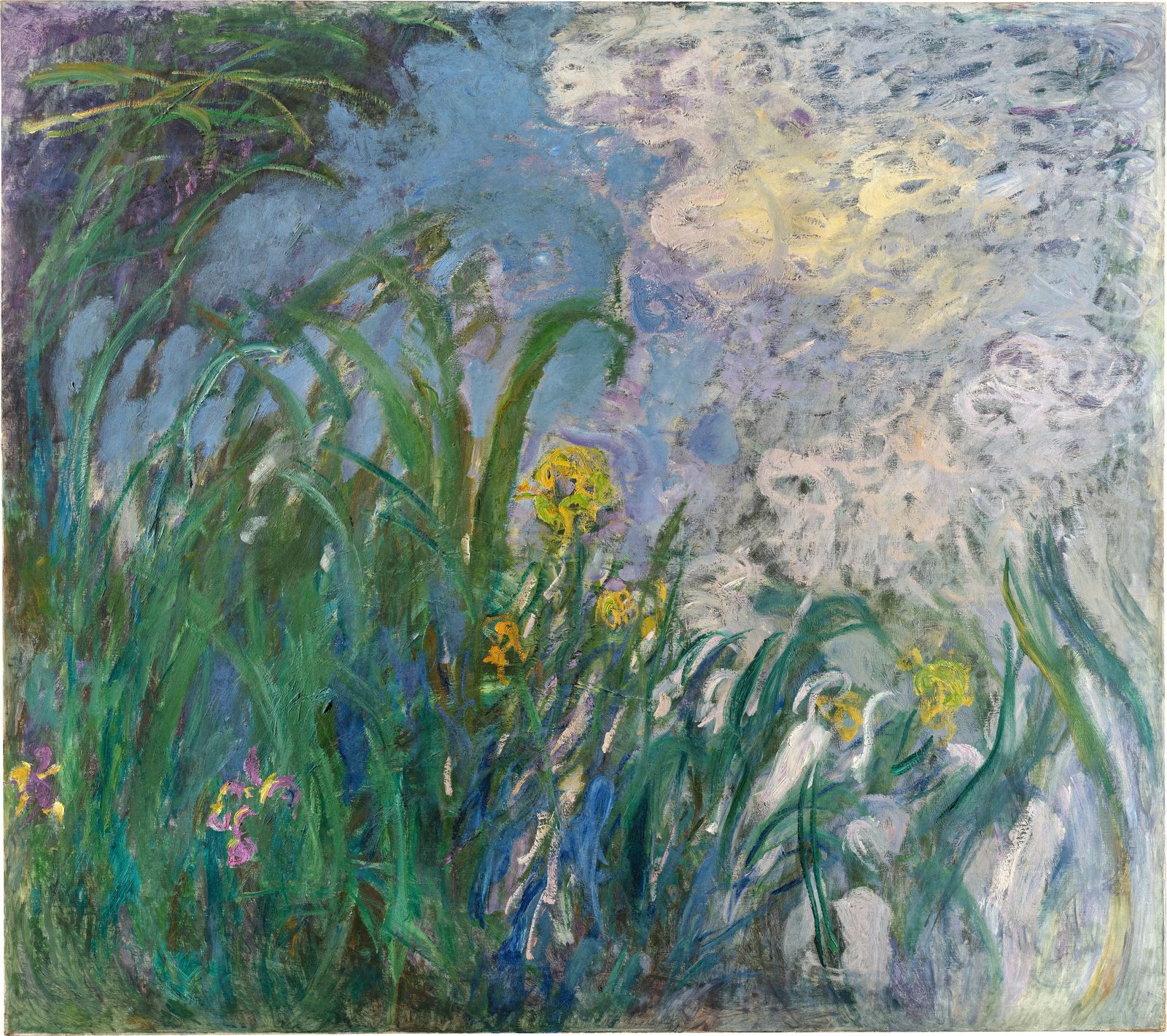
The Impressionist painted “Iris” a year or two before his death, at a time when his work was becoming increasingly abstract and falling out of favor with critics. Now, it’s considered a masterpiece ahead of its time October 26, 2026 8:00 a.m. Monet is believed to have painted Iris in 1924 or 1925, shortly before his death in 1926. Sotheby's As he neared the end of his life, Impressionist master Claude Monet filled a large canvas with his interpretation of flowers swaying by the pond at his home in Giverny, France. Now, more than a century later, the piece, called Iris, has sold for roughly $56.2 million, setting a record for the most expensive piece of art ever sold at auction in France. Iris sold after a 42-minute telephone bidding war between at least six collectors during a Sotheby’s sale in Paris on October 22. It ultimately went to a private buyer in Asia. “I’ve never seen bidding that long,” Helly Nahmad, a London art dealer, tells the New York Times’ Scott Reyburn. “It was insane, but these things are mega-rare.” The fierce competition for Iris may partially stem from its late date. Monet is believed to have painted it in 1924 or 1925, just a few years before his death in December 1926. The work is also large, measuring about five feet tall and nearly six feet wide. “The appetite for these large, late Monet paintings is increasing,” Alon Zakaim, another London art dealer, tells the New York Times. Until recently, Iris belonged to the descendants of Jeanne Schlumberger, whose family made its fortune in the oil industry. The piece has never been displayed publicly, having remained on the walls of the Schlumberger family mansion in Paris for decades. Because of that, Iris is still in “miraculous” shape, Thomas Bompard, co-head of modern and contemporary art at Sotheby’s France told journalists last month, as reported by Bloomberg’s Angelina Rascouet. As Monet got older, his work became increasingly abstract. He was “no longer painting landscapes, but atmosphere, space and time,” Marianne Mathieu, an art historian and former head curator at the Musée Marmottan Monet in Paris, told the London Times’ David Chazan last month. “Rather than simply representing nature by painting his garden at Giverny, he created a pure pictorial world freed from conventional perspective and fixed horizons,” she added. Did you know? Proust on Monet French writer Marcel Proust described Monet’s Giverny as a “garden of tones and colors even more than of flowers.” Though critics embraced Monet’s early work, they were far less enthusiastic about his later paintings. Schlumberger, along with Paris art dealer Katia Granoff, however, understood that Monet’s late works were “not the final chapters of Impressionism, but the opening pages of modernism and abstraction,” Bompard tells the London Times. Granoff acquired Iris and roughly 50 other Monets from the painter’s son, Michel, in the 1950s. According to Artnews’ Daniel Cassdy, Schlumberger appears to have helped finance this deal. Though Schlumberger died in 1983, her family waited until this year—which marks the 100th anniversary of Monet’s death—to offer up Iris, several other Monet pieces and works from other artists in the family's vast collection. Their bet seems to have paid off. The auction brought in about $83.7 million, with nearly three-quarters of the pieces on offer selling for above the high end of their pre-auction estimates, per Artnews. Monet emerged as the biggest draw. Saule pleureur ou L’Arbre de feu, a piece painted around 1918 or 1919 that depicts Giverny’s weeping willows, sold for $10.9 million. La Seine à Vernon, l'arbre, a dreamy 1894 view of the Seine River near Vernon, brought in $4.8 million, while La maison à travers les roses, another late work created in 1925 or 1926, went for $2.9 million. Three early works by Post-Impressionist Paul Cézanne—La Ferme, Arbres au bord de la rivière and Ciel entre les arbres—were initially slated for sale but withdrawn just hours before the sale was to begin. All three were recently granted French national treasure status, prompting discussions between the Schlumberger family and officials in Aix-en-Provence, where Cézanne was born. The city in southern France now plans to acquire the trio for its Musée Granet with help from France’s Ministry of Culture. “These are all remarkable works, but the undisputed masterpiece of the collection is Iris,” Bompard told the London Times. “A century after it was painted, it still seems modern.” You Might Also Like Get the latest stories in your inbox every weekday. More about: Art Art History Auctions Claude Monet France Impressionism Money Painters Painting
This Massive, 'Mega-Rare' Monet Painting Is Now the Most Expensive Artwork Ever Sold at Auction in France
Full Article
Original Source
Read the full article at Smithsonianmag →KhanList aggregates and links to publicly available news content. We do not host full articles from third-party sources. Always verify important information with original sources.