
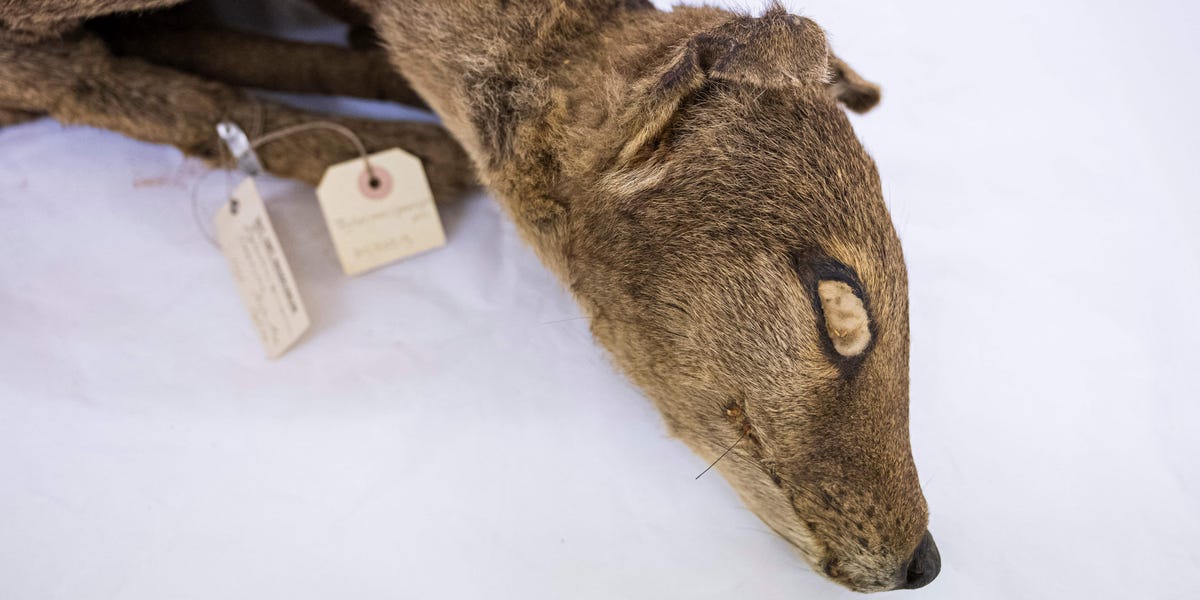
3 min readHere’s what you’ll learn when you read this story:The last known thylacine—a dog-like marsupial—died in captivity in 1936, but a taxidermied thylacine head just sold at auction for upwards of $85,000. The seller had no idea of its immense value when he originally bought the item at an antique store in southeast England for roughly $70. The stuffed head was added to the International Thylacine Specimen Database, which keeps track of the 800 or so thylacine-related artifacts around the world.As of this week, the thylacine (Thylacinus cynocephalus), known colloquially as the Tasmanian Tiger, has been extinct for precisely 90 years. A dog-like marsupial, though extirpated from continental Australia more than 2,000 years ago, persisted into modern times on the island of Tasmania, until humans deemed them a threat to the sheep industry. The island’s top predator was subsequently eradicated, with the last known member of the species dying on September 7, 1936. However, even nearly a century later, the long-dead thylacine still pops up in the unlikeliest of places.Last month in Bristol, U.K., one of two known taxidermied thylacine heads in existence surfaced at an auction, selling for £62,600 (or around $85,000). That’s a hefty price tag at first glance, but because the species has been extinct for decades, any artifact related to it, whether pelts, bones, or taxidermied objects, are immensely rare and incredibly valuable. But the story actually gets stranger, as the stuffed head’s seller admits that he had no idea what he was buying at the time.“It was quite a shock to discover we were sitting on something so special,” Andrew Stowe, an auctioneer and valuer at Auctioneum who eventually sold the item, told the BBC. “The vendor had purchased it simply because the novelty googly eyes attached to it made them laugh. When we broke the news that it was actually a thylacine, they were in complete shock.”According to natural-history curiosities dealer James Cranfield, who eventually purchased the taxidermied head, he initially dismissed the auction listing as the head of a fox until he took a closer look. Speaking with Science Alert, he says the clue was in the teeth. While foxes have six upper incisors, Cranfield knew that thylacines had eight. Unfortunately for Cranfield, someone else had guessed at the specimen’s true worth too, and a bidding war ensued, which resulted in the high selling price.To confirm his marsupial hunch, Cranfield authorized x-rays and CT scans of the mystery head, and experts confirmed it was indeed a member of the extinct T. cynocephalus species. The International Thylacine Specimen Database (ITSD) added the taxidermied head to its archive of thylacine-related objects. The database also includes the only other taxidermied thylacine head, which resides in the collection of the University of Tasmania’s Eric Guiler, who led several attempts to find hidden populations of thylacines on the island before his death in 2008.Cranfield told Science Alert he was relieved the head was, in fact, what he’d thought it was. “I haven’t got egg on my face for spending [so much] on a fox head,” he said. “I could have never shown my face in the community or online or anywhere."The surprise return of the thylacine at an auction house may not be the last we hear from this extinct species. Colossal Biosciences, a biotechnology company in Dallas, Texas, intends to resurrect the thylacine so that it can resume its ecologically important role as top predator on Tasmania. In 2024, the company, in partnership with experts at the University of Melbourne, announced that they’d successfully reconstructed 99.9 percent of the thylacine’s genome, with only 45 gaps remaining. The work built on a 2017 study that partially reconstructed the thylacine’s genome from a young specimen. Colossal is also using some of the same thylacine-genome techniques to help the world’s largest carnivorous marsupial, the imperiled Tasmanian devil, overcome a rare contagious cancer known as the devil facial tumor disease.Who knows if the thylacine will one day walk the Earth again? But if they do, the thylacine curiosities market will be in chaos.Darren lives in Portland, has a cat, and writes/edits about sci-fi and how our world works. You can find his previous stuff at Gizmodo and Paste if you look hard enough.
This Man Thought He Bought a Fox Head With Googly Eyes. It Was Actually an Extinct Tasmanian Tiger.
Full Article
Original Source
Read the full article at Popularmechanics →KhanList aggregates and links to publicly available news content. We do not host full articles from third-party sources. Always verify important information with original sources.