
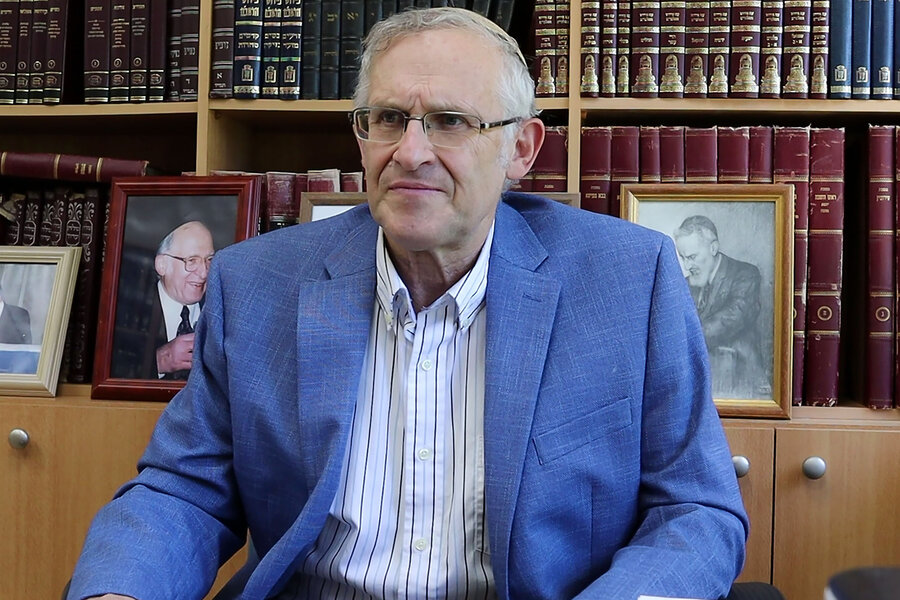
Rabbi Mosheh Lichtenstein felt compelled to deliver a message to students during his weekly lecture at the West Bank seminary he helps lead. It was early September, just before Rosh Hashana – the Jewish New Year and, traditionally, the Day of Judgment.The theme of his talk would be the prayers for forgiveness – selichot, in Hebrew – that religious Jews recite in the run-up to the High Holidays.About 30 minutes in, Rabbi Lichtenstein had launched into a jeremiad against the “moral complacency” of his fellow religious Israeli Jews toward settler violence against Palestinians in the West Bank. He described the situation as a “shame” and a “disgrace.” “I’m talking about the atmosphere that makes this possible,” the rabbi said in Hebrew with heavy New York inflections. “Reality is broken.”Since January, in the Israeli-occupied West Bank, Jewish extremists have carried out more than 1,600 attacks against Palestinians resulting in casualties or property damage, according to the United Nations. At least 82 Palestinians have been killed by Israeli security forces or settler vigilantes, according to U.N. figures that do not distinguish between civilians and militants. Hundreds of others have been driven from their homes.During his recent address to the U.N. General Assembly, Israeli Prime Minister Benjamin Netanyahu dismissed the outburst of settler violence as the actions of “a handful of young juvenile delinquents.” Leo Correa/APA damaged room is seen in one of the two West Bank houses belonging to the Tubasi family, which were burned during an overnight attack by Israeli settlers, Sept. 29, 2026. In mid-September, the Institute for National Security Studies in Tel Aviv put out a rare strategic alert, warning that unchecked “Jewish terrorism” poses “a distinct strategic threat to the State of Israel and its democratic character.” Yet the admonition from Rabbi Lichtenstein is rare in the religious settler world. He co-heads a prominent West Bank settlement yeshiva, whose alumni include a sitting Israeli Supreme Court justice, members of Israel’s Parliament, the chief rabbi of the United Kingdom, and a former U.S. envoy to Israel, Jason Greenblatt.The Har Etzion Yeshiva is a sprawling complex at the heart of Alon Shvut, a Jewish settlement six miles southwest of Bethlehem in the occupied West Bank. Students there combine military service with intensive study of Talmud, the bedrock of Jewish law.The shelves behind Rabbi Lichtenstein’s desk are lined with uniform volumes of rabbinic texts with titles embossed in gold alongside photos of his father and grandfather, both leading 20th-century Orthodox scholars in the United States and Israel.Though a respected scholar from an illustrious rabbinic lineage, Rabbi Lichtenstein is a lonely voice in the world of religious Zionism, a roughly 700,000-strong community in Israel distinguished by its Orthodox observance, ardent nationalism, and crocheted skullcaps. Since the Oct. 7, 2023, attack, Israeli society – and the political center of gravity among religious Zionists in particular – has lurched to the right.Shmuel Rosner, a pollster and senior fellow at the Jerusalem-based Jewish People Policy Institute, says among the knit-kippah set “there’s a large chunk of people who don’t really care” about Jewish vigilantes. A greater number oppose it for “tactical reasons,” he adds, because this sort of behavior could hinder the settlement enterprise by fueling international condemnation. “Then there is the small number of people that, like Lichtenstein, are worried because of values,” Mr. Rosner says. Ariel Schalit/APA supporter holds a sign that reads "Bibi we love you," while Israeli Prime Minister Benjamin Netanyahu speaks at a Likud party event in Tel Aviv, Israel, Sept. 17, 2026. Rabbi Lichtenstein has been outspoken about what he considers the moral bankruptcy of National Security Minister Itamar Ben-Gvir’s far-right Jewish Power party, which has evolved from a fringe group of ultranationalist pariahs to a major player in Israeli politics.“What I’m trying to address is the mainstream who simply shrugs it off, and just moves on with their life and doesn’t feel scandalized by what’s going on,” says Rabbi Lichtenstein, sitting behind a desk stacked with heavy religious tomes in his yeshiva soon after his morning prayers. “I feel it’s a desecration of Torah, of God, if you want.”Jewish violence against Palestinians, he says, is enabled by the public’s apathy and official inaction. “The government is unwilling to do anything to make any serious effort to stop this,” he says, because Israel’s leaders lack “the political will, the moral clarity.”Rabbi Lichtenstein describes a “moral crisis” within the religious Zionist world, as it has come to embrace an ideology that includes a “willingness to glorify power and force.” That, he says, is antithetical to Jewish values.“It’s also a huge moral problem: We are responsible. We control the land, we have the power, and I think it’s incumbent upon us to prevent these things and to oppose them,” he says. “The correct thing is not to lose your human compassion ... and you should have the ability to also empathize and to provide [Palestinians] with basic human dignity and needs.” Whereas pro-peace religious parties once existed in Israeli politics, such positions have evaporated as the public has widely adopted hawkish views on the Israeli-Palestinian conflict.“There’s a lot of fear among rabbis to come out against what’s happening or present any kind of alternative,” says Yair Ettinger, a public radio host in Israel and author of “Frayed: The Disputes Unraveling Religious Zionists.” Fear of being branded as “leftist” – a mark of Cain for a large swath of Israeli society – prevents rabbis from speaking up “directly, critically, sharply about what’s happening in the [occupied] territories.” Deepen your worldviewwith Monitor Highlights.Politics with respectGet political stories with respectful analysis.There‘s a world of new ideas in everyBooks newsletter.There‘s more to life, enrich yours withCulture & Learning weekly.Follow humanity‘s discoveries withScience & Nature stories in your inbox.Gain a spiritual perspectivefrom the stories in your inbox.Want to understand the deeper impact of critical events? Learn the Monitor‘s insight.Already a subscriber? Log in to hide ads. Rabbi Lichtenstein concedes that his viewpoint is part of the minority in Israel today. But he says that won’t keep him from speaking up.“The quality of your message and the morality of the message is not influenced by numbers,” he says. “And I do believe that there’s a fair amount of people who agree.” ALREADY A SUBSCRIBER? LoginReal news can be honest, hopeful, credible, constructive.The Christian Science Monitor was founded in 1908 to lift the standard of journalism and uplift humanity. We aim to “speak the truth in love.” Our goal is not to tell you what to think, but to give you the essential knowledge and understanding to come to your own intelligent conclusions. Join us in this mission by subscribing.
This Israeli rabbi is calling on religious Jews to condemn settler violence
Full Article
Original Source
Read the full article at Csmonitor →KhanList aggregates and links to publicly available news content. We do not host full articles from third-party sources. Always verify important information with original sources.