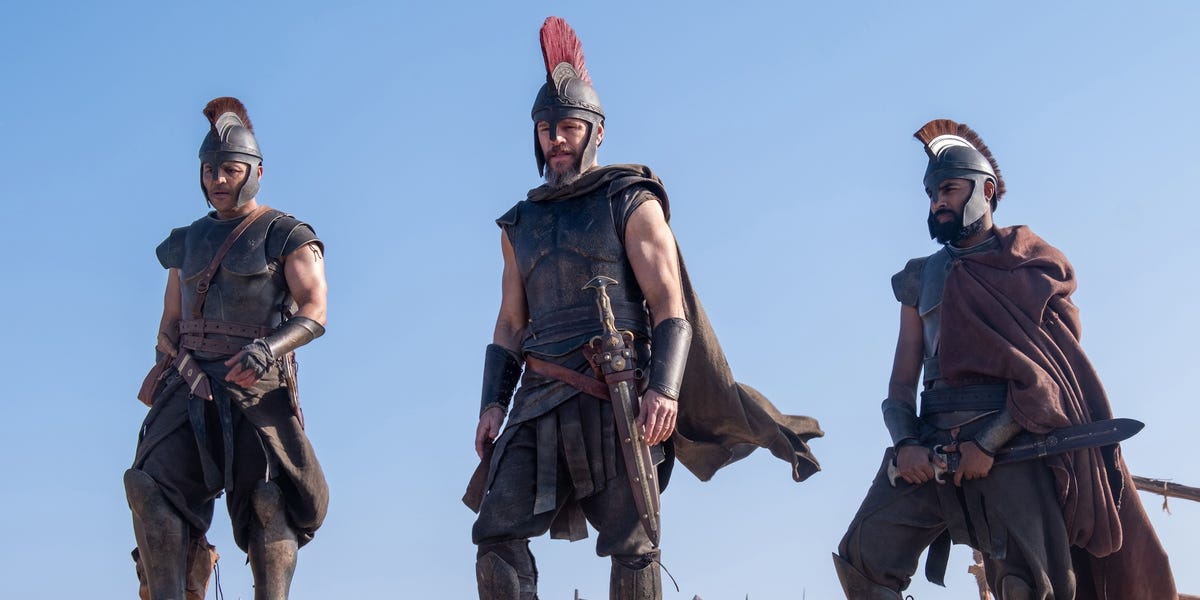
6 min readMelinda Sue Gordon/Universal PicturesLike so many ancient stories, it started with an apple. Adam and Eve had one. Snow White had one. And so did Paris, prince of Troy. In hindsight, they probably all would have been better off if they’d just let them apples be.In Paris's case, he gave one to the goddess Aphrodite as a symbol of her beauty, and she paid him back with the most beautiful mortal woman in the world—who just happened to already be married. Cue a siege, a wooden horse, a burning city, and a ten-year war waged in blood and bronze.It wasn’t all bad. Without it, there’d be no Homer’s Odyssey. And without that, no Christopher Nolan’s The Odyssey.But here’s the thing about Homer’s Odyssey—it’s all about the Trojan War, without really being about it at all. The Iliad covers only a short stretch of the war’s tenth year; The Odyssey deals with its aftermath. In The Odyssey, the fighting is mostly described in songs and discussions over dinner. So, in effect, it’s just a plot device to set Odysseus on a journey home. But we never get the full story—how it started, who was fighting whom, or why a war over one woman somehow lasted a decade.So, if—after watching the film—you were left wondering what the Trojan War was really about… read on.It Always Starts With an AppleFirst thing to say—the Trojan War, as the poets tell it, is a fictional conflict. Something like it may have happened at some point in history, and you can read about that in our article about the true stories behind Homer’s Odyssey. But Homer’s version of the war is a myth—a folktale handed down and reshaped by generations of singing bards.It all began at a wedding. Peleus, a mortal king, was marrying Thetis, a sea goddess—a match so significant that every god and goddess on Olympus was invited. Except one: Eris. As the goddess of discord and strife, she was a known vibe killer. She was so upset, however, that she crashed the party and tossed a golden apple into the crowd inscribed with the words: “For the fairest.” Three goddesses—Hera, Athena, and Aphrodite—all decided it was meant for them, and a wedding fight ensued.The three goddesses got into a row. Zeus, sensibly, refused to pick a winner and sent them to Paris of Troy, who was ordered to choose who was easiest on the eye. But before he could cast his judgment, all three tried to lure him: Hera offered dominion, Athena victory in war, and Aphrodite the most beautiful mortal woman on earth. Her name was Helen of Sparta, the wife of King Menelaus.UniversalThe Trojan War is, in effect, just a plot device to set Odysseus on a journey home. But Christopher Nolan makes it into much more than that.A Royal KidnapParis made his choice and rushed straight off to Sparta to collect his prize.Paris was, by ancient accounts, one of mythology’s truest fuckboys. The Greek writer Philostratus says he didn’t allow dirt to settle on his hair even on the battlefield, wore eyeshadow, polished his nails, and wore panther skins on his shoulders.Helen, meanwhile, is described by absolutely everyone as a picture of pulchritude. Her beauty was most famously invoked by Shakespeare’s rival, Christopher Marlowe, in Doctor Faustus: “Was this the face that launched a thousand ships, / And burnt the topless towers of Ilium?”Paris arrived in Sparta as Menelaus’s guest. Then, while his host was away in Crete for his grandfather’s funeral, he made his move, and Helen left for Troy with him.There are conflicting versions of this part of the story. In some, Helen elopes; in others, she is kidnapped. Either way, Aphrodite—goddess of love—saw to it that Helen fell in love with Paris, casting a divine spell over her heart.Helen: an Egg-Born Perennial AbducteeThis wasn’t Helen’s first abduction. Indeed, as covered by several ancient Greek and Roman authors such as Homer, Euripides, Virgil, and Ovid, she was one of Zeus's daughters—conceived, according to the weirdest version of the story, after Zeus seduced her mother Leda in the form of a swan. Helen was said to have hatched from an egg, sister to Clytemnestra, Castor, and Pollux.Her famous beauty caused trouble long before Troy. As a child, or in some versions a young teenager, she was abducted by the Athenian hero Theseus—yes, the Minotaur one—who wanted to marry her once she came of age. Her brothers, Castor and Pollux, invaded Attica and got her back.It was practice, in hindsight, for what was coming: by the time Paris arrived, Helen had already spent much of her life being fought over, whether she liked it or not.The Oath of TyndareusBack in Troy, Menelaus was understandably rather upset at the abduction of his wife. He himself had won her hand from a field of suitors.When Helen came of age, every eligible king and prince in Greece wanted to marry her. There were so many, in fact, that her father, Tyndareus, feared whoever was picked would provoke a war with the rest. So, on Odysseus’s advice, he made every suitor swear an oath first: whoever Helen married, the rest would defend that marriage if it was ever threatened.Menelaus won because he was the richest and he took Helen to Sparta. So, when Paris took her, Menelaus called in the oath.What Was the Siege of Troy, and What Did Agamemnon Have to Do with It?Agamemnon, played by Benny Safdie in Nolan's The Odyssey, was Menelaus's brother. As King of Mycenae and the most powerful ruler in Greece, he took command of the combined fleet—partly out of ambition, partly because his brother's stolen wife gave the whole expedition its cause.It cost him before he'd even set sail. Stuck at Aulis with no wind to launch his ships, Agamemnon was told the gods demanded a sacrifice: his own daughter, Iphigenia. He obliged—a decision that would eventually get him killed by his wife, but that's another story.Ten years of siege followed, most of it stalemate outside Troy’s walls. The Iliad covers only a short stretch of the tenth year, sparked by Agamemnon and Achilles falling out over a captive woman, Briseis. Achilles refused to fight, the Greeks nearly lost without him, and it took Hector's death, Achilles' own death, and one final trick to finally end it.Melinda Sue Gordon/Universal PicturesChristopher Nolan’s Trojan horse, in all its glory.The Trojan HorseAfter ten years, the Greeks couldn’t take Troy by force—so they tried trickery instead. They built a giant wooden horse, hid their best soldiers inside it, and pretended to sail away, leaving the horse behind as an offering to Athena. Homer barely covers this part—the fuller, more dramatic account comes from Romans writing centuries later, like Virgil.In Nolan’s The Odyssey, we see the horse lying half-submerged on the beach like the Statue of Liberty at the end of Planet of the Apes—echoing, perhaps, the fall of a civilization.In Virgil’s version, one man is left behind in plain sight: Sinon, a Greek soldier planted as a decoy to spin a sob story for the Trojans about being abandoned as a sacrifice to the gods. He tells them that the horse was left as a gift for the goddess Athena, so if they destroyed it, that would anger the gods. They had to keep it. Drag it inside, on the other hand, and Troy will win her protection.So they did just that. On the very same night, the hidden Greeks climbed out, opened the gates, and let the rest of the army in.Priam, Troy’s king, was killed at his own altar; the city’s women were enslaved, its men slaughtered, and Hector’s young son Astyanax was thrown from the city walls. Troy burned to the ground.But the story didn’t end there. Nostoi means “homecomings,” and it was also the title of a lost poem in the Epic Cycle devoted to the Greek soldiers' journeys home. None of them got home cleanly. Agamemnon was murdered by his wife the day he arrived. Menelaus was blown off course for years (though he did get Helen back). Ajax the Lesser drowned. Odysseus took a decade.Troy’s fall wasn’t really an ending, then—just the start of a different kind of war, fought against gods, monsters, and the sea itself. That’s the story The Odyssey tells. And the story Nolan is telling now.
This Is Your Reminder That the Trojan War Didn’t Actually Happen
Full Article
Original Source
Read the full article at Esquire →KhanList aggregates and links to publicly available news content. We do not host full articles from third-party sources. Always verify important information with original sources.