
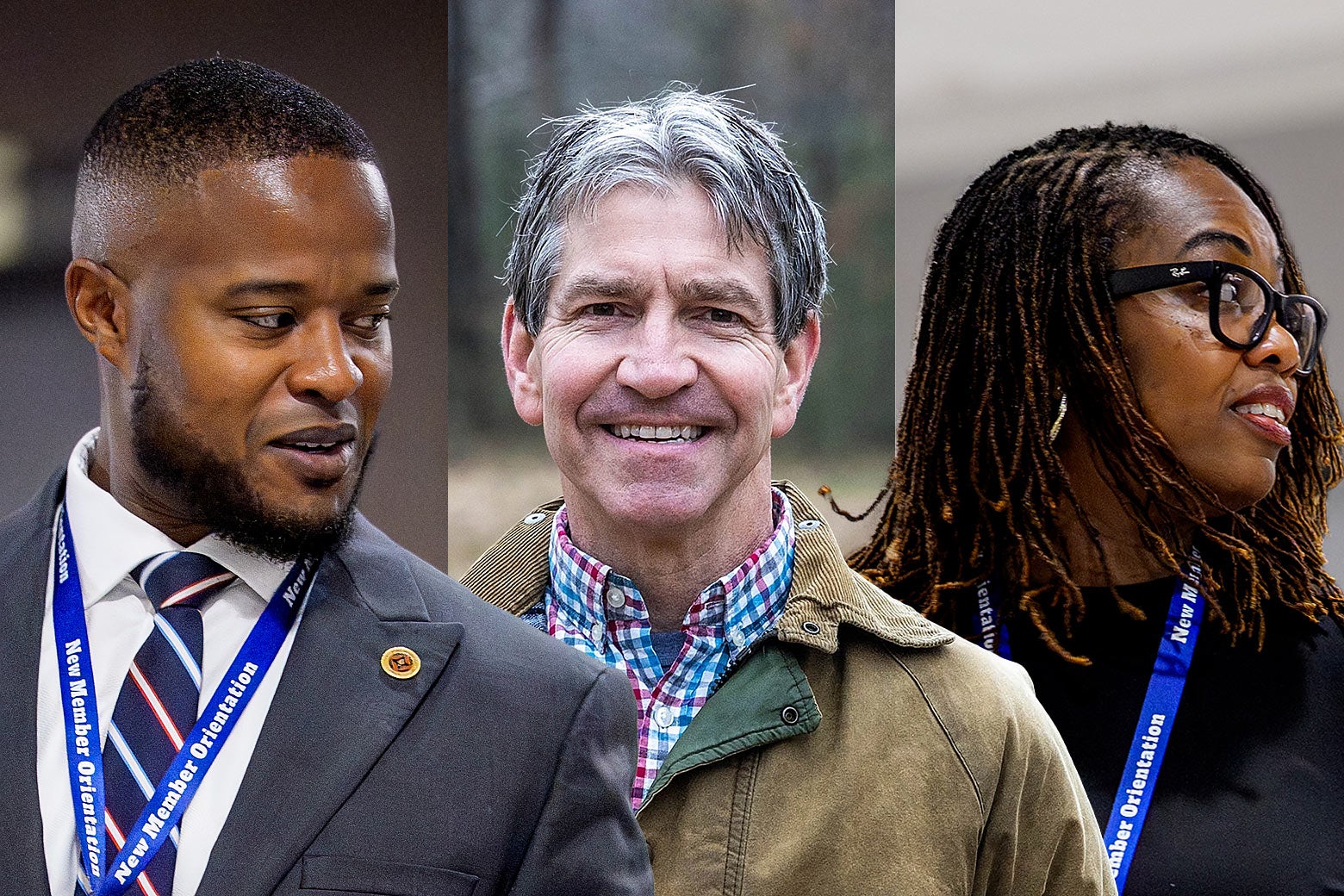
Politics Don’t Call It an Upset Very few people expected these candidates to win. Then, election night happened. By Enter your email to receive alerts for this author. Sign in or create an account to better manage your email preferences. Unsubscribe from email alerts Are you sure you want to unsubscribe from email alerts for Molly Olmstead? Nov 13, 20265:50 AM Photo illustration by Slate. Photos by Andrew Harnik/Getty Images and Paul Barringer for Congress. Sign up for the Slatest to get the most insightful analysis, criticism, and advice out there, delivered to your inbox daily. Coming out of Democrats’ wild success in the midterms, there were the winners who had fought heated battles in the glare of the national spotlight. And then there were those who had just barely registered on the national radar. When Slate wrote of Texas’ 23rd district, for example, we wrote of the boorishness of the Republican nominee and barely mentioned the Democrat, Katy Padilla Stout, given that the district had voted for President Donald Trump by a 15-point margin in 2024. Padilla Stout won by 8 points. Many of these long-shot candidates weren’t blessed by the resources of the national party until late in the game, if at all. They were left to launch quixotic bids in districts thought to be immovable, and in districts that in some cases had been redrawn to give Republicans easy victories. And against all odds, some of these candidates succeeded. In the days since the election, the rest of the country has scrambled to learn who these newcomers are and how they managed to flip their seats. Others chuckled at the thought that some everyday people in red states launching symbolic challenges with no actual expectation of winning would suddenly find themselves part of Congress. But if you talk to the candidates, you’ll find something striking: confidence, and a decent amount of disdain for the doubters. Paul Barringer, formerly a healthcare lawyer in D.C. who unseated a Trump-backed incumbent in North Carolina’s gerrymandered 13th District, ran after moving back to rural North Carolina to care for his ailing mother. He had been a Republican, but he was galled by what he saw as the corruption and chaos and excesses of the Trump administration. We reached him Friday, as he was still trying to catch up on all his messages from election night. (“You ever had 600 text messages come into your phone?” he said. “How ’bout that boss that was really terrible to you, and told you you’d never amount to anything because you were too nice, reaching out to you?”) He knew he could win, he said. When pressed, he doubled down, insistent that he had always been confident. “Yeah, I mean, I felt that,” he said. “Maybe I was deluded.” Most people in his position would probably not have felt so confident. Trump won Barringer’s district by 17 points in 2024. Its awkward borders twist to avoid the urban populations of Raleigh and instead pull in rural Southerners. But Barringer insists he had heard enough firsthand from voters to convince him that they were ready for a change. “Maybe my odds at the beginning were, I had to flip a coin and have it come up heads three times in a row,” he conceded. But the polling a year in, in the spring, suggested there was an opening. “I had heard so many people saying they were angry,” he said. He had hammered the issues of cost of living, healthcare, and corruption while on the campaign trail. The Cook Political Report moved his race from “solid” to “likely” Republican in mid-October. Similarly, Cyril Jefferson says he never really doubted he could do it. Jefferson ran in North Carolina’s 6th District, a bit farther west. Like Barringer, Jefferson ran against a Trump-endorsed Republican, but his odds were even longer. In 2024, the Republican, Addison McDowell, beat his Democratic opponent by 38 points. “Cyril has a better chance of winning the lottery than convincing the 6th District to vote for a woke, far-left politician,” McDowell said in response to Jefferson announcing his campaign. The Cook Political Report had, until the end, labeled it “solidly Republican.” And yet Jefferson beat McDowell in what the Washington Post called a “stunning upset.” Jefferson is the mayor of High Point, the ninth most populous city in North Carolina, so he felt he knew his district well. He said he thought polls from 2025 showed weakness. But more than that, he felt McDowell wasn’t suited for a real challenge. “Anytime you get comfortable and you take it for granted, you get caught sleeping, you get caught with your pants down, things like Tuesday night happen,” he said. “So I had a lot of confidence that that was going to be a major factor, that we were just going to outwork them, and we were going to outmaneuver and out-strategize.” He did acknowledge that the national mood helped. “Yes, there were national political headwinds, we know that,” he said. But there was also, he said, faith. It was a faith in his own tenacity, but also a religious faith. LaKesha Womack, who flipped North Carolina’s 14th District, has an inspirational personal story that lent credibility to her talking positions on affordability and healthcare. She had, six years back, been what she described as “housing insecure,” living out of a hotel. She has Type 1 diabetes and had a medical emergency that caused her son to end up in foster care. This low period, “seeing how the system works for people who find themselves hitting rock bottom, not because they’re lazy, not because they don’t want to work, but because life just happens,” arguably strengthened her position as a candidate. But Womack is more guarded in her language than someone like Barringer, and she has reason to be cautious: She has recently been charged with a felony over a rental car that she allegedly failed to return during that period. She said she cannot comment on the case for legal reasons, but suggested it was a politically motivated charge. “Just hypothetically, if someone stole a car six years ago, I feel pretty certain that the police are not going to wait six years to come after that person,” she said. “So, as hurtful as it was, it was a little encouraging. And that’s what I just told my supporters. I was like, ‘Hey, I know it’s hard, but it just means that we’re winning.’ ” She did come to see it as a sign of her campaign’s legitimacy, she said. And as she explained her victory, it wasn’t about any special alchemy. She had just known what number of votes she needed to hit, and focused on reaching out to enough people to hit that vote number—and not on the more intangible politics of positioning herself against her opponent. Jefferson spoke of faith, Womack spoke of numbers, but both appeared to feel equally certain they could pull it off. There are, of course, many candidates who work to the point of exhaustion every year who still come up short. There are candidates who understand the numbers, but still fail. But running a campaign is an incredibly taxing job, so it is understandable that these three North Carolina candidates wanted to ensure they and their team, and not the national political environment, got the credit. The day Slate spoke with Womack, she said she planned to finish the day with 35 media interviews. Jefferson mentioned having had just a few hours of sleep over several days. Still, if the claim that those of unwavering confidence could win through their own hard work and talent are true, such seemingly deluded self-assurance may have been the key to their success. That may be exactly what these kinds of races require: absurd self-conviction, in the face of long odds. These candidates now face their next challenge. And while they mostly want to talk to reporters about how they’ll make good on their campaign promises, they’re also thinking about their strange transition from being political unknowns to members of Congress. They’re setting up offices, going through résumés, figuring out housing in Washington. Barringer mentioned that he turned to the internet to find out if he can bring his dogs, Billy and Penny, to the Capitol. (“I read on ChatGPT that you can’t take them on the House floor, but otherwise you can have them in the office building,” he said.) These Democrats now have a kind of odd celebrity. Barringer said both Seth Meyers and Chris Hayes (he said he wasn’t previously familiar with the latter) had mentioned him as someone they’d never heard of. “I mean, the subtext with those stories is like, ‘Where do these people come from?’ ” Barringer said. “ ‘It’s sort of random that they’re in Congress.’ But, I mean, I feel very confident saying that most everyone who actually made it through worked their tail off. “So, the notion that people have shown up and that just—It may be that the national media, or authorities, weren’t expecting them. But I feel pretty confident that the people who got in felt like they had a chance to win. Because that’s what kept them motivated down the stretch.” He laughed at the idea of being described as “random.” “I happen to live inside this body,” he said. “All the randos that kind of made it through, they did not feel like they were as random as the national press feels they were.” Democrats Elections North Carolina 2026 Midterms
This Is What It Takes to Win a Can’t-Win Race
Full Article
Original Source
Read the full article at Slate →KhanList aggregates and links to publicly available news content. We do not host full articles from third-party sources. Always verify important information with original sources.