
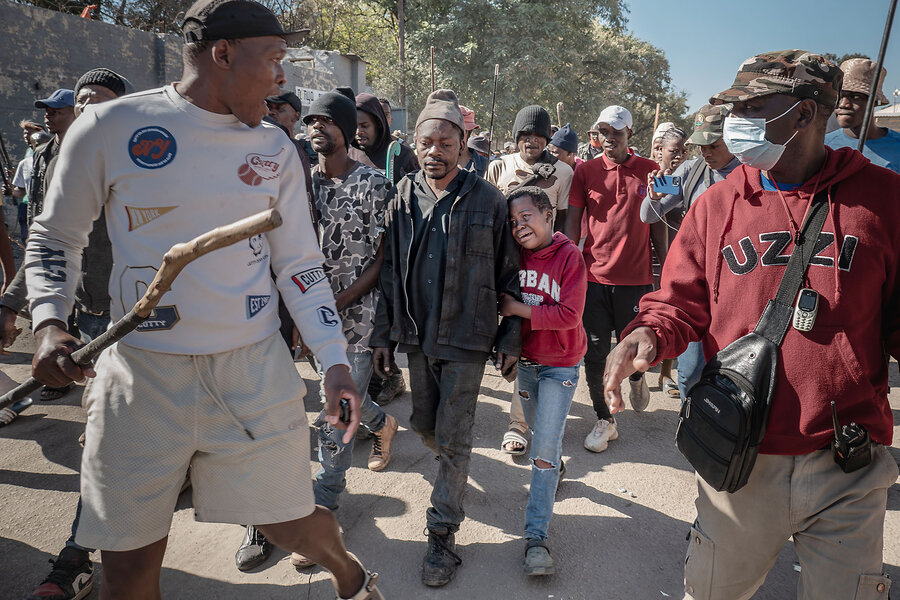
The men came wielding sticks, leather whips, cricket bats, and hammers. One carried a rusted saw. Some covered their faces with balaclavas and draped themselves in South African flags.They rushed through the streets and narrow alleyways of Alexandra township, banging on metal gates and chanting: “Go away, foreigners!” In one apartment building, at the end of a dark corridor, they kicked in a door, revealing two wide-eyed children on the other side.Yvonne Selale stood outside, watching as the protesters ushered the little girls out into the street. “They’ve been given a lot of time to leave. Why are they still here?” she asked as the men carried out belongings and dumped them on the sidewalk: cupboards, mattresses, teddy bears, and framed school pictures. Why We Wrote This As the world marks the 75th anniversary of the U.N. Refugee Convention on July 28, South Africa is grappling painfully with familiar questions about migration and belonging. The girls’ family came to Johannesburg from Zimbabwe more than a decade ago. The children had grown up in the neighborhood.But to Ms. Selale and her fellow protesters, the family was emblematic of what they believe is a migration crisis in South Africa. Without credible evidence, these activists pin many of the country’s problems – from unemployment to overstretched public services and crime – on immigrants. They say a lack of government action has pushed them to act as vigilantes.“This is our land, our country,” Ms. Selale explains. Yvonne Selale has helped organize several demonstrations targeting undocumented immigrants in South Africa. She lives with her mother and two daughters in the Alexandra township near Johannesburg. Pushed on social media and by political groups, that kind of rhetoric is fueling a wave of anti-immigration marches and attacks throughout South Africa. Since May, at least four migrants have been killed, and more than 160,000 have left the country, according to figures from several governments that coordinated repatriations.But the frustrations driving the demonstrations have been much longer coming.Anger and hopelessnessMs. Selale’s own anger toward foreigners churned slowly.She came of age in the early 1990s, during South Africa’s turbulent transition from apartheid to democracy.“We were raised to believe that when Nelson Mandela becomes president, we will be free,” recalls Ms. Selale, now in her mid-40s.The reality proved more complicated. Today, the country’s unemployment rate tops 30%; some estimates put it closer to half. South Africa consistently ranks as one of the world’s most unequal countries, with a per capita murder rate eight times that of the United States and 30 times that of France and Australia.Alexandra, where Ms. Selale lives, provides a vivid snapshot of that reality. Residents are crammed into dilapidated apartment blocks and shacks erected on sidewalks and rooftops. Rubbish bags pile up on corners, and raw sewage runs through the potholed streets. “We live in fear every day,” says Ms. Selale. Meanwhile, less than three miles away is Sandton, a gleaming financial district of spotless streets and sleek glass skyscrapers often dubbed “Africa’s richest square mile.”“Poverty will make you do wrong things,” explains Ms. Selale, sitting on a couch in her mother’s cramped house. She moved back home two years ago after losing her job as a community health worker.This two-bedroom house isn’t where either of them wants to be living. Mother and daughter have long pinned their hopes on receiving a free house from the government, a key promise of Mr. Mandela’s party, the African National Congress, in the years after apartheid ended. A woman from Zimbabwe searches through her belongings, which had been thrown into the street by anti-immigrant vigilantes in the Alexandra township near Johannesburg, July 18, 2026. Three decades in, however, the women’s applications are still trapped in a provincial backlog of more than 1 million hopefuls. Moving into her mother’s modest house with her two children has strained the family dynamic to a breaking point.“I know the feeling of living somewhere you are not welcome,” Ms. Selale says, her eyes welling up.She desperately wants to move out, but grueling job searches have led nowhere. Employers prefer younger applicants, or, she claims, foreigners, whose precarious status means they are often pushed into working longer hours for lower wages.“Since I’m no longer working, I grew angry. I’ve become a different person,” Ms. Selale says. “I just want a small place where I can put up my own shack.”In late 2024, Ms. Selale came across the Last Gado Civic Movement, a community group that carried out raids on buildings housing undocumented foreign nationals.“They said they were removing foreigners, and I could get one of the houses,” she recalls. “So, I joined.”Whereas many of South Africa’s problems – corruption, a stagnant economy, and the general state of the country – felt “beyond repair,” Ms. Selale saw expelling undocumented immigrants as something still within her grasp.Official statistics estimate around 2.4 million foreign nationals live in South Africa, making up just less than 4% of the population, on par with the global average. Anti-immigrant vigilantes evict a Zimbabwean family from their home in Alexandra township, July 18, 2026. The family had lived in the neighborhood for 13 years and their two children were born there. But activists here often speak of a country “invaded” by migrants. Echoing rhetoric used by far-right movements worldwide, they claim many immigrants are criminals, responsible for social ills ranging from drug dealing to rape. Police data, however, tells a different story: Only about 3% of people arrested over the past five years were foreign nationals, and nearly 1 in 5 of those arrests were for immigration violations.Earlier this year, calls for undocumented migrants to leave the country began growing louder, amplified by a movement called March and March. The group set a June 30 deadline for them to go. As the date approached, Ms. Selale joined a committee in Alexandra organizing its own marches.“Also human”When The Christian Science Monitor first met her on July 9, Ms. Selale was walking on the sidelines of a march, one of just a few women among several hundred men carrying sticks.“The plan is to go to shops and ask the landlords to chase the Somalians out before we touch them,” she explained.She insisted the march would be peaceful. Instead, it quickly descended into lawlessness – as did during at least two subsequent marches.Protesters looted foreign-owned stalls and raided homes and apartment buildings, smashing windows and kicking in doors.“We’re here to kill, no more talking! We’re doing mob justice,” yelled a protester, wielding a whip and wearing a black balaclava over his face.“The police won’t do anything. We are the ones running this country,” boasted another. Anti-immigrant vigilantes evict a Zimbabwean family from their home in Alexandra township, Johannesburg, July 18, 2026. The vigilantes’ targets were ostensibly undocumented foreigners, but they rarely waited around for proof before dragging people out of their homes. One bewildered South African man said protesters had burst into his home and stolen the lunch from his plate.Vigilante violence against migrants “tends to resurface a few months before elections,” says Jurol Loemba, a migrant rights activist from the Republic of the Congo who has lived in South Africa since 2001. This phenomenon has been well documented during previous waves of violence. And with local government elections approaching in November, Mr. Loemba says some politicians and their supporters are trying to take South Africans’ legitimate anger over corruption and poor service delivery and “redirect [it] toward innocent people.”In Alexandra, as the protests touted as peaceful systematically turned rowdy, Ms. Selale felt frustrated.“We want them removed and gone, but why do we steal their belongings?” she asked. “I don’t like [it] when people are mistreated. They’re foreigners, but they’re also human.”When the two Zimbabwean girls were pushed out of their home, Ms. Selale appeared deflated. It was July 18, Mr. Mandela’s date of birth, which South Africans traditionally mark by doing community service. On her way home, Ms. Selale railed against the former president’s Pan-Africanism, which she saw as a “betrayal” of South Africans.“He messed up. Every house must have rules,” she said.Still, she was beginning to feel remorse.“I’ve realized I don’t like what I’m doing. The picture of those children is still on my mind,” she said a few days later, sitting in her mother’s living room. “I know the pain of poverty. I just wanted to help people.”But she wasn’t sure she would stop joining the protests.After all, she still needed a house.
‘This is our land’: Why one woman fights to expel South Africa’s migrants
Full Article
Original Source
Read the full article at Csmonitor →KhanList aggregates and links to publicly available news content. We do not host full articles from third-party sources. Always verify important information with original sources.