
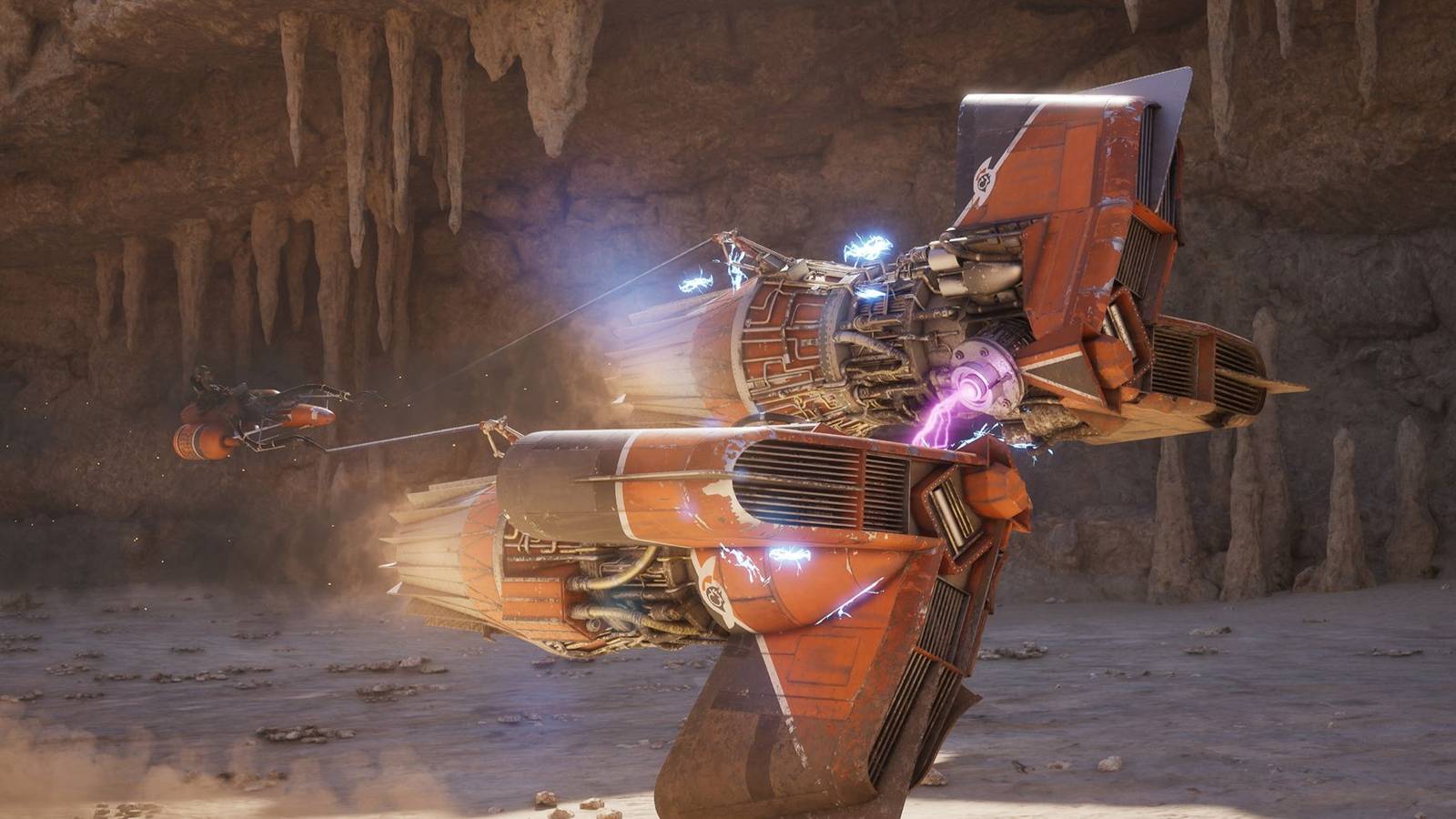
Published Oct 2, 2026, 8:00 AM EDT Hannah covers horror, sci-fi, and games at Collider, where she writes news and features, reviews new releases, and interviews the people who make them. She’s helping build out Collider’s gaming coverage, with Pokémon as one of her specialties. If she isn’t writing about a monster, she’s probably watching one on a tape from her VHS collection. I used to have a racing simulator in my living room, but put me in Mario Kart and I become everybody’s problem. I’ve played and enjoyed the F1 and Gran Turismo games, even if that style of racing isn’t really where my heart is. The racing games I get most excited about are the ones that let things get a little ridiculous. Give me speed, great handling, and a spectacular disaster when things go wrong, and I’m happy. That made Star Wars: Galactic Racer an appealing prospect before I picked up the controller. I loved the Star Wars podracing arcade game, and the chance to race on Tatooine again came with some pretty high expectations. For other players, those memories might belong to Star Wars Episode I: Racer, the 1999 home game. Mine belong to the separate Sega title, Star Wars: Racer Arcade, which followed in 2000. Either way, there’s a lot of affection for this particular corner of Star Wars gaming. Playing on PS5, I wanted Galactic Racer to give me some of that arcade excitement back. What I got was smoother racing, modern graphics, and an experience that exceeded the memories I brought with me. The speed feels amazing, the handling is excellent, and even crashing managed to make me laugh. I went in hoping for a worthy return to Star Wars racing and came away with my favorite racing game ever. ‘Star Wars: Galactic Racer’ Gives Its Racing Some Dangerous Stakes Image via Secret Mode Developed by Fuse Games, Galactic Racer takes place after the Empire’s fall, when an underground racing circuit called the Galactic League offers its competitors a chance at glory. You play as Shade, a pilot drawn into a rivalry with reigning champion Kestar Bool. Darius Pax, the League’s founder, needs help keeping control of the competition. It’s a setup that places the action in a part of the galaxy where ambition, money, and dangerous machinery have plenty of room to collide. The campaign builds that competition around a series of runs. Players choose branching routes through events, collecting rewards and modifying their vehicles along the way. Races sit alongside elimination events, field tests, and mystery encounters, with different challenges offering different rewards. Winning matters, but so do the decisions that determine what you’re bringing into the next event. There are consequences for getting things wrong. Crashing too many times or failing to meet certain placement requirements costs League Entry Tokens, and losing them all ends the run. Some progression carries over, including resources that can unlock vehicles and improve their base stats. The structure gives the campaign more to consider than a sequence of races where the only question is whether you finished first. Vehicle builds add another layer through upgrades, passive parts, and active abilities. Racer Styles also change the traits and abilities available to you, while backer contracts offer additional objectives during races. There’s plenty surrounding the action for players who want to think about their next advantage. For me, though, the biggest selling point remains what happens once the race starts. The Handling Is What Makes ‘Galactic Racer’ So Much Fun Image via Secret Mode The racing feels fantastic. Speed, steering, and drifting work together beautifully, making the act of controlling a vehicle as enjoyable as watching it tear through a track. A recognizable planet can get me excited to start a race, but it can’t compensate for controls I don’t enjoy, and Galactic Racer earns my enthusiasm where it matters most. Its vehicle lineup also extends beyond podracers, which was a nice challenge to figure out what matches my racing style best. Landspeeders can drift through corners, speeder bikes convert braking energy into a Kinetic Burst, and skim speeders use a Knife Edge maneuver to navigate tighter spaces. Podracers compete separately from those other vehicles, as they're an entirely separate beast. That distinction is worth making for anyone coming in expecting the whole game to be a new version of Episode I: Racer. Drifting was a particular pleasure for me. The landspeeder handling is smooth and satisfying, and it contributes enormously to how much I enjoyed racing. I want the controls to make me excited about what I can do next. Here, steering and drifting were part of the fun, with the speed making them even more exhilarating. The boost systems put danger directly into that pursuit of speed. Afterburner offers a familiar rechargeable boost, while the Ramjet becomes available once a speeder reaches its operating speed. Keep pushing it, and you risk overheating, with an explosion waiting if you take things too far. Trust me: you will take things too far, and you will cause an explosion. I know I did on more than one occasion just out of the sheer excitement of experiencing Star Wars racing again. Environmental conditions can also affect that calculation, giving the planets a role beyond providing scenery. That machinery belongs in a universe where racing has always looked like a questionable decision made at tremendous speed, and Galactic Racer understands the appeal of participating in it. The modern visuals make the action look great, but the handling is the improvement I appreciated most when thinking back to the arcade game. I loved that older experience, and this one feels better. Tatooine Is a Highlight, and Even the Crashes Deserve Some Love Image via Secret Mode Obviously, the Boonta Eve classic was a highlight for me. There was no chance I was going to approach it without a considerable amount of excitement, and, thankfully, it lived up to that anticipation. Getting to race there with these visuals and this level of smoothness was exactly what I wanted from a return to podracing. The game’s locations also include Jakku, Ando Prime, and Crait (which is without a doubt the most visually striking backdrop to race in), alongside worlds such as Lantaana and Sentinel One. Between races, planetary paddocks provide places to meet characters, buy parts, and work on vehicles, which is a good world building bonus as that broader setting gives Galactic Racer room to establish its racing world. Tatooine is the personal favorite I brought into this review, and I'm willing to admit that's for nostalgic reasons, but the game has more on its itinerary than revisiting that one familiar destination. The crashes, meanwhile, were much funnier than I anticipated, and I had some high hopes here because the folly in The Phantom Menace's crashes has continually ensured its place among my favorite Star Wars scenes. Both the mechanics and the crash scenes added some welcome absurdity to the experience. I’m hardly going to recommend crashing as a winning strategy, but I appreciated getting a laugh out of things going wrong. Those moments helped the whole game feel so distinctly Star Wars, and I'll be the first to admit that a crash is the most likely outcome of me taking the wheel of a pod racer. Ultimately, Star Wars: Galactic Racer delivers the kind of racing I enjoy most. With superb handling and spectacular crashes, Galactic Racer captures the thrill of arcade racing at its best. The Boonta Eve classic gave me the nostalgic thrill I wanted, while the overall racing gave me a reason to love this game beyond that connection. My arcade memories are still special, but Galactic Racer is the one I’d choose to play now. Score: 9.5/10 Star Wars: Galactic Racer launches October 6 on PlayStation 5, Xbox Series X|S, and PC. Reviewed on PS5.
This Is Officially the Most Addictive Star Wars Game in Years and It's Not Even Close | Review
Full Article
Original Source
Read the full article at Collider →KhanList aggregates and links to publicly available news content. We do not host full articles from third-party sources. Always verify important information with original sources.