
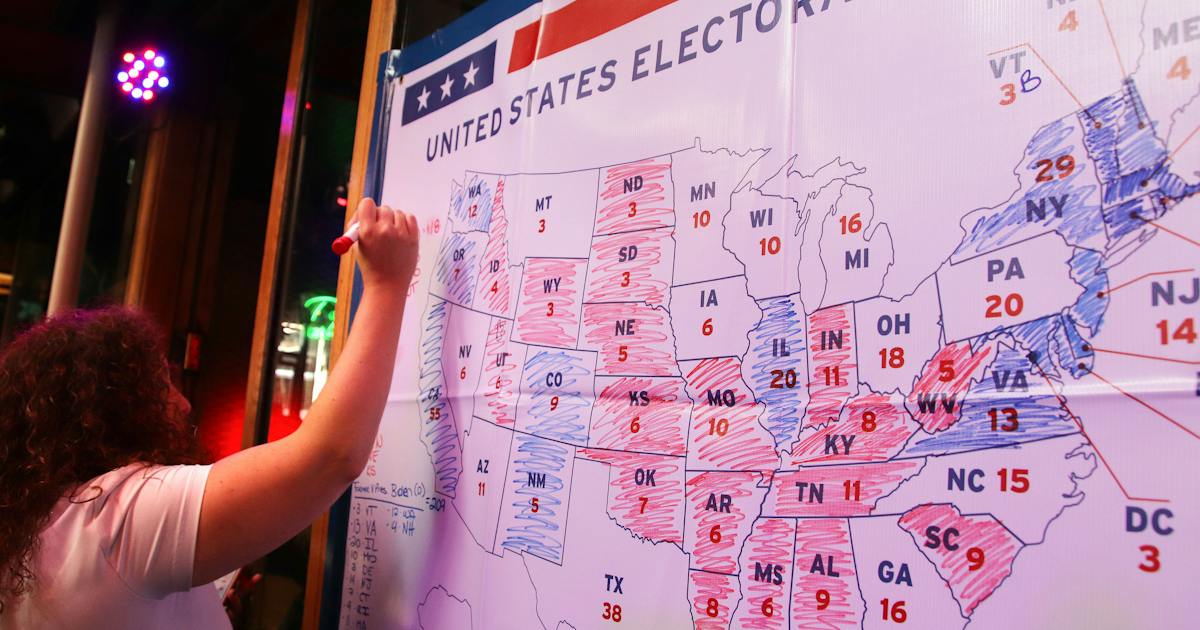
The 2026 midterm elections saw Democrats win popular majorities in states long written off as irredeemably red and dark purple. But blue state Democrat legislators could sink this chance to regain lost constituencies and reset the national political map, by enacting a misguided work-around to supplant the state-by-state structure undergirding the Electoral College. If they are not careful, they could turn a blue wave into a dead-end quagmire. The proposed scheme is an interstate agreement, technically known as a “compact”—the National Popular Vote Interstate Compact, or NPVIC—that its architects claim could “bypass” the constitutionally prescribed Electoral College without taking on the futile odyssey of attempting to amend the Constitution. After the dust had settled on Election Day, Democrats had taken control of state legislatures and governorships in Pennsylvania, Michigan, Arizona, Wisconsin, and Nevada. None of these states had previously agreed to the compact. But if all five agree to join, the total number of electoral votes apportioned based on the national popular vote jumps to 283—enough to end the Electoral College tradition.Since Republican George W. Bush entered the White House in 2000 with a razor-thin majority of electoral votes (271 of the requisite 270), while his opponent, Democrat Al Gore, won the popular vote by a comparably slim margin of 0.52 percent of the more than 101 million votes cast, Democrats and liberals have demonized the Electoral College, characterizing it as uniquely biased against them and inimical to democratic (small-d) governance. But, as I detailed after Donald Trump narrowly won the 2024 election, this perception is simply dead wrong. The Constitution in no way mandates the state-by-state winner-take-all system that liberals have decried. Rather, the Framers’ terms dictate merely that each state must be allocated electors matching the number of its respective Senate and House seats. But its provisions give each state discretion to decide how to select their electors (consistent with other constitutional provisions, such as the Bill of Rights, Reconstruction, Progressive-era, and kindred twentieth-century amendments). Hence, near-national winner-take-all exists because individual states voluntarily adopted it, having determined that approach boosts their clout with the federal government. By 1836, all but one state had chosen winner-take-all. By 1880, all states did so. Currently, all 50 states except two, Maine and Nebraska, plus the District of Columbia, embrace it. Further, over the nation’s history, any partisan tilt of the system, to the extent that it has measurably existed, has often shifted, due to demographic, economic, policy, and technological changes—as Democratic strategists expect it will shift their way in 2028. The concept of an interstate compact to substitute a national majority popular vote approach originated early in the present century, when Democrats’ path to the White House seemed more daunting than it appears today—though even then, events intervened and Democrats won the presidency in the next two cycles and three of the next five. The idea had distinguished parentage; in particular, a 2007 paper by the Yale Law constitutional savant Akhil Amar.A cadre of enthusiasts took up the idea for such a constitutional work-around, and formed a 501(c)(4) nonprofit organization, National Popular Vote, to draft the NPVIC and promote it in state capitals. In essence, the terms of the measure bind a state to cast all its electoral votes for the presidential candidate who wins a majority of popular votes nationwide, regardless of who wins a majority of that state’s voters. As of November 2026, 18 states and Washington, D.C., had adopted legislation to join the NPVIC. Together, they represent 222 Electoral College votes—82 percent of the 270 votes needed for the agreement to go into effect. After November 3, liberals trumpeted that, as Mother Jones headlined, “America Finally Has the Votes to End the Electoral College.” Deploying their newfound power to push the NPVIC across that finish line would constitute a historic, catastrophic mistake, contravening the transformational lessons liberal leaders should have learned (and voters conservative as well as liberal did learn) from the traumatic Trump decade. Significantly, Akhil Amar, whose 2007 paper and drafting expertise provided critical impetus for the compact, has over the intervening years developed reservations about his idea. On November 8, he shared with an MS NOW interviewer what amounted to a repudiation of the NPVIC and the specific provisions of the one now on the cusp of taking effect. To date, that interview has received scant coverage.Amar’s turnabout acknowledges the lessons that other liberal leaders have missed. The first lesson, of course, the 180-degree shift of the 2026 election itself. In my 2024 critique, I contended that liberals were scapegoating the “Electoral College,” to sidestep their surest and most efficient route to rebalance power over presidential selection. That route was to play the politics right by tailoring candidates and appeals to the flyover states and constituencies that their coastal elites’ inbred parochialism had driven away. Lo and behold, this time around they did just that.Granted, Democrats’ huge victory could be a one-off aberration. Its trigger was Republicans’ obeisance to an unhinged leader indifferent to popular needs and aspirations. That said, postmortem analyses reveal changes that with responsive politicking can make the electoral map competitive, or even tilt blue. For starters, look at Texas. A November 16 Wall Street Journal account revealed potentially durable reasons why:Every Texas county swung to the left, some by more than 70 points. Latino voters, who had moved to the right in recent cycles, swung 37 points leftward. White voters with a college degree swung 15 points in that direction; those without a degree moved 13 points; young voters, 54 points; seniors, 12 points; and small towns and rural areas, 22 points.Hispanics alone comprise 32 percent of Texas’s eligible voters (and 40 percent of all Texas residents). Their shift was prompted not only by inflation, like all voters, but by anger at Republican-supported ICE brutality toward their community, as well as other grievances common to working- and middle-class voters across the board. Texas has 40 electoral votes, second only to California. Surely, Democratic political leaders can find ways to deepen traction with Hispanics and constituencies that flipped in 2026, sufficient to make Texas’s 40 electoral votes at least competitive, if not tilting blue. Democrats would thence start off presidential campaigns with three of the top four states (California, Texas, and New York), totaling 113 votes in their column, plus scores more from other purple and blue states.The Texas turnaround is part of a broader prospect. On Sunday, November 15, Mississippi Senator-elect Scott Colom told Meet the Press interviewers that Democrats “need to put senators like myself in position where we can deliver for the rural South, where we can be leaders in ways that show the voters in [all of] rural America that we care about them, that we want them to be successful.” (Emphasis mine.)Further in that vein, as Harold Meyerson detailed in the November 13 American Prospect, “There are deeper reasons why Texas, Georgia, and North Carolina have become politically purple.… All three states are increasingly dominated by metropolitan areas, populated by racially diverse professionals, racially diverse service-sector workers, young newcomers from neighboring states and distant lands.” Understanding these “tectonic shifts,” Meyerson notes, can enable Democrats to “create what might become a new political majority.” A still broader perspective is warranted. The 2026 blue wave marked a historic triumph for the Civil Rights Movements of the 1960s, ’70s, and ’80s. Red and dark purple jurisdictions flipped not despite Black, brown, and female priorities but because of these formerly embattled minorities’ mobilization—and broadly shared commonsense, center-left concerns, including by white male cohorts. The second lesson from the Trump-driven turmoil is this: The Framers were correct to delineate not only a federal chief executive powerful enough to lead and defend a far-flung nation but also intricate institutional checks and balances to constrain a demagogic wannabe dictator abusing those vast powers to shred constitutional democracy and the rule of law. In particular, we have seen the indispensable role of federalism—devolution of substantial legal authority and political autonomy to states. Under Trump, a large portion of the pushback successes by liberals and others—against, for example, abusive immigration enforcement, domestic military repression, and federally manipulated elections—have relied on constitutionally prescribed state authority. Junking the Constitution’s state-grounded framework for selecting presidents—which grants the president zero basis for meddling and Congress merely a limited oversight and backup role—would upend those foundational safeguards. Those two lessons augur against replacing the Electoral College with a national popular vote model by any procedure, including a constitutional amendment. But those drawbacks would be exponentially magnified, and others added, by the legally vulnerable NPVIC proposal now before state legislatures. The NPVIC has advanced rapidly for three reasons. First, stealth—unintentional but de facto: The national media has had little to say about the compact, which has kept the electorate in the dark about the general idea and its disruptive consequences. Second, the stated goals of the compact—national majority rule; one-person, one vote; equal weight for each American’s vote—resonate as unobjectionable and as American as apple pie. That perception, plus the delusion of liberals that the current system structurally disadvantages them, has led politicians to sign on with little thought and no attention to details or the lack thereof, or the real-world fallout. Those textual and practical infirmities led Akhil Amar to pump the brakes on enacting the compact during a postelection interview with MS NOW’s Jacob Soboroff. Amar explained that while he is “one of the co-inventors” of the NPVIC, he wasn’t “sure that it’s actually in its current incarnation a great idea.” Amar framed his concerns as tentative. In his view, the states should not rush to embrace the compact. Instead, he recommended “going slow” and having a “national conversation” about the issue. However, his criticisms—which echo points spelled out by other critics—undermine the whole idea of replacing the Electoral College’s state-by-state regime with a national popular vote system. Amar pointed out that, if the goal is “one person, one vote,” that cannot be achieved “without a lot of central oversight because different states let people vote in different ways.” As legal scholar David Beier has detailed: “In [three jurisdictions] people with felony convictions never lose the right to vote. Twenty-three [restore it for former prisoners] when people leave prison.” Fifteen do so [only after] parole and probation. Ten disenfranchise prisoners permanently or erect additional hurdles. Beier adds, “Some states let 17-year-olds vote in primaries if they will be 18 by the general election; others do not.”All states but one (Mississippi) prescribe procedures for recounts, but their terms vary widely. The NPVIC, however, prescribes no provision for postelection dispute resolution. States could let 17- or 16-year-olds vote, or otherwise configure their rules for partisan, or discriminatory, reasons. But under the NPVIC all states would be compelled to accept other states’ certification of their results, with no way of challenging them. The 2000 Florida postelection brouhaha was a walk in the park compared to what such disputes would look like in the NPVIC’s national popular vote system.The big problem here is that spelling out uniform rules essential for any national election scheme would require a federal statute, flatly barred by the Constitution. For that reason, it would not be possible without a forbiddingly complex statute and/or amendment.But there’s a more fundamental issue in play. After what the nation has gone through in the past decade, who would want a presidential election system managed by the president? As Amar asked rhetorically, would we want federal monitors picked by this or any president at every polling place purporting to enforce federal election rules? That is, of course, exactly what Trump fought to impose and, thankfully, what the federal courts, including the Supreme Court, have blocked him from doing—on constitutional grounds.All of these defects puncture the illusion that adopting the NPVIC will immediately enshrine a one-person, one-vote election system. On the contrary, the instant that NPVIC takes effect, multiple well-prepared lawsuits will hit the courts. Such litigation could drag on for months or years, unless it is somehow terminated by the Supreme Court. As suggested by the above-noted particularly glaring glitches, the overwhelming likelihood is that the court will strike it down, quite likely with more than the six conservative justices’ votes. Numerous plausible constitutional objections have been proffered by a spectrum of experts. The simplest, most likely overruling ground will be the Constitution’s curt specification “that No state shall, without the consent of Congress, enter into any agreement or compact with any other state.” Securing such assent to any radically transformative presidential election scheme, certainly the one currently in play, would be a daunting process, provision for which the crafters of NPVIC conspicuously left out. There is no realistic chance that the courts, certainly the Supreme Court, will overlook that omission. As I noted in 2024, there is at least one sound, legal, and feasible electoral reform alternative to constitutional amendment or a “bypass” interstate compact bound to fail in court. This approach is expanding the membership of the House of Representatives.Respecting the preference of a majority of individual voters is, for sure, a fundamental goal of the Constitution’s plan for our democratic republic. But ensuring due regard for regional interests is likewise an appropriate, even essential goal. After the 2016 election, Democrats decried the fact that Hillary Clinton won the national popular vote by (approximately) 2.9 million votes. But outside of California, which she won by approximately 4.2 million votes, Clinton trailed Trump’s popular vote by 1.3 million votes. Giving some weight to intercoastal regions is a legitimate instrument for reinforcing all major constituencies’ stake in nationhood. Some weight—but probably not today’s 700 percent difference between the voting power of individual citizens of, say, Wyoming and California.That gross discrepancy is due to the fact that a requirement of two Senate seats for each state is embedded in the constitutional formula for allocating electors among states. But that formula specifies that the “number” of each state’s electors must be “equal to the whole Number of Senators and representatives” of each state. Unlike the upper House, the number of representatives requires only legislation to change.For over a century, since 1910, that number has been fixed at 435, but until 1910 Congress had increased the number of its members 13 times. In 1910, each district had 211,000 constituents. In 2020, the 435 representatives were obliged to meet the needs of 762,000 constituents—a 360 percent increase. That number is projected to grow to 874,000 by 2040.In 2021, the American Academy of Arts and Sciences recommended increasing House membership to 585. Its bipartisan study was led by conservative scholar Yuval Levin and liberal congressional expert Norman Ornstein. Their report notes that House members each represent far more constituents than in other populous democracies and that “the United States is the only Western democracy that does not regularly adjust the size of its lower legislative chamber.”Finally, and most important, America’s state-centric system does in practical fact reliably respect national popular majorities. Critics complain that in the 60 presidential elections since the Constitution took effect in 1789, four times candidates with popular-vote majorities were trumped by electoral vote winners—in 1876, 1888, 2000, and 2016. But even that quite low number is at least twice too high. The 1876 electoral—and popular—votes were infamously overridden by an ersatz presidential commission that arbitrarily “awarded” 22 electoral votes to Republican Rutherford B. Hayes from four states in which the popular vote was disputed (three of them former Confederate states), as a notoriously corrupt bargain for Hayes’s promise to withdraw federal troops from the South, thus ushering in the racist Jim Crow state terror regime. Likewise, the 2000 decision to hand the White House to George W. Bush was not made by the Electoral College electors but by five Republican Supreme Court appointees, who aborted a recount of Florida’s popular votes, by overturning a Florida state Supreme Court order. Bush v. Gore’s unprecedented rejection of state judicial authority was so redolent with raw partisan activism that the Republican justices themselves attempted to deny it any precedential status, calling their “consideration limited to the present circumstances.” In a system for managing any process as complex as picking the leader of a huge continental nation, 58 out of 60—96.7 percent—is as near perfection as anyone could reasonably expect. It provides Americans with presidents selected by a majority of individual votes nationwide, without unleashing those presidents to turn their country into a massive, or at least an irretrievable, banana republic. The backers of the NPVIC are undoubtedly well intentioned; they certainly aspire to firm up the nation’s democratic foundations. But the compact is unconstitutional and unworkable, and the time spent debating its soundness will only serve to undermine the constitutional order, which, despite our recent Trumpian disruption, is too sturdy and reliable to overthrow.
This Is Not the Way to Abolish the Electoral College
Full Article
Original Source
Read the full article at Newrepublic →KhanList aggregates and links to publicly available news content. We do not host full articles from third-party sources. Always verify important information with original sources.