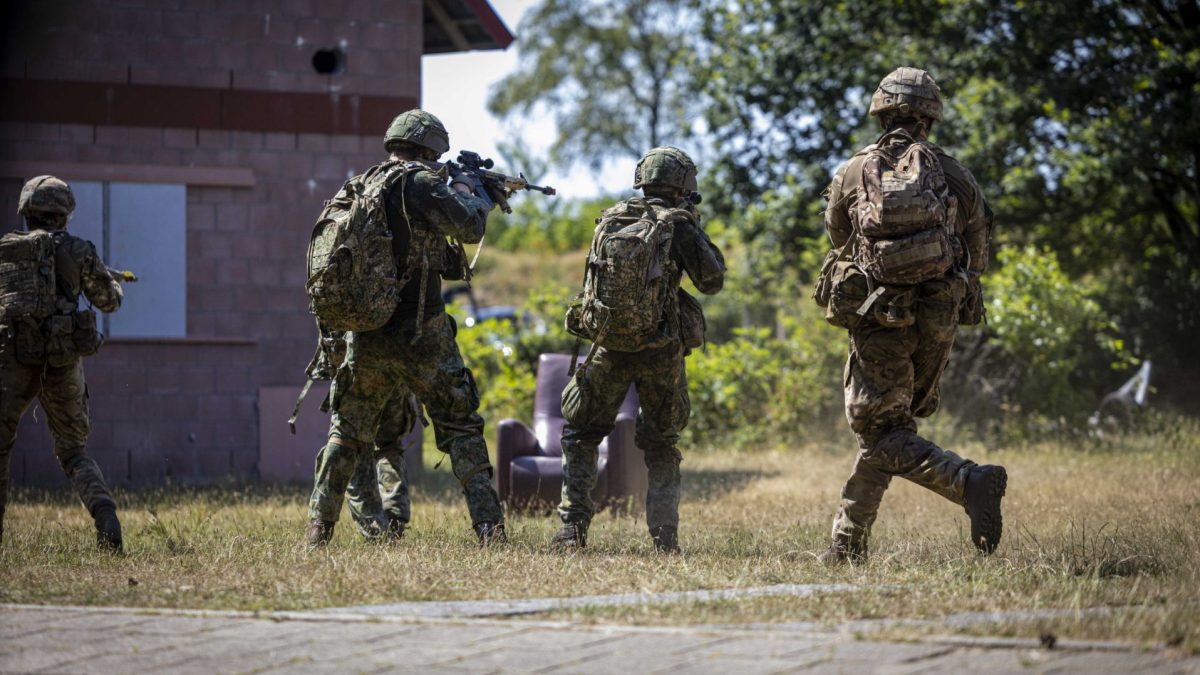
PUTTEN, THE NETHERLANDS – Red smoke rises from an abandoned building outside Amsterdam. “Move, move,” comes a shout from the undergrowth. Five camouflage-clad soldiers rise from a trench and scramble through an open window. Methodically, they move from room to room, unleashing rounds of ammunition to kill off any enemy soldiers inside. The sound of the bullets – a burst of sharp, quick cracks – bounces off the empty walls. This is a simulation, in a village built specifically for soldiers to learn how to fight in urban environments. Today, it is university officer cadets – students who spend afternoons, weekends and holidays training with the British Army – but around the world, this kind of urban warfare is a brutal reality. Shorts Anthony King, chair of War Studies at the University of Warwick, calls urban warfare the “central, maybe even the defining form of warfare in the 21st century”. He says that in the 20th century, armies prepared to fight in the field. “Today, it seems all but inevitable that they will fight in cities.” In Ukraine, frontline villages have become battlefields. Civilian buildings have been converted into bases, while major cities are blitzed with drone and missile strikes. The heavy use of drones, which patrol the skies and hunt out targets, has compounded the need for shelter, making movement in open spaces almost impossible in daylight hours. Meanwhile, the conflict in Gaza, which a UN panel of experts described as a genocide, unfolded in one of the most densely populated areas on Earth. As well as blasting the Gaza Strip with bombs and missiles, Israeli forces have carried out ground operations in residential areas, while Hamas militants have been accused of using civilian buildings such as hospitals as their headquarters. Displaced Palestinians pass buildings destroyed by Israeli attacks in Jabalia, Gaza, in 2025. More than 90 per cent of homes in the Gaza Strip have been damaged in the war (Photo: Omar Al-Qattaa/AFP) Urban war is not new. During the Iraq War, coalition forces fought insurgencies in Sadr City, a densely populated suburb of Baghdad, and were tasked with retaking the city of Fallujah from insurgents in late 2004. The battle to take the Iraqi city of Mosul from terror group Isis in 2016 and 2017 became one of the most “destructive cases of urban combat since the Second World War”, according to Lance Davies, a senior lecturer at the Royal Military Academy Sandhurst, which trains British Army officers. And as Russia’s threat towards Europe grows, the UK is ramping up its own preparations, spending more on defence and updating its training with lessons from the fighting in Ukraine. Nato has warned that Russia could attack a member state within five years. The nature of the alliance, in which an attack on one is viewed as an attack on all, means that an invasion of somewhere like Estonia or Latvia would bring the UK directly into the war. “The warfare that’s going to continue to happen in the future is all going to be in built-up areas,” said Andy, a soldier who did several tours of Afghanistan in the 2000s and is helping to train the younger cadets. “Going back to Afghanistan, the Taliban used to use people’s compounds and use that as a set-up, and then just moved to other people’s houses,” added Andy, who preferred not to give his last name. British commandos withdraw after a sunrise attack on Taliban positions in March 2007 near Kajaki in Helmand, Afghanistan (Photo: John Moore/Getty) “That’s where the law of armed conflict really comes in, because the enemy [approach] was to then take over a compound for a short period of time while the family was still in there,” meaning civilians would be in close proximity to the fighting. Urban warfare is not only about taking residential areas from the enemy, but seizing items useful for intelligence and avoiding traps, Andy told The i Paper. “It’s weapon systems, explosives, any intelligence mapping, if it is used by enemy forces,” he said. Those taking part in the training “gain the understanding of what you’re looking for, where you should be looking, the potential hazards such as booby traps or IEDs or anything like that, and then work out the tactics and techniques from that”. Davies describes urban centres as “messy environments that are densely populated with complicated physical terrain and infrastructure”, adding that it is “the presence of the civilian population that is the biggest factor in urban operations”. Ukrainian soldiers take part in an urban warfare training exercise at an unspecified location in the UK (Photo: Christopher Furlong/Getty) Modern urban warfare training begins with theory in the classroom, before taking troops into empty buildings, and then introducing obstacles such as furniture and enemy combatants. Not everything is entirely realistic; the cadets use rifles, but in real situations would switch to a pistol. The proximity to civilian life can have devastating long-term consequences on communities. Urban fighting often destroys or damages infrastructure necessary to supply vital services such as electricity, water and sanitation, health care, food and education. This can trigger mass displacement, public health crises, waterborne illnesses and starvation. And the effects of urban warfare can last for decades. War zones are frequently littered with unexploded devices including landmines, which can detonate when civilians return home after the conflict is over. School closures can leave children without education for years, while the “brain drain’” caused by people fleeing en masse can hinder economic growth and rebuilding of services and infrastructure. British university officer cadets training alongside their Dutch counterparts this month (Photo: Mark Owens/British Army/MoD) The International Committee of the Red Cross has urged militaries to make the protection of civilians a strategic priority when planning and conducting operations, and to avoid using heavy explosive weapons that are ill-adapted to urban areas. For many of the British cadets taking part in the training earlier this month, it was their first time in a realistic urban conflict environment – which brought home the reality of war for civilians. “It’s been an interesting experience because you’re like, ‘Okay, I’ve got to clear this,’ and then you see a sofa,” said 19-year-old Dylan Cromarty, who is studying international relations at York University and plans to become an officer in the reserves after graduating. “It immerses you completely in it,” he told The i Paper. “You see the after-effects, the cost of war, and it makes me want to go and do the best job possible. You want to take minimal casualties. You want to make sure the civilian population is safe. You get into the mindset.” He added: “I know it’s a mock village, but seeing household furniture, it brings home the reality of war.”
This is how British forces would retake a village captured by Russia
Full Article
Original Source
Read the full article at Inews →KhanList aggregates and links to publicly available news content. We do not host full articles from third-party sources. Always verify important information with original sources.