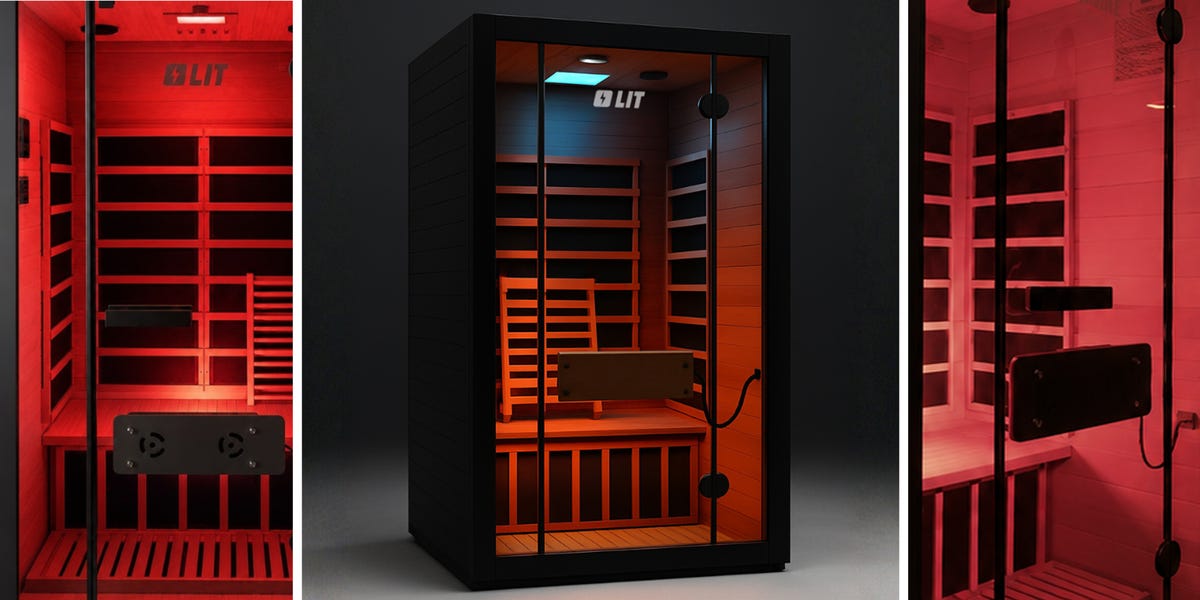
Every product was carefully curated by an Esquire editor. We may earn a commission from these links. Here’s how we test products and why you should trust us.LIT6 min readDoes it feel like, suddenly, everyone is talking about getting a sauna?Let me put some numbers behind that feeling. The worldwide sauna industry has now crossed $1 billion in annual revenue, with the U.S. generating more than $206 million. It’s a small slice of the larger wellness industry ($2.1 trillion stateside) but all signals point toward accelerated growth in the next five years. High-end hotels and gyms are investing in topline products, private equity-backed chains and direct to-consumer lines are rapidly expanding, and celebrities like Glen Powell are touting sweating it out as the new chosen activity for him and his bros.The practice of sweating it out, of course, has existed for millennia. Nearly every culture in the world—past and present—has embraced heat therapy at one point or another: the sweat lodges of Indigenous peoples of North America, Mexican temazcals, Korean hanjeungmaks, Turkish hammams, Japanese onsen, Roman thermae, Estonian savusaunas. For some, it’s ceremonial or religious; for others, it’s a path to physical betterment. The best-known and currently most widespread version of the wellness practice here in the U.S.—the sauna—comes from Finland. (There, a staggering 90 percent of the population uses a sauna once a week, and the city of Helsinki just opened Saunasaari, which translates to “Sauna Island,” to the public.) New makers are clamoring to become the brand to meet this moment for both home and hospitality clients.We are focused on the at-home option. And as we began to research which was best, we were faced with a variety of considerations. In many ways, saunas are very simple in structure: The rooms can be dry or wet, so long as they are hot. But in many more ways, these are very complicated facilities. Price, materials, heating method, energy requirement, and additional capabilities like red light and infrared are all huge sticking points. The Esquire team consensus was that infrared saunas which use infrared light to heat you, and don’t require the intense plumbing and ventilation of traditional saunas—make the most sense for the modern consumer, and that of all the brands doing it, one tended to stand out.In December, I had the LIT Method BeautyBox, a medical-grade red-light-therapy and full-spectrum-infrared-heat sauna, installed in my basement. I was on maternity leave, having just given birth to twins and—I can’t imagine this requires too much of a stretch of the imagination—not feeling my best.Shop at litmethod.comLITLIT Method was founded in 2015 by the couple Justin and Taylor Norris. It stands for Low Impact Training Method, and while the company has cycled through several focuses (it began with an emphasis on in-person public fitness studios), recovery and—gulp, buzzword incoming—longevity-boosting practices have been the overarching priority. For the last several years, cold plunges and saunas have been the main expression of this approach.Shortly after the sauna arrived, I spoke with Justin. He offered me two of his own personal favorite approaches to the appliance. The first was meant to enhance the visible effects afforded by the machine. (It is the BeautyBox, after all.) Two or three days a week, sauna for twenty to thirty minutes, with a minimum temperature of 130 degrees and a maximum of 150 degrees, with the red lights. The supposed benefits of red light are, in this moment for even casual users of the internet, I suspect, well-known: boosting collagen, reducing fine lines, and evening out skin tone. His second approach was for deep sleep and recovery. For that, he recommended I shut off the red light and use only infrared for fifteen to twenty minutes and then take a cold shower before bed.The immediate impact was the most important: I loved the experience. In the depths of winter, I would sneak downstairs and have thirty quiet, hot minutes. The sauna is beautiful to look at—Taylor is a graduate of Parsons Design School in Manhattan and oversees the aesthetics of all LIT releases—and lovely to sit in. It’s no wonder that the bulk of LIT Method’s early sauna sales were to high-end gyms and hotels, and it’s even less curious the bold-faced names who are now having them installed in their tricked out abodes. (Between the time that Justin and I first spoke, in December, and our second conversation, in May, sales to individuals for private home use had grown 300 percent.)LITUse does require some planning. You cannot keep the appliance plugged in constantly, so you need to go plug it in about twenty minutes in advance of your using it and allow it to warm up. The infrared functionality actually helps here: Infrared panels are a form of radiant heat, meaning they heat your body directly. Unlike a traditional sauna, you don’t have to wait until the final temperature is achieved to get the heat benefits. You can get in a ten or twenty degrees earlier and warm up along with the machine.Still, has this ever annoyed me? Yes. But this is not brand-specific (many saunas have the exact same recommendation) and having an electrical fire in my basement would surely upset me, as well as the rest of my neighborhood, far worse.There are a lot of claims about what red light can do, but it’s important to consider what’s realistic—this is not Botox or a resurfacing laser—and what grade your panel is. The BeautyBox has a 660 nm and 850 nm panel, which is, in short, ideal. The 660 nm is absorbed at surface level; the 850 nm probes deeper. I have been a red-light mask user for several years, so I felt certain that I knew what amount of improvement I would reasonably consider a benefit and, after a little more than two months, my skin felt, honestly, great. It had its bounce back, and it was nice to feel that was as apparent in my neck, chest, and arms as it had been in my face with my red light mask.LITThis is as good as any other moment to highlight other important notes concerning the LIT construction. The ingredients matter. If you’re going to be sitting in a 130 degree room, you better hope it’s not being held together by toxic glues. (You don’t microwave your food in plastic bags, right?) LIT only uses nontoxic, low-VOC adhesives. This, for me, was crucial. That diligence shows up in the price—this is not the easiest or cheapest way to build an infrared-slash-red light sauna—but this is not the place to skimp. In speaking with Justin, it’s obvious what pride he takes in this approach and how genuinely bummed he is when people test lower-grade products just to develop a distaste for the practice. For wood, it employs Canadian hemlock, which is practically odorless and unlikely to cause skin irritation. Not to be ignored: It’s also beautiful.The final benefit, however, is purely anecdotal, and as is this not an essay on the benefits of embracing sauna but a review of this specific model, I debated including it here. But, alas, here we go: After continued, consistent use, I took a break. Life gets in the way, all that. I got sick quickly—head cold, totally run down. It was only then that I noticed the only thing that had changed in my routine was that I had been skipping my regular sauna sessions. The previous months had been particularly challenging for my immune system with winter viruses, school-aged children frequently falling ill, and lack of sleep with newborns, but I was using the sauna and remained totally fine. Shockingly fine.The science does not fully support my claim. You cannot, in objective terms, prove that sitting in a sauna improves your immune system. And when I spoke to Justin again after my testing was complete, I told him about my experience and asked how he responds to the fact that the research does not currently conclusively link sauna use to improved immune function despite so many people, like me, feeling like it improved immune function.What you are experiencing matters, he reminded me. “It’s not just placebo effect,” he explains. “When you go into that sauna, you’re immediately reducing your stress levels. That boosts your immune system. Next, your heart rate is being elevated within that sauna—that’s improving your circulation. And, when you’re on a consistent sauna schedule, I guarantee you that you’re improving your hydration. You’re getting a detox in. Those three things play a role in what you’re experiencing.”Health, in other words, is a result of many things, never just one. I cannot prove that my LIT BeautyBox kept me any healthier than, say, thirty-minute meditation sessions or a regular wine date with friends. But, meditation doesn’t make you sweat, and even with as good as they say socializing is for the body, I think we can all assume heat therapy does a bit more.All I know for sure is that once I stopped using the sauna, its absence felt profound. That’s worth the price of installation.Shop from $6,000 at litmethod.com
This Infrared Sauna Is the Final Frontier of At-Home Wellness
Full Article
Original Source
Read the full article at Esquire →KhanList aggregates and links to publicly available news content. We do not host full articles from third-party sources. Always verify important information with original sources.