
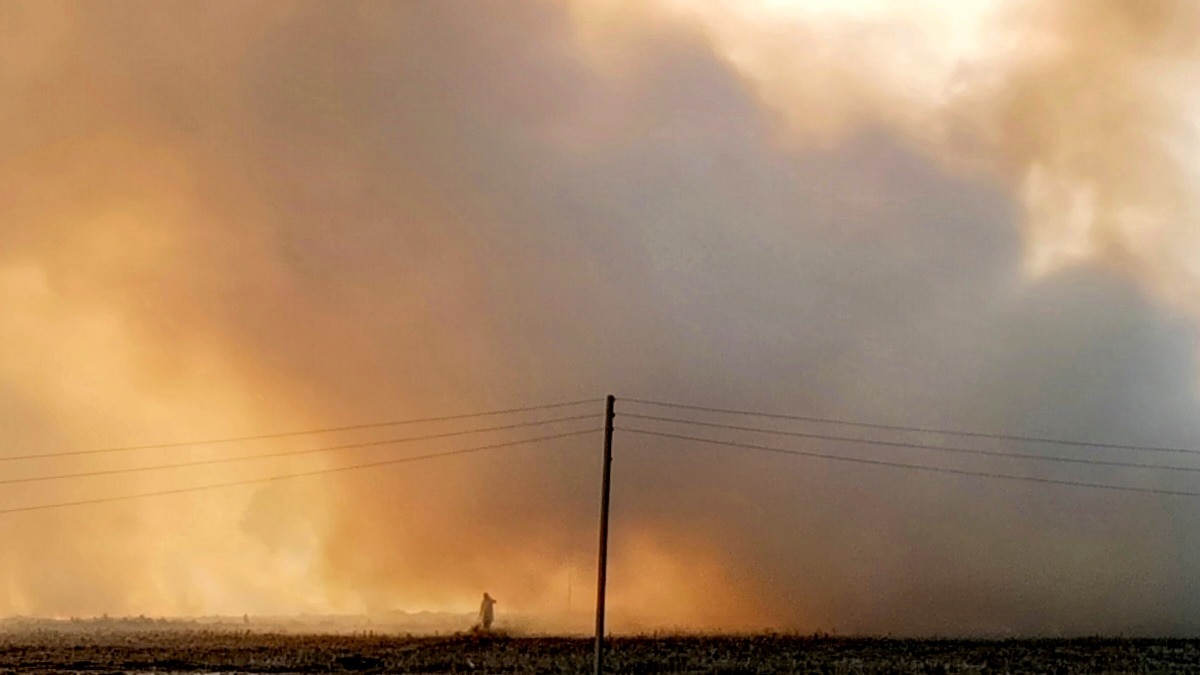
Bathinda in Punjab has emerged as the world's most polluted city, with its Air Quality Index (AQI) climbing as high as 1,048 on Thursday, according to AQI.in.The reading placed the city ahead of Meerut in Uttar Pradesh, which recorded 680, and Sirsa in Haryana, at 636, in the global pollution ranking. People stroll amid a thick layer of smog. (Photo: PTI) The soaring pollution levels come days after Diwali, when firecracker smoke contributed to pollution across northern India. But Bathinda's deteriorating air quality has a different explanation.The continued burning of paddy stubble across Punjab, combined with weather conditions that make it difficult for pollutants to disperse, is adding to the pollution burden. According to the AQI.in ranking, all of the world's 10 most polluted cities on Thursday were in India, with Punjab, Haryana and Uttar Pradesh accounting for most of them, with all the 10 cities recording AQI above 400. A graph illustrating Bathinda's AQI in the last 24 hours. (Photo: AQI.in) FARM FIRES CONTINUE TO ADD TO POLLUTIONThe timing is significant because Punjab's paddy harvesting season is still contributing to widespread crop-residue burning. Farmers often burn the leftover stalks after harvesting rice to quickly clear their fields before sowing the next wheat crop. The practice releases large amounts of smoke and fine particles, including PM2.5, which can travel across districts and worsen air quality.The latest available district-wise figures from the Commission for Air Quality Management (CAQM) showed that Punjab had recorded 4,459 farm-fire incidents up to November 8. A farmer burns paddy stubble in a field in Punjab. (Photo: PTI) Bathinda accounted for 406 of these, making it the fourth-worst affected district in the state after Tarn Taran, Ferozepur and Sangrur.The problem also intensified around Diwali. Punjab recorded 1,152 farm fires on November 8 alone, with Bathinda accounting for 132 incidents.WHY WEATHER IS MAKING THE SITUATION WORSEFarm fires are only part of the problem, as weather conditions determine how quickly the smoke and other pollutants disperse.During November, falling night-time temperatures and relatively stable atmospheric conditions can prevent polluted air from rising and mixing with cleaner air above, creating a situation in which pollutants remain trapped closer to the ground. Smoke billows as a farmer burns stubble in a paddy field. (Photo: PTI) Light winds can make matters worse by slowing the movement of polluted air out of an area.Bathinda's weather on Thursday was also marked by smoky haze, with winds remaining relatively light during the morning.With agricultural fires continuing and conditions not always favourable for pollution dispersal, smoke can accumulate and push pollution levels higher.The situation in Bathinda is a reminder that India's pollution problem is not limited to firecrackers. Seasonal farm burning and unfavourable weather can continue to deteriorate air quality well after the celebrations are over.- Ends
This Indian city is most polluted in the world today. It's not due to firecrackers
Full Article
Original Source
Read the full article at Indiatoday →KhanList aggregates and links to publicly available news content. We do not host full articles from third-party sources. Always verify important information with original sources.