
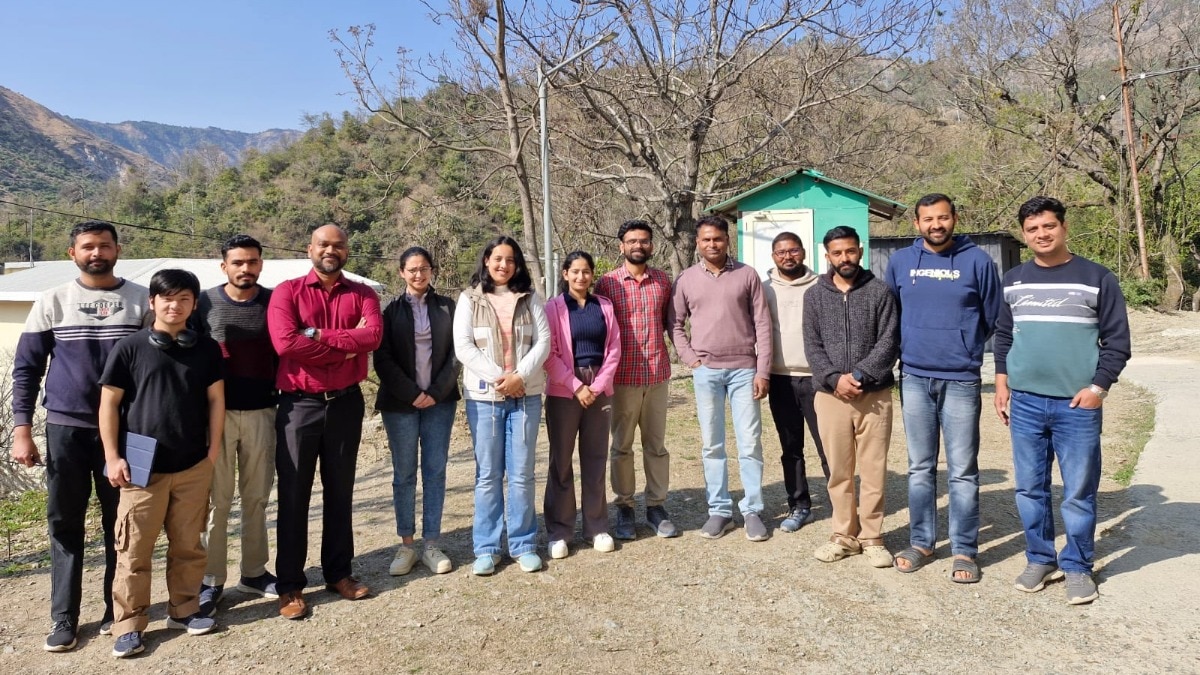
IIT Mandi researchers used tiny cracks and missing atoms in an ultra-thin material called WS₂ to control the flow of electricity. This could help develop devices that store and process information while using less energy.New Delhi,Nov 18, 2026 13:58 ISTResearchers at the IIT Mandi have found a way to use tiny defects in an ultra-thin material to improve its electronic properties, opening up possibilities which would remain helpful in developing the next-generation memory devices and brain-inspired computers. The findings were published in the research paper titled “Crack-defect landscapes enable multimodal memristive switching in WS mono-bilayers” in the journal Advanced Functional Materials.The study focusses on how structural imperfections in tungsten disulfide (WS), an extremely thin material, can be used to control the movement of electrical charges. The findings could contribute to the development of electronic devices that store and process information more efficiently.The research is of high importance because it explores an approach in which a single electronic device can perform varied functions which are connected with memory storage and information processing.Such devices could, in the future, help reduce the energy required to run certain computing operations. The team used chemical vapour deposition (CVD) to prepare WS-based devices and examined how missing sulphur atoms and microscopic cracks affected their electrical behaviour.The study was led by Prof Viswanath Balakrishnan, along with researchers Anjali Sharma, Yadu Chandran and Bhumit Luhar from IIT Mandi. HOW THE RESEARCH COULD BENEFIT EVERYDAY TECHNOLOGY The researchers were able to find out that defects, which are generally treated as unwanted features during manufacturing, could serve a useful purpose when properly controlled.Microscopic cracks and missing atoms influenced how electrical charges moved through the material, allowing the device to switch between different electrical states.In simple terms, the device could change how it stores and conducts electrical signals. It demonstrated gradual changes in electrical conductivity, sudden switching between states and operations at low electrical currents.This is important for the development of neuromorphic computing, an approach that attempts to reproduce certain functions of the human brain in electronic systems.In the human brain, connections between nerve cells become stronger or weaker as information is processed and learned. Similarly, artificial devices known as memristors can change their electrical resistance in response to electrical signals and retain information about those changes.The ability to perform multiple switching functions in a single device could help engineers develop compact systems that combine memory and computing operations.For ordinary users, the potential benefits could extend to several areas.In healthcare, for instance, future wearable devices could process information collected from the body while consuming less power. Smart sensors could analyse information locally instead of sending every piece of data to distant computer servers. The technology may also find applications in robotics, portable electronics, industrial automation and artificial intelligence. Devices that process information closer to where it is collected could be particularly useful in situations where continuous internet connectivity is unavailable or costly.The researchers also observed that the devices showed promising data-retention and endurance properties during laboratory experiments.These characteristics are important because memory devices must retain stored information and continue functioning through repeated operations.Published in Advanced Functional Materials, the study adds to research into materials that could make future computing systems more energy-efficient. For India, the research also demonstrates the work being undertaken at its academic institutions, especially the IITs, in advanced materials and semiconductor technologies, fields that are important to the development of future electronic devices.- Ends
This IIT is helping India advance memory tech for future computers
Full Article
Original Source
Read the full article at Indiatoday →KhanList aggregates and links to publicly available news content. We do not host full articles from third-party sources. Always verify important information with original sources.