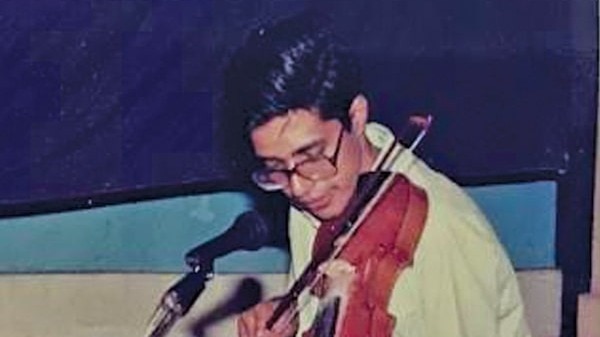
The director of one of India's top IITs has never travelled to a foreign country, nor does he own a passport, by choice. Professor V. Kamakoti's journey from a village to IIT Madras has had several ups and downs, but his firm beliefs have allowed him to learn more and share his knowledge with oVeezhinathan Kamakoti has spent decades in research, headed one of India's premier engineering institutions and now finds himself at the centre of the government's ambitious education reforms. Yet, unlike most academic leaders of his stature, the IIT Madras director has never travelled abroad and, by choice, does not even own a passport.He has publicly stated that he does not possess a passport because he has never felt the need to travel abroad.The decision, unusual in a profession built around international conferences and collaborations, traces back to a childhood spent not in a bustling city but in the villages of Tamil Nadu, a life experience that continues to shape his worldview, his public positions and, increasingly, the debates around him.Kamakoti has spoken on several occasions about not having a passport, saying that he wants people from abroad to come to India and discuss ideas with him, rather than travelling overseas himself. His strong beliefs and his desire to contribute while staying in India have meant that he never felt the need to apply for a passport, as he has highlighted on multiple occasions.Despite that, it is difficult to imagine that someone with his academic achievements does not own the document required to travel abroad and has never even considered the possibility of getting one. Unlike many academics who regularly attend conferences abroad, pursue international fellowships or collaborate through overseas visits, Kamakoti chose to remain in India throughout his career.THE RESEARCHER, THE PROFESSOR WHO WAS MOCKED BY PRIYANKA GANDHI IN PARLIAMENTFor many, however, Kamakoti is no stranger to public attention. Over the past year, the IIT Madras director has made headlines for his remarks on Indian knowledge systems, traditional practices and indigenous sciences.He has, on several occasions, openly shared his views with rationality, where he has been cited with great focus on IKS and other Indian traditional knowledge.Just days after being named to the Centre's high-powered task force on examination reforms, Kamakoti once again finds himself in the national spotlight.Congress MP Priyanka Gandhi called him a "Gaumutra Expert" on the floor of parliament, making mockery despite having the kind of scientific temperament he has.The committee, constituted to recommend structural changes to India's examination system of which Kamakoti is part, also includes former ISRO chairman S Somanath, Infosys co-founder Nandan Nilekani, Intelligence Bureau chief Tapan Kumar Deka and other senior experts.He told India Today that his priority is to fix the leaked system and focus on the future of students.Away from the controversies, however, lies a personal story that is unlike that of most IIT directors.A CHILDHOOD THAT BEGAN IN THE VILLAGE, NOT THE CITYBorn in Chennai in 1968, Kamakoti belonged to a family deeply rooted in academics. His father was a professor of Sanskrit at the University of Madras, while both his paternal and maternal grandparents lived in villages in Tamil Nadu.Instead of beginning his education in Chennai, his father decided that his early childhood should be spent in the villages of Mudikondan and Vishnupuram, believing that Indian culture could best be understood through rural life.It was a decision that Kamakoti often describes as the defining influence of his personality.Living with his grandparents, he witnessed farming at close quarters, understood the challenges faced by agricultural families and developed an appreciation for nature and traditional ways of life.He has often recalled through podcasts and interviews that the villages taught him one lesson above all, that farmers remain the foundation of society because they feed the country, irrespective of economic status or technological progress.Years later, even after becoming one of India's leading computer scientists, Kamakoti continued to credit those early experiences for shaping his outlook towards education, society and Indian traditions.A CRICKET BAT THROWN INTO A WELLReturning to Chennai marked the beginning of formal schooling, but Kamakoti was far from being the stereotypical academic topper. By his own account, he was shy, introverted and more interested in cricket than textbooks.That changed during Class 7.While opening the batting for his school cricket team, a rising delivery struck his spectacles. Worried that the sport could lead to a serious injury, his father took away his cricket bat and famously threw it into a well, telling him that he could pursue any hobby except cricket, as noted by Electronics for you.Kamakoti protested for weeks, but eventually discovered another passion that would stay with him for life, the violin. With a music teacher living across the street, he began learning the instrument and soon immersed himself in classical music.Looking back, he often says the episode also taught him another lesson. Apart from the cricket incident, his parents never forced career choices upon him, something he believes helped him grow without the pressure that many students experience today.FROM AVERAGE STUDENT TO IIT TOPPERAcademics were not Kamakoti's strongest suit in his early school years. It was only after Class 10, when his grandfather reportedly predicted that he would excel academically, that he began taking studies more seriously.After joining PS Senior Secondary School in Chennai, he faced another setback when he fractured his hand soon after admission and scored just 25 out of 100 in mathematics in his first examination. Encouragement from his school principal, however, proved to be a turning point.By the end of the academic year, the same student had scored a perfect 100 in mathematics and significantly improved in physics, laying the foundation for a journey that would eventually take him to IIT Madras itself.He went on to complete his BTech, MTech and PhD at IIT Madras before joining the institute as a faculty member, building a distinguished career in computer architecture, embedded systems and cybersecurity.Whether one agrees with his views or not, those early years spent in rural Tamil Nadu continue to echo through his speeches, decisions and public interventions.And perhaps that explains why one of India's most talked-about IIT directors still does not own a passport, not because he could not travel, but because he chose a different path.- EndsPublished By: Rishab ChauhanPublished On: Jul 29, 2026 19:13 IST
This IIT director doesn't have a passport, has never travelled abroad. But why?
Full Article
Original Source
Read the full article at Indiatoday →KhanList aggregates and links to publicly available news content. We do not host full articles from third-party sources. Always verify important information with original sources.