
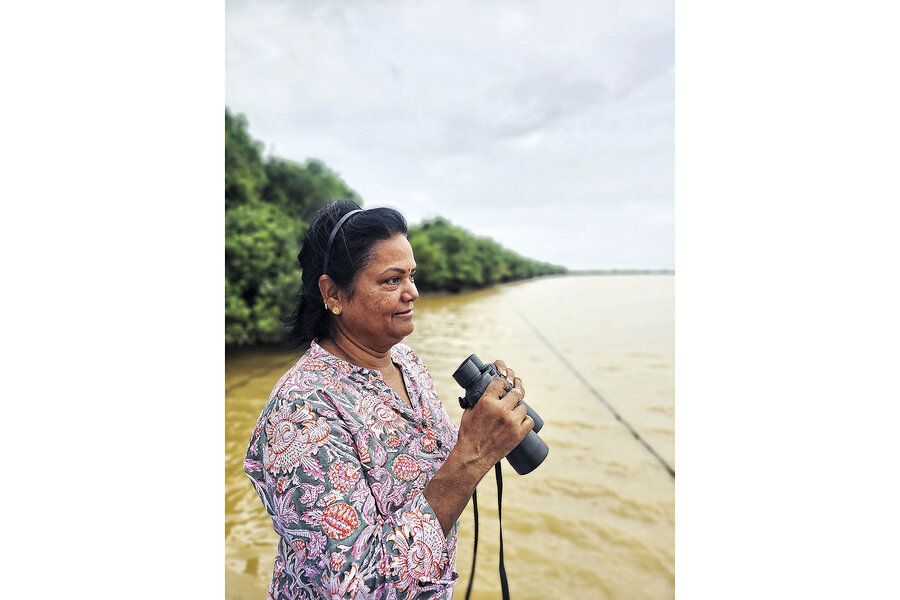
As dawn breaks over the misty mangrove creeks winding through Bhitarkanika National Park, the calls of kingfishers and Brahminy kites fill the silence. Standing on the deck of a sleek catamaran gliding through the water, Sanghamitra Jena peers through the binoculars slung around her neck. Suddenly, she spots a sinuous saltwater crocodile sunning itself on a mudflat and points it out to the delighted tour guests on the boat. “We have local names for many of the crocodiles here,” she announces. “This one is Kalia. ... He’s one of the oldest and has grown darker with age.”Sprawled across the Brahmani and Baitarani river deltas on the coast of remote Odisha state, Bhitarkanika is India’s second-largest mangrove ecosystem, after the more famous Sundarbans. And Ms. Jena, Odisha’s first female tour guide and the founder of its first nature camp, is the person who put this fragile wilderness teeming with crocodiles on the country’s ecotourism map. Why We Wrote This The mangroves of Bhitarkanika National Park buffer Odisha’s vulnerable coastline against frequent cyclones and provide breeding grounds for fish, prawns, and crabs that sustain thousands of fisher families. This is the environment that Sanghamitra Jena wants tour guests to see and appreciate. “I have always loved living close to nature and am happiest here, far away from the concrete jungle,” she says later.The point of the tours she leads is to spread that feeling.“The greatest joy is watching our guests discover this place,” she adds. Courtesy Of Antara Cruises Bhitarkanika is famous for its saltwater crocodiles. Breaking barriersMs. Jena’s connection with nature began in childhood. She was born in Odisha, in the village of Pokhariapada, but traveled extensively with her father, a civil engineer, while she was growing up. His work building roads and bridges across the state often took the family deep into forests and remote villages. This nurtured Ms. Jena’s fascination with India’s rural areas and the people who lived inside them.She graduated from college with an honors degree in history. Marriage and a career as a primary school teacher in Kolkata followed, but she found herself yearning for something more and soon moved back to her home state of Odisha.In the early 1990s, she watched a television documentary about a female guide working with foreign tourists in Mumbai. “This was exactly what I wanted to do,” Ms. Jena recalls. “At that time, very few women worked in tourism, and certainly not in forests or remote places.”Ignoring skepticism even from people close to her, she enrolled in a professional guide training program and emerged as Odisha’s first female tour guide in 1992. Now licensed to lead tours across five eastern Indian states, she quietly broke barriers in a profession that had been dominated by men. Her career took another turn in 1995 thanks to Lyle Lawson, an American travel writer and tour operator, whom Ms. Jena met while guiding her group through Odisha. She “funded my reconnaissance trips across India to discover offbeat destinations,” Ms. Jena says. Soon Ms. Jena started her own agency, Eastern Treasure India Tours, offering village visits and nature walks. Her travels deepened her understanding of her country’s extraordinary diversity – from its food traditions to its flora and fauna.But it was Bhitarkanika that kept calling her back. “There was absolutely no infrastructure here,” Ms. Jena says. “People came for day trips and left. Nobody stayed long enough to really understand the forest and the mangroves.” Courtesy Of Antara Cruises A painted stork is one of the myriad bird species found in the area. She established Odisha’s first nature camp in Bhitarkanika in 2008, with just seven Swiss tents, a modest kitchen, and basic bathrooms, employing residents and helping to pioneer community-based tourism in the state. Ms. Jena’s efforts encouraged local residents to value and protect the mangrove ecosystem that surrounded them.Bhitarkanika is most famous for its crocodiles. According to a 2025 census, 1,826 saltwater crocodiles inhabit these waters; they often bask in the sunshine on the mudflats at low tide. They are some of the world’s longest saltwater crocodiles, reaching up to 7 meters (23 feet). The bird life here is equally remarkable. More than 300 species have been recorded in the park, making it one of eastern India’s finest birding destinations. Every winter, thousands of migratory birds arrive from Central Asia, Siberia, and parts of Europe. Beyond the birds, there are king cobras, pythons, fishing cats, monitor lizards, spotted deer, and mongooses.Once the private hunting reserve of the Raj Kanika royal family, the area was declared a wildlife sanctuary in 1975, and a national park in 1998. Today, its mangroves buffer Odisha’s vulnerable coastline against frequent cyclones and provide breeding grounds for fish, prawns, and crabs that sustain thousands of fisher families. When Delhi-based Antara Cruises began operating in Bhitarkanika in 2024, running catamarans from the village of Gupti, company chairman Raj Singh invited Ms. Jena to become the resident naturalist aboard the boats. The partnership was a natural fit, as both believed that tourism should enrich local communities and leave the lightest possible footprint on the environment. Immersed in mangrovesMs. Jena was the “natural choice to lead the cruises,” Mr. Singh says, citing “her deep knowledge of Odisha’s flora, fauna, history, and culture.”The 17-meter catamarans pass silently through Bhitarkanika’s waterways, allowing guests to immerse themselves in the mangroves without disturbing them, Ms. Jena says. Courtesy Of Antara Cruises A catamaran glides through the waters of the Pathsala in Bhitarkanika National Park. “No other accommodation has permission to stay overnight in the core zone of a national park,” she notes.Meals on board are prepared “the way our grandmothers cooked,” she says, with traditional regional recipes using locally sourced ingredients. Fresh bhetki, also known as Asian sea bass, is often served alongside regional sweets such as chhena poda, a caramelized cheese dessert.“The entire crew is made up of locals from nearby villages,” Ms. Jena says. “We switch off most of the lights at night and keep the blinds closed so we don’t disturb the wildlife.” She adds, “Every piece of rubbish comes back with us to be disposed of properly after the cruise.”Sneha Thomas, a tour guest from Kochi who traveled with Ms. Jena last year, says the guide shifted how she looks at conservation. “Sanghamitra brings a level of personal connection and compassion to it,” she adds.Today, as protected areas across the world struggle to balance tourism and conservation, Bhitarkanika offers a compelling model. Reflecting on her philosophy, Ms. Jena says with a smile, “I believe nature should groom us and we should not groom nature.”
This guide put a park, and its crocodiles, on India’s ecotourism map
Full Article
Original Source
Read the full article at Csmonitor →KhanList aggregates and links to publicly available news content. We do not host full articles from third-party sources. Always verify important information with original sources.