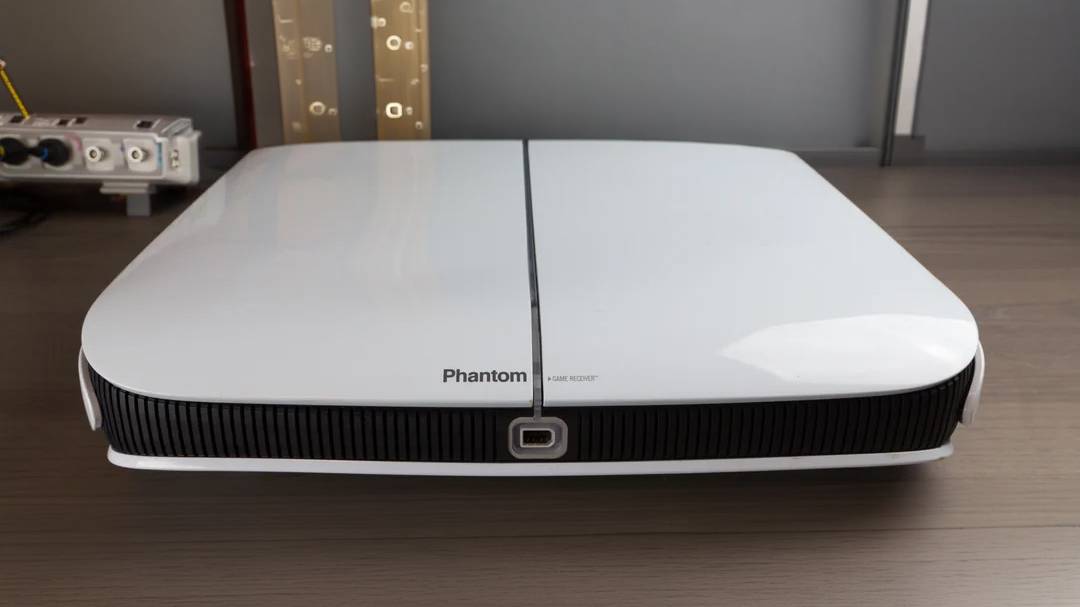
Published Jul 18, 2026, 3:00 PM EDT Patrick O'Rourke is XDA's News Editor and Entertainment Segment Lead. Previously, he was Pocket-lint's Editor-in-Chief, the Editor-in-Chief of Canadian tech publication MobileSyrup, and earlier in his career, he worked as the technology editor at the Financial Post and Postmedia. He's based in Toronto. Over the past 15 years, he's written thousands of articles. Patrick has also interviewed dozens of tech industry executives and covered GDC, E3, Gamescom, WWDC, Apple keynotes, Samsung Unpacked events and more. Patrick has a BA in journalism from Toronto Metropolitan University. Sometimes, the tech world produces a device so far ahead of its time that looking back, it's hard to believe it ever existed — and in this particular case, it basically didn't. Back in the early 2000s, online blogs were just emerging, and big tech and gaming stories were almost always revealed in print magazines like Electronic Gaming Monthly (EGM). I fondly remember flipping through a 2002 issue of EGM and coming across an image of an odd-looking console called the Phantom — I was instantly hooked. This wasn't Microsoft's next console, since the original Xbox had only just dropped, and Nintendo was still firmly in the GameCube era. Even Sony's PS3 was still several years away at this point, with the PS2 riding high. So what was this thing from some company called Infinium Labs? Every month I'd eagerly grab the latest issue of EGM and try to hunt down all the information I could about the mythical system that, looking back, was decades ahead of the rest of the gaming industry with several of its core concepts. A console so futuristic it sounded too good to be true (and it was) Infinium Labs wanted to launch an Xbox Game Pass-like service The Phantom seemed absolutely wild for the era. It ditched cartridges and discs for an internet-only game-delivery system that included downloads and a subscription model. This is similar to how many of us get our hands on games today, whether it's via Steam, Xbox Game Pass, PlayStation Plus, or one of the countless other digital retail platforms. Still, at the time, it was a very bold strategy when most people didn't even have broadband internet yet. The closest comparison was something like the ill-fated Sega Channel, which delivered Sega Genesis games to subscribers over the internet. Even the simple fact that games were entirely installed directly on the Phantom's hard drive was a groundbreaking concept for a console. More information about the Phantom slowly began to appear online through Infinium Labs' website, which I checked at least once a week, hoping to learn more about the mysterious console. A few months after the initial reveal, I'd learn that the Phantom featured a Nvidia graphics card, an Intel motherboard, and that it would use Windows XP as its operating system. If this sounds like a PC in a fancy box that's designed for use in your living room on a TV, you're on the right track. The Phantom's core concept has a lot in common with the Steam Machine Infinium Labs was embroiled in controversy from the start Credit: 5kHz This is also strikingly similar to how Valve marketed both its new SteamOS-powered Steam Machine and its original attempt at a living room PC back in November 2015. The Phantom was a PC designed to be hooked up to your living room TV, bringing computer gaming experiences out of the confines of a desktop PC and onto the couch. How could I not be into that? The prospect of using both a controller and a mouse/keyboard opened the Phantom up to more genres than consoles of that time. It all sounded way too good to be true, even to my 13-year-old brain, and I started to become skeptical of the whole thing. Eventually, Kevin Bacchus, a key member of the original Xbox's development team, joined Infinium Labs, and the Phantom pivoted to being entirely free for Phantom Game Service subscribers, with the company taking a hit on hardware but making it up over time through a monthly subscription fee. Credit: Eddie Schlesinger Then came the legal troubles. Now-defunct PC gaming blog HardOCP published a lengthy article criticizing The Phantom, prompting Infinium Labs to send the publication a cease-and-desist. HardOCP won the case, and Infinium Labs was forced to fork over undisclosed damages. The founder of HardOCP then smashed one of the few Phantom prototypes in existence at Quakecon in 2004 — yeah, the mid-2000s were a bit wild. The Phantom, which was supposed to be released in November 2004, never hit store shelves, and reports that Infinium Labs employees weren't being paid began to crop up. The console appeared one final time at CES 2005, and Bacchus took over as CEO later that year, but he eventually resigned because he also wasn't being paid (he also sued the company for unpaid wages). At this point, the Phantom's history gets a little murky and difficult to track because a lot seems to have happened in a short period. Infinium Labs hired a new CEO who repeatedly claimed the mythical console would actually hit store shelves, and a weird keyboard-mouse controller called the Phantom Lapboard was revealed and actually did release (based on reviews I found, it was awful). According to a 2006 Eurogamer article, the company had lost $70 million since its creation and still hadn't released a product. Tim Roberts, one of Infinium Labs' several former CEOs, was also investigated by the SEC for "irregularities regarding the promotion of its shares." Oh, and at some point in 2006, the company changed its name to Phantom Entertainment. Phantom prototypes have surfaced a few times over the years The second-generation Phantom's design is a big step over the original prototype Credit: Eddie Schlesinger Since then, the Phantom console has surfaced a few times. In 2015, Ars Technica reported that it was spotted at a computer repair shop in Venice, Florida, offering an in-depth look at the failed console. Then, in 2016, a second-generation, sleeker-looking prototype that had reportedly been shown off at E3 2004 appeared online, courtesy of 5kHz. It features an air duct made out of a Pepsi 12-pack — no, I'm not joking. While the Phantom might have just been an elaborate scam from the start, the prospect of using a PC in your living room, downloading games, and game subscription services are now an industry mainstay. Was the ill-fated system just too early with all of its innovative concepts? Probably. But at the same time, it seems that mismanagement and pump-and-dump stock scams killed the Phantom before it could even really get off the ground. Still, you can see the video game industry's future in a lot of Phantom's core ideas.
This failed game console chased the Steam Machine dream 23 years ago
Full Article
Original Source
Read the full article at Xda-developers →KhanList aggregates and links to publicly available news content. We do not host full articles from third-party sources. Always verify important information with original sources.