
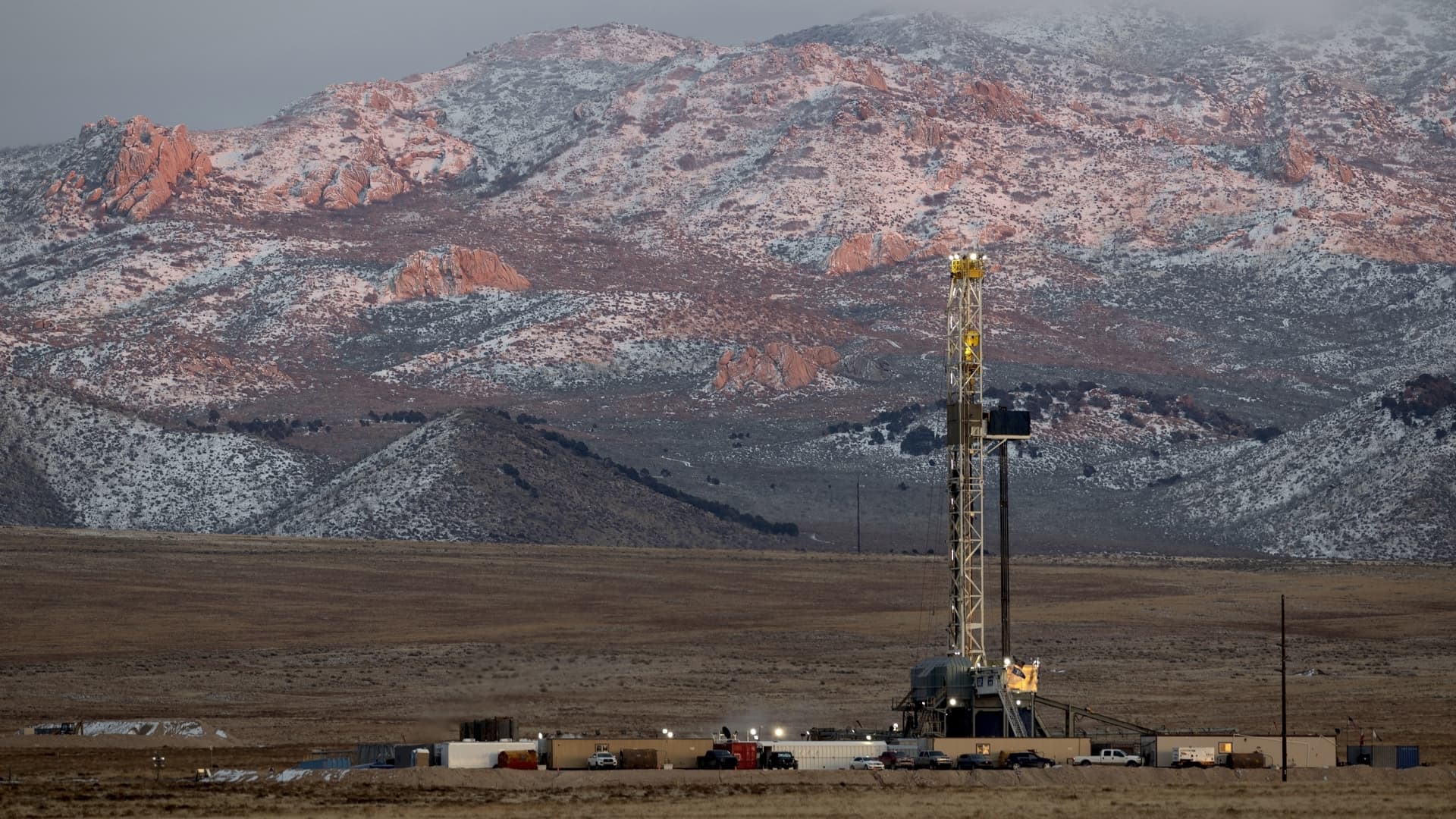
A drill rig stands at a Fervo Energy geothermal site under construction near Milford, Utah, Nov. 26, 2023.Ellen Schmidt | APMILFORD, Utah — Deep in the Utah desert, down miles of gravel roads and hours from a major city, Fervo Energy bets it can economically harness heat from the Earth's core for power, potentially unlocking dozens of gigawatts of baseload, emissions-free electricity at a time when U.S. power demand is meaningfully growing for the first time in decades.Geothermal power is not new. Traditionally, it required specific geological formations, vastly limiting its potential. Now, Fervo aims to prove that, by utilizing the same drilling and hydraulic fracturing techniques developed by the oil and gas industry, what's known as enhanced geothermal can become a key power source for the U.S. The company's Cape Station project in Milford is on track to send power to the grid next month, which would make it the first enhanced geothermal system in the U.S. to reach commercial operation. After an initial public offering in May and a new offtake agreement with Google, Fervo must prove it can provide cost-competitive enhanced geothermal at scale.A transformation in the demand for powerThe company's roots precede the data center power boom. CEO Tim Latimer began his career as a drilling engineer in South Texas, before founding the company in 2017 with Chief Technology Officer Jack Norbeck. As Latimer tells it, when they first tried to raise venture capital funds, a common response was, "'Why would we invest in a power generation company? The electric grid's not growing.'" Oil and gas companies also dismissed Fervo, with the prevailing assumption being that the kind of drilling the company was looking to do — hotter wells through harder granite — wouldn't work. Now, less than a decade later, that narrative has flipped."It's a total transformation from 10 years ago, when people were questioning even the need for more new electricity," Latimer told CNBC. "This is a once-in-a-generation boom moment where hyperscalers, utilities and other customers need [power] now, and it's our power that will be an important part of the electric grid."Recognizing the importance of prime acreage, Latimer, in Fervo's early days, started acquiring geothermal rights on land across the Western U.S., amassing a portfolio of nearly 600,000 acres. The company acquired the rights at an average price of $4 per acre, a move that now seems prescient: The same land can now go for north of $400 per acre. Fervo's land grab included acreage across Beaver County, Utah, which is also where the Department of Energy set out to prove the case for enhanced geothermal via its Frontier Observatory for Research in Geothermal Energy, or Forge, amassing data aimed at helping private players commercialize enhanced geothermal system technology. Cape Station, Fervo's flagship project, sits adjacent to Forge. The goal of emissions-free powerOn a tour of Cape Station, Latimer pointed out many of the same things you might see in the Permian Basin, down to drill rigs provided by Helmerich & Payne. The difference is that in Utah, the goal is emissions-free power.While traditional geothermal projects required specific reservoirs, in enhanced geothermal systems companies are creating their own reservoirs.Fervo drills a pair of wells more than 2 miles deep, including a lateral well that can extend for more than a mile horizontally. It creates fractures in the surrounding rock before sending water down the injection well, where it is heated by temperatures above 400 degrees Fahrenheit. The water then returns to the surface via a separate production well, before being sent through a heat exchanger and ultimately producing electricity. The geothermal brine is then cooled by rows of industrial fans that sit atop Fervo's power plant, before it's reinjected into the ground in a closed-loop system. From the moment the non-potable water hits the surface to when it's reinjected into the ground, takes mere minutes.Latimer said Fervo's drilling is a step beyond traditional shale methods, due in part to three challenges: harder rock, hotter temperatures and longer well lives. As a result, the company has developed innovative techniques around drill motors, bit designs — the company uses a polycrystalline diamond compact drill bit — and drilling fluids. Those innovations have led to what he called a "step change in performance for geothermal drilling."Latimer said Fervo's mission from day one was to push the edge of science and technology — the latter behind the curve, in his view, in the traditional geothermal industry. The company constantly collects data to optimize its operation, since longer drilling times translate to higher costs. In the driller's cabin atop the rig, screens display real-time metrics sent back from underground sensors — data that's simultaneously being monitored from company headquarters in Houston. An on-site geologist analyzes the changing properties of the granite coming out of the ground, all with the goal of maximizing optimal drilling conditions.Cost reductionsFervo has brought down its costs as it drills more wells. But geothermal remains more expensive than other power sources — even with federal tax credits that were preserved for it under President Donald Trump's One Big Beautiful Bill Act.The company's first wells at its pilot facility in Nevada took 70 days to drill to a measured depth of 11,220 feet. At Cape Station Phase I, the average dropped to 21 days and 14,483 feet of measured depth, costing about $7,000 per kW. Now Cape Station Phase II is targeted for $5,500 per kW and the deepest wells yet at 19,448 feet. Along the way, temperatures have grown hotter and pipes have gotten larger, both of which increase the electricity generated by each well.Still, costs need to fall further if geothermal has a shot at being competitive with other forms of power generation. Long term, Latimer said, the company can produce at $3,000 per kW. "[B]ecause we can drill consistently… we've removed a lot of the uncertainty and the exploration risk that has plagued geothermal for years," he said. "[We] put geothermal on the kind of learning curve that has yielded dramatic cost reductions in other industries … We're expecting dramatic cost reductions in both the drilling side of the business and the power plant side of the business through that modularity and standardization."Fervo's costs are split between the subsurface drilling and the power plants that sit adjacent to the wells, where expenses are also coming down. Pieces for the first power plant — 33 MW — were delivered individually. Parts and designs were standardized for the Phase II plants, which are 50 MW and on track for a more than 30% reduction in construction time. Fervo's long-term goal is to be able to put these plants everywhere, including behind-the-meter for data centers. Behind-the-meter refers to having energy production and storage systems on the customer's property. "We are developing a model where we are both going to be pursuing at the right locations transmission and grid-connected projects, as well as customers who want faster delivery. Behind-the-meter is a great opportunity there," Latimer said.Working toward a sustainable gridThe agreement with Google brings Fervo's total contracted power to about 1 GW, and Latimer said the company is in advanced commercial negotiations with several potential buyers. Southern California Edison, Shell Energy and NV Energy will also buy the company's power.The company hasn't disclosed the terms of its power purchase agreements, but hyperscalers have been willing to pay above-market rates for power, thanks in part to climate goals. Fervo also said its faster timelines set it apart from other sources of generation. The company relies on existing supply chains that have been established by the oil and gas industry, while the Organic Rankine Cycle turbines it uses in its power plant don't face the same backlogs as seen in the gas turbine market, where companies like GE Vernova have said they're sold out for years to come.Fervo went public in May in a hotly anticipated IPO, raising nearly $2 billion in an oversubscribed offering. The stock hit a record high on May 15, but shares are down about 57% since.Fervo said it plans to use the capital from its IPO for expansion."We have project sites throughout the entire Western United States. We now have the capital to pursue it, and we want to repeat these GeoBlocks all over the West and then all over the world until we realize a more reliable, affordable, and sustainable electric grid," Latimer said.
This enhanced geothermal project aims to unlock gigawatts of power to fuel the data center boom
Full Article
Original Source
Read the full article at Cnbc →KhanList aggregates and links to publicly available news content. We do not host full articles from third-party sources. Always verify important information with original sources.