
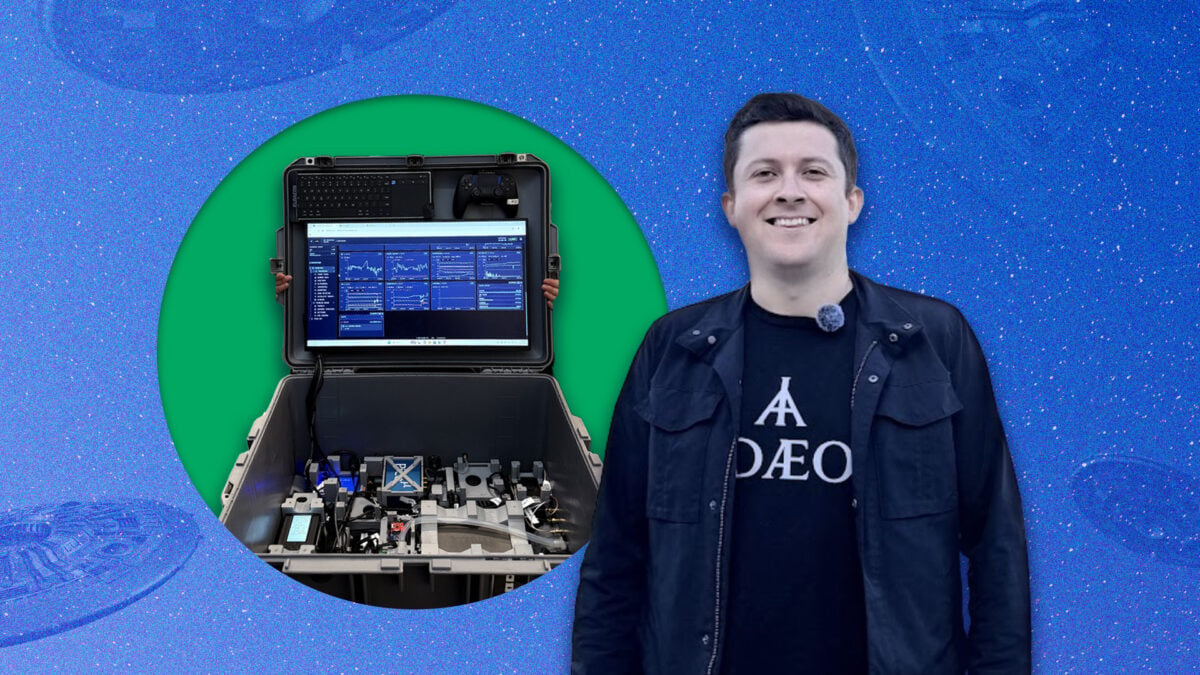
Gizmodo’s Human Generated is a series of profiles and interviews with some of the most inventive people working across tech, science, entertainment, and art. We go beyond the finished product to explore the process and person behind it. Meeting David Dominguez Hooper—founder of the aerial detection and identification startup ELDÆON—is a bit like meeting Marty McFly maybe five or six years after the final moments of Back to the Future Part III. Years have passed since his friend and mentor, eccentric physicist Dr. Emmett Brown, blasted off into the sunset on a steam-locomotive time machine, but McFly’s teen interest in the weirdest edges of science has remained. Hooper has that same quick-on-his-feet exuberance you might associate with the incomparable McFly. It’s the same brand of plucky optimism that would try to harness a lightning bolt from a clock tower and transform it into the catalyst for time travel. A graduate of the University of California, Berkeley’s electrical engineering and computer science program, Hooper founded the state university’s drone club, UAVs@Berkeley, a little over a decade ago. His goal, as he told campus news back in 2016, was to “bring about the world’s first-ever intercollegiate drone race.” A few years after Hooper graduated, his curiosity was piqued by a more technically and reputationally tricky challenge: What in the hell was going on with unidentified flying objects (UFOs), or, as the government now calls them, “unidentified anomalous phenomena” (UAP)? And critically, what signals-collection hardware would actually help solve the mystery? “I was not an alien person or a UFO person before Covid,” Hooper told Gizmodo. “Covid [was] when I was like, ‘Okay, there’s something weird here. Let’s go explore it.’” That pandemic lockdown deep dive produced ELDÆON: a small but growing tech company built on the premise that a well-designed sensor suite could provide more clarity on this issue than grainy cell phone videos or heavily redacted Pentagon files. ELDÆON is now taking orders for its enterprise-level multi-sensor UAP-detection platform, Dionysus, and its consumer-grade model, Nemesis, which uses FM radio and digital broadcast TV signals as raw material for passive radar. Nemesis can cross-reference radar readings with ADS-B flight data to distinguish known aircraft from otherworldly objects in the sky. Nemesis Hooper’s team is now working with a faculty member at his alma mater, Jasenka Rakas of UC Berkeley’s Aerospace Engineering Program, to deploy ELDÆON’s passive radar and help airports deal with unauthorized drone incursions. ELDÆON’s Nemesis is particularly useful, Rakas told Gizmodo, because it operates without actively beaming its own radar, which could interfere with an airport’s air traffic control radar and violate federal law. “We are trying to see how data can overlap and further inform us of potential collisions, intrusions, incidents, accidents,” Rakas, deputy director of Berkeley’s FAA-funded National Center of Excellence in Aviation Operations Research (NEXTOR), said. “That is very valuable software and hardware. Particularly, it’s in line with this big modernization of the FAA, BNATCS, you know, ‘Brand New Air Traffic Control System.’” (It’s really called that.) Gizmodo spoke with Hooper about UFOs (obviously), the perils and moral calculus of building citizen-science tools that could also be used in drone warfare, and why ELDÆON decided to build its own in-house AI tools rather than rely on subscriptions from the industry’s major players. This interview has been edited for length and clarity. You founded the drone club at UC Berkeley. Was there a connection between that work and your eventual interest in UFO detection? To be honest, no. I just got into drones because I liked hacking. I wanted to extend my drone’s range so it could fly farther out. So I happened to do that, and then I built a community. My background with drones has really helped me deal with the UAP subject because I’m grounded in what regular drones are. I know their flight characteristics and their performance. I know the difference between something unusual and something that’s probably within the capabilities of existing technology. I saw what was out there and thought, “Hey, I want to reverse engineer it, do it my way, do it better, and then build it up myself.” When did your interest in UFOs become something you wanted to pursue professionally? During COVID, the world stopped. I’ve always had a quest to understand the nature of the universe, or God, or what God is. But during COVID, that translated into, “Okay, there’s something weird here. Let’s go explore it.” And it was the whole UFO subject. Between 2023 and 2025, I started thinking about doing this professionally. In 2023, I attended the Sol Foundation symposium. That was my first time taking my technology to the big people in the UAP community and showing it off. It was my way of asking, “Is there any merit? Is there any value in what I’m doing?” I got a lot of yeses. By 2025, I’d met people like [former director of the Pentagon’s Unidentified Aerial Phenomena (UAP) Task Force] Jay Stratton and [former director of the Department of Defense’s All-domain Anomaly Resolution Office] Sean Kirkpatrick. They asked about calibration, thermal lenses, and how the system worked. Getting that feedback was valuable. © Courtesy of David Hooper For someone unfamiliar with ELDÆON, what exactly are you building? We have two products. One is enterprise-grade: Dionysus, the $25,000 system. Then there’s Nemesis, which is more like something everyone can get for $500. Dionysus is more for research labs or investigatory work. Dionysus lets us add new sensors as we learn what works. But integrating and testing them takes longer than people realize. With Nemesis, I wanted to set a different bar. How do you make passive radar basically plug-and-play? People don’t just want to see something moving on a radar screen. They want to know where it is relative to where they’re standing. That’s the challenge: making this technology consumer-friendly. What makes passive radar particularly interesting for detecting UFOs? And do we actually know whether it works? Anyone who’s building passive radar for UAPs should state this: We don’t know if passive radar can pick up UAPs. Anyone who tells you that they know it works is bullshitting. You first have to build it, go out in the field, and test it to see if there’s any anomalous activity you can correlate with other sensors. We can pick up airplanes. We can even pick up some drones. But if you’re really going after UAPs, you’ve got to build it first. To answer whether radar can pick up anomalous UAP activity, we need affordable systems. Passive radar uses signals that are already out there, so we don’t need an FCC license to transmit our own radar signals. If you can put enough of them out there, you can start doing the science. That’s my mission with Nemesis. I’m not claiming, “Hey, you can detect UAPs.” But it has potential. Beyond radar, what kinds of sensors are you most excited about? Two things interest me: redshifting and blueshifting—observing potential changes in electromagnetic frequencies—and relativistic physics, like time dilation or spacetime distortion. With Dionysus, one approach we’re exploring involves atomic clocks. You synchronize two precise rubidium oscillators, put one in the field, and later compare them to see if there’s any measurable drift. That’s the theory, at least. Dionysus also has cosmic-ray detectors that measure muons [subatomic particles that are essentially heavier versions of electrons]. If something unusual affected the environment, we might see a measurable change. Again, this is theory. It’s cutting-edge, speculative stuff, and it needs testing. © Courtesy of David Hooper You’re also exploring applications beyond UFO research, including airport safety. How does that work? We’re working on a potential research collaboration with Professor Jasenka Rakas at UC Berkeley. Her research deals with airport design, airport safety, and mitigating airborne risks. She’s been taking FAA reports of unauthorized drone activity around airports and visualizing them as heat maps. The interesting question is whether ELDÆON can validate some of those findings. Can we match eyewitness reports of traditional drones with Nemesis radar data? We use the Nemesis Passive Radar Detection System near LAX to record air traffic, so when the FAA publishes its next dataset, we want to compare the reports with our radar tracks. But what if there are more unauthorized drone incursions than eyewitnesses are reporting? And once you’ve established a baseline of ordinary drone activity, are there any objects displaying truly anomalous behaviors—fast flight speeds, right-angle turns, unusual accelerations? We start with the prosaic stuff and see whether there’s anything beyond that. Why is it important to make a consumer-grade system when so much aerial detection technology is developed for governments and the military? One of our taglines is that we want Nemesis passive radar to be the Ring doorbell for the skies. Someone comes to your door, and you can assess the threat. We need something similar for the skies. Think about the future of drone deliveries and drone services. People are going to need to know what’s coming into the airspace around their homes. Can I trust the thing that’s coming onto my property? Is it supposed to be there? Is somebody spoofing it? Passive radar is old technology. We use reflections from FM radio and television broadcasts to detect moving objects and make it plug-and-play. There’s also an obvious military application for something that can identify and track drones. How do you navigate the ethical questions that come with that? As I explored the El Segundo defense-tech ecosystem, people encouraged me to pitch the company toward counter-UAS (technology used to track, identify, and destroy hostile drones) and defense applications. But the more I pitched that way, the more I realized it wasn’t authentic. Investors like Boost VC didn’t want the counter-UAS pitch. They wanted to hear about UFOs, the future, and how UFOs might impact humanity. There’s also the responsibility that comes with making this technology available. What happens if you’re detecting sensitive military technology? What if the information you’re collecting could compromise national security? I don’t want to expose capabilities that could undermine our national defenses. You want to give power back to the people, but with that power comes responsibility. You have to abide by the laws and work with the government while maintaining your own principles. How are you using artificial intelligence to develop these systems? At ELDÆON, we’re trying to leverage AI to move fast, break fast, iterate, and learn what works and what doesn’t. I started out programming everything myself. ChatGPT and other models accelerated my development process. Very early on, I had to decide. Are you going to be an engineer who just produces “vibe slop”? Are you going to give away your sovereignty and agency to AI-generated code? Or will you use it as a tool? I decided to retain my agency by reviewing the output rather than copying and pasting it. You still need a human reviewer. © Courtesy of David Hooper You’ve also invested in running your own AI models instead of relying entirely on companies like OpenAI or Anthropic. Why? One of the stances we’ve taken as a company is not to shy away from AI, but to become sovereign users of the technology. We bought Nvidia DGX AI supercomputers, plus servers and storage, so our engineers can run models. Cybersecurity, export controls, and regulatory changes need to stay at the top of mind. What if governments restrict certain models or providers change their policies? With our own infrastructure, we have more freedom to keep developing products without those dependencies. AI can also hallucinate or produce incorrect information. How do you keep those mistakes from making their way into real-world engineering? You still need a human in the loop steering it. AI can go down a rabbit hole of bug fixing or problem-solving that’s just wrong. If you don’t have the expertise to recognize that, you can end up following it in the wrong direction. You need knowledgeable people who can tell the AI, “No, go here.” I look for engineers who can interact with these models and recognize hallucinations. You still need people to do the physical work. The point isn’t to replace human expertise. It’s to accelerate what people who understand the technology can accomplish. What’s been the most unexpectedly difficult part of building ELDÆON? Manufacturing. That’s probably been the biggest surprise. I didn’t realize how much capital and infrastructure hardware manufacturing requires: people, materials, workflows, facilities, and quality standards. I was so focused on building the company, hiring people, showcasing the technology, and raising money that I wasn’t thinking enough about scaling production. Going from building one product to 10 to 50 is a lot harder than people think. An advisor encouraged us to outsource manufacturing. But outsourcing raises costs and reduces control. I wanted to do more in-house. Nemesis is actually a loss leader. We don’t really make money on the hardware. The potential is in software subscriptions, data storage, and additional services. Dionysus, the $25,000 system, has much better margins. Finally, what do you hope people take away from the technology you’re building? I want people to make informed decisions about what’s going on in the skies. We saw that confusion with the drone sightings in New Jersey. People couldn’t identify what they were seeing, and panic spread because they lacked reliable information. Most companies developing counter-UAS technology are trying to sell to the military. I want to take a different approach: build a U.S.-led company that promotes safety, understanding, and real data collection about what’s in our skies. That’s our whole bet.
This Electrical Engineer Now Builds UFO Detection Tools
Full Article
Original Source
Read the full article at Gizmodo →KhanList aggregates and links to publicly available news content. We do not host full articles from third-party sources. Always verify important information with original sources.