
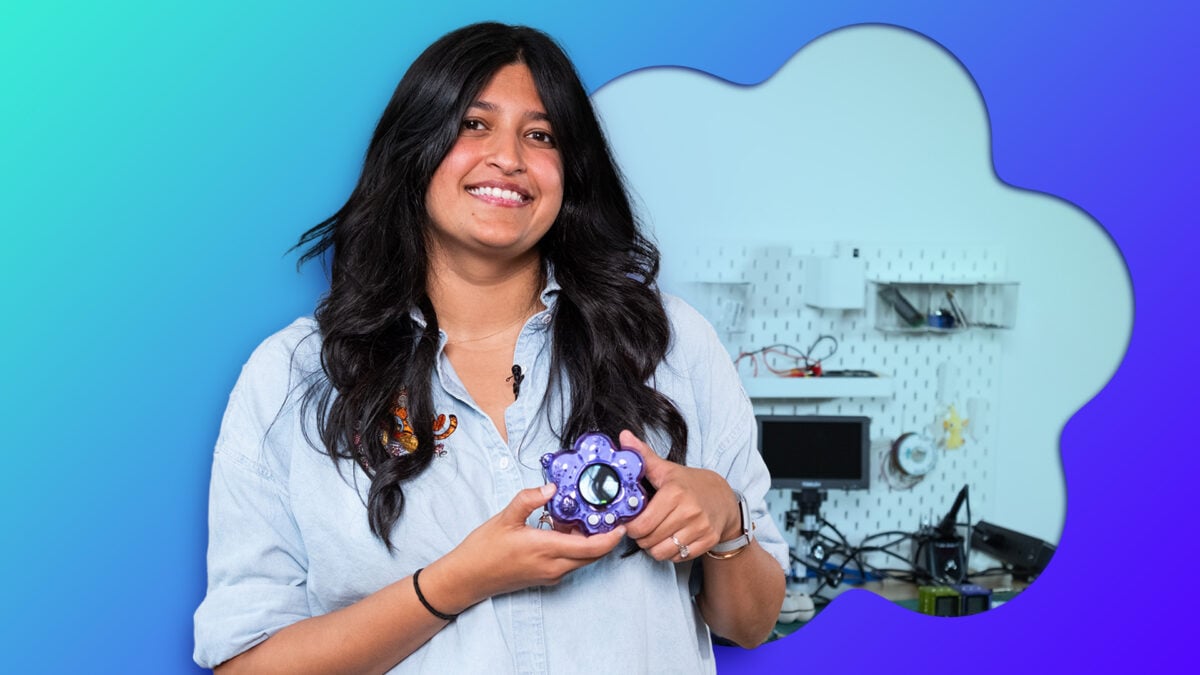
Gizmodo’s Human Generated is a series of profiles and interviews with some of the most inventive people working across tech, science, entertainment, and art. We go beyond the finished product to explore the process and person behind it. Tru Narla remembers when the latest tech—the cutting-edge consumer hardware itself—was colorful. You probably do too, even if it feels like we’re a long way away from flip phones, bedazzled digital cameras, and endearingly bulbous, candy-colored Apple laptops. In 2023, Narla hopped off a career track that had taken her from Brown University’s computer science department to software engineering for companies like Square and Discord. Now, with 448K followers on her Instagram and over 9 million likes on her TikTok videos, the Hyderabad, India-born creator has reinvented herself as a maker of custom-built devices that feel like forgotten artifacts from the mid-2000s or the kind of fictional tech you might have seen on iCarly. “I just miss the age of ‘everything was a rainbow,’” Narla told Gizmodo. “Everything is a rectangle now. Let’s change it up.” But the 30-year-old New Yorker’s work isn’t just about escaping the sterile “quiet luxury” of brushed steel and muted palettes. Her work, like an in-progress step counter inspired by both Nintendo’s Pikmin and its Pocket Pikachu, meets a genuine practical need the same way any other gadget does. © Adriano Contreras / Gizmodo Along with soothing people’s pangs of Y2K nostalgia, Narla creates fanciful products that defy modern motifs—a retro digital camera shaped like a flower, a digital compass that points only to the nearest Taco Bell, and, most recently, a Magic 8 Ball hairclip for the fashionably indecisive. “There’s some heart and soul in the creations,” Narla added. “Mine are basically my babies because I’ve gone through the entire process of building them.” Arguably, the subculture of tinkering that Narla’s creative projects and short tutorials best fit into is “cyberdecking”—a virtual community built around a love of constructing DIY portable computers and other hardware for highly niche use cases. Decades of these bespoke computer and gadget-makers have typically leaned more into the cassette-futurism aesthetic described in dystopian science fiction, like William Gibson’s Neuromancer. Narla’s vision for this kind of build, however, aims to inspire more sheer enjoyment and scrappy optimism than past waves of cyberdeckers, who have often leaned into cyberpunk defiance with their DIY hardware. Gizmodo spoke with Narla about what inspired her to start cyberdecking, what tools she can’t work without, starting her own whimsical hardware and software company, and thoughts on AI’s role in the creative process. This interview has been edited for length and clarity. Gizmodo: First things first—your handle is MewTru. Can I assume you’re big into Pokémon? I’m a huge Pokémon fan. As a kid, I used to get Nintendo handhelds for Christmas: Game Boy Color, Game Boy SP, then the DS. I remember playing Pokémon games on all of them. I used to have Pokémon cards, too. © Adriano Contreras / Gizmodo Did you have an interest in making art before you started doing this professionally? I’ve always been interested in art. In high school, I wanted to take an art elective, but my parents put me in computer science instead. They both have technical backgrounds. At the time, I was a little upset because the Art Cubed elective was this really cool multimedia class where you’d do sculpture, painting, drawing, all of that. But I think it was the right decision. Then I learned coding and built a website for a Microsoft competition. I made it really interactive—things moved when you scrolled over them—and I won an Xbox. I was like, “Okay, maybe there’s something to this coding thing.” Why did you decide to move from software into hardware? Hardware, specifically, I’ve always wanted to do. I used to watch a bunch of hardware YouTubers—people making really funny, different things and crazy hardware builds—so I always wanted to get into it. Toward the end of last year, I saw AI make coding feel a little obsolete—at least in the content world. I was using code to build fun things and websites, but suddenly everyone could ask a tool to do that. I thought, “Maybe now is the time to pick up something more hands-on, where you have to put in a little more effort than just asking a tool to build something for you.” So I started learning how to solder, connect components, 3D print, and model things. When you start a project, does the technical idea or the creative idea usually come first? It can happen either way. I’m collaborating with a fashion creator right now, and that means starting with the aesthetic: What kind of dress do we want? What should it look like? We ended up making a dress with around a thousand programmable LEDs, and then I had to figure out the technical side—microcontrollers, portable power, and its own Wi-Fi hotspot so she could control it from her phone. © Courtesy of Tru Narla Other times, I’ll just have a part sitting around. I had two square touchscreen panels that are the perfect shape for a mini chessboard, and my friend and I really like chess. So I thought: What if we each had a little magnetic chessboard on our fridge and could play against each other? My ideas are honestly all over the place. I keep a journal and write everything down. Sometimes it starts with, “I have an e-ink screen—what can I make with it?” and sometimes it starts with a problem I want to solve. Both are equally fun. What draws you to technology and design from yesteryear? First off, there were just so many colors. I miss the age when everything was rainbow. You had frosted cases, transparent cases, different shapes—so many variations. It felt personal. I remember being a kid, going into a store, and seeing all the different colors and shapes. It was so much more fun. I want to build things that feel like that. I remember Tamagotchis coming in all these different shells, and it was cool to have one that felt specifically yours. Now it feels like we’re not being as creative with hardware. Everything is a rectangle. How did that philosophy influence your flower-shaped camera? I chose a circular preview screen because I’d never seen a camera that didn’t have a rectangular one. From there I thought, “What shape can I make around that?” I started arranging spheres around the circle, and eventually it looked like a flower. I printed it, picked it up, and it felt really good in my hand because it’s so curved. I was like, “This is great. Let’s run with this.” People have compared it to a mochi donut, too—which I love. But it’s fun to see a camera that isn’t rectangular and gray. © Adriano Contreras / Gizmodo How much of your work is engineering versus art? I’d say it’s pretty close to 50-50. On the engineering side, there’s connecting wires, soldering, writing code, and assembling the electronics. Right now it may even lean a little more toward art because I’m learning 3D modeling, sketching, and all these new design tools. It shifts depending on the project, but overall it’s pretty evenly split. Why make your own technology instead of simply using what already exists? There’s a certain joy in making something specifically for yourself. Years ago, I made little mobile apps for things I needed, and it was always cool to say, “I made this, and now I can actually use it.” When I started building hardware, it was very selfish. I wanted a camera, so I built a camera that suited my specific needs. I wanted a dual-screen e-reader that actually felt like a book, so I started making one with two screens that you open and read like a book. Being able to personalize something exactly how you want it is just really fun. © Adriano Contreras / Gizmodo Could AI make something as personal or weird as one of your gadgets? Absolutely not. I’ve actually asked it for ideas before when I’m burned out and thinking, “What do I make next?” And it is so bad at that. It’s not original. It’s pulling from whatever data it was trained on, so it gives me ideas that are basically things I’ve already made, just slightly different. I definitely don’t think it could come up with the kinds of things I make. I do use AI to help with some of the code because the tools exist and it makes that part easier. But the art side I do myself—no AI there. What makes a piece of technology feel human? I think there’s usually a story behind it—a reason why somebody made it. I made a mini Kindle because I wanted something small enough to read on the subway and keep as a keychain on my bag. It was personal. I wanted it for myself. I think UX is a huge part of it, too. It’s about considering how a person will actually interact with something—what feels satisfying, playful, or useful. I want to make tech feel more playful and human. I also hope my work encourages other people to also build things themselves. How does making content about your projects affect the way you build them? A lot of times I build something twice. It’s nice to figure it out once without constantly having to film myself. I also really like showing the process. People respond to series where you have a problem in part one, try to solve it, something goes wrong, and then you come back in the next part. Sometimes people say I go too deep into the code, but I want to encourage others to try building things. Even if it’s outside someone’s normal skill set, I think it’s cool to show them how it works. What’s the best part of your job? I get to make whatever crazy idea comes to mind. I feel like some people—in the past, me included—focus so much on building things that solve a problem. But making things just because you want them to exist is reason enough. What’s your next step? What’s on the horizon? I’m launching a consumer hardware and software company called Pochi! I don’t want to create content forever, and I’ve always dreamed of making cool tech for people. Our first software product is a mobile app that lets you create punchcards as widgets to track habits. So, you can create a punchcard for drinking water and then punch the holes out. The first hardware product is a digital camera shaped like a flower! It has a flash, and you can even take videos on it! © Adriano Contreras / Gizmodo What has building hardware given you personally? A few months before I started doing the hardware stuff, I was probably at the lowest point I’d been in for a while. Doing content full-time can be rough because you’re alone so much, and I felt like I didn’t have a purpose or anything I was really passionate about. I was lucky enough to have the opportunity to experiment and figure out what I actually enjoyed doing—and where that overlapped with something I could make a living from. Even with the LED dress, just sitting there and finally seeing it working in real life was so rewarding. I do wish I had more people around to build things with, because it can still be lonely, but apart from that, I’m so happy I found this. I freaking love it. It feels like being a kid again. Jeremy Glass contributed to this story.
This DIY Creator Is Building a Compass That Only Points to Taco Bell
Full Article
Original Source
Read the full article at Gizmodo →KhanList aggregates and links to publicly available news content. We do not host full articles from third-party sources. Always verify important information with original sources.