
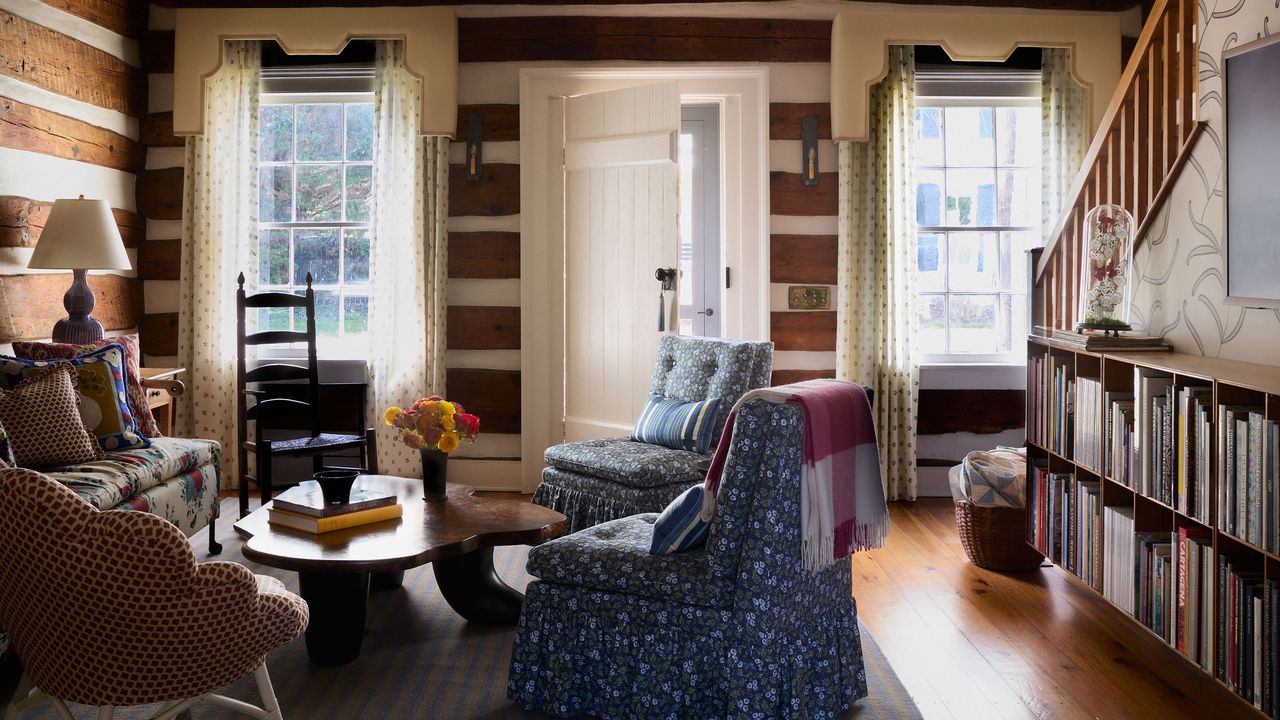
Melissa Colgan turned what was formerly home to the county doctor into a pattern-packed escape for her familyThe family room of designer Melissa Colgan and Daniel Schned's Sperryville, Virginia farmhouse. To combat the dark, heavier nature of the room’s exposed beams, pine floors, and log walls, Colgan looked to her window treatments to maximize light. “I wanted a brightness,” she says of the sheer fabric she selected from Décor Barbares. “I gave it a bit more structure and presence by adding the valances.” The architecture is by Mortar & Thatch, the construction is by Hampton Massie Construction, and the millwork is by Trails Trim.In the foothills of Virginia’s Blue Ridge Mountains, just minutes from Shenandoah National Park, the town of Sperryville (population: 350) still feels like a well-kept secret. In recent years, it’s attracted the eye of Washington, DC–based designer Melissa Colgan of Melissa Colgan Interiors, who purchased a weekend home there in 2023.Though born in the Midwest, the designer and her husband, Daniel Schned, moved to DC in 2016 and spent their early years and weekends exploring the surrounding countryside. “One of the areas we fell in love with is Rappahannock County,” she says of discovering its scenic pastures, rolling hills, and grazing cows. “It feels a world away from DC.”In 2020, the couple eloped at The Inn at Little Washington and began looking for a vacation home in the area. Three years later, they found a listing for an 1830s farmhouse and barn, which happened to be the former home and office of the county doctor. “It’s a very special house in Sperryville because it’s where the doctor saw all his patients in the early 1900s,” Colgan says.What began as an 1830s single-room log cabin evolved to include a barn and second story in the 1890s, followed by another addition in the late 1990s. “A lot of the original details were still there,” Colgan says of the 1,200-square-foot residence. “We just wanted to freshen things up a bit.”In the family living room, the windows, along with the original chink log siding, date to the 1830s. “I wanted to lean into some of the depth that was already there,” Colgan says of her color palette. “That prompted me into the world of deep reds, ochres, and blues.” In a cozy corner, a Casamidy chair covered in soft mohair flanks a Swedish Gustavian oak secretary from the 1800s. Colgan solicited the help of DC architect Alexander Smith of Mortar & Thatch. “The thing we aligned with from the very beginning is we didn't want it to feel like a new renovation,” Smith says. “Maybe we slapped on some paint or got new countertops, but we didn’t want it to seem like we were implanting foreign ideas.”The biggest task was subdividing the single bedroom upstairs to accommodate Colgan’s growing family. At the time, she was pregnant with her now two-year-old daughter. “We basically took down the walls of the one bedroom, made a middle bedroom for our daughter, then eked every inch we could in order to fit a king bed and built-in closets in our room,” she says. The result is a quaint and colorful two-bedroom blueprint, with dappled light dancing through the street-facing windows.In the pocket-size half bath, an American Federal mahogany mirror broadens the space, which is wrapped in Iksel Mogul Berry Wallpaper by Schumacher and adorned with an oil painting by Jay Harper. Incorporating open shelves in the kitchen helped maximize storage while enabling the designer to showcase more of the home’s attractive chink log siding. Farrow & Ball’s Terre de Egypte paint accentuates Colgan’s collections of splatterware mugs and vintage objects, like an early-20th-century painter’s palette. Today, they spend most of their time in the living room downstairs, with its original chink log siding from the 1830s. “The room is so soulful. You just walk in and take a deep breath,” she says. “The thing that came to mind early on was a little Russian country house or dacha. When we first saw the listing, we were in Switzerland, so that was the original seed for the design.”Drawing from the warmth and depth of the living room’s original pine floors and log siding, Colgan conjured a rich color palette of ochres, reds, and blues with botanical and floral-patterned fabrics that mirrored the pastoral landscape. “We’re surrounded by mountains and flora and fauna, so I wanted the house to reflect that as well.”A brisbee curtain in Lake August’s flowering Nasturtium fabric adds light and whimsy to the kitchen’s neutral cabinetry. The furnishings are an array of old, new, and local finds from their 1920s French fruitwood dining table to the early American rocking chair salvaged from Ruckersville Antiques. “We didn’t really have anything for this house because the style is so different from our city home, so we had to start from scratch,” Colgan says. Still, the designer is an avid collector and had some pieces sitting in storage like the BDDW sofa, purchased at auction, that’s now in her living room. Currently, it’s upholstered in Décors Barbares’ lively Roses Tchékhonine print, with winged butterflies flitting across a canvas of cobalt and crimson flowers.In the primary bedroom, every inch mattered. “We did multiple layouts and wanted to make sure the details, finishes, and everything in there was an appropriate scale so things didn’t feel too big or too small for the space,” says Smith. The walls and his-and-her closets are painted in Farrow & Ball’s Pink Ground and Eating Room Red, with Roman shades done in a Lucrezia fabric by Fortuny. An acrylic and ink work on paper by artist Julie Wolfe, which Colgan gave to her husband for their first wedding anniversary, hangs over the bed. In the sunlit bathroom, blue and white garden tiles from Marble Systems bloom alongside fittings by Waterworks, D Porthault patterned towels, and an antique French mirror, circa 1785. Other spaces, like the mudroom and laundry located near the home’s side entrance, were made more welcoming and useful, with cupboards dressed in wholesome, hay-colored gingham skirts. Reconfiguring appliances and adding cabinets and open shelving helped optimize the kitchen’s storage and traffic flow. “We were able to inch out so much in such a small space,” Smith says.Despite its demure size, the house today is a sensory retreat for the couple. “That first Thanksgiving was a real stress test,” Colgan says. The barn in the back, where the doctor kept his horse for making house calls across the county, was renovated by the previous owner to include a kitchenette, an open living room space, and sleeping quarters. “The barn had pigs in it up until the last owner, and he renovated it,” she says. “I’ve since layered in a lot of fabrics and antiques.”Ultimately, however, it was the historic farmhouse where Colgan concentrated her creative energy. “A lot of times people come into these old houses and instead of trying to think carefully about how to make modern life function there, they blow out walls and make everything open,” she says. Instead, she champions her home’s nuanced details, including planks of weathered wood that have patinated over time or the way sunlight shimmers off the 19th-century windows, with their panes of wavy glass. “They are very much not energy efficient,” she says, “but they are absolutely beautiful.”On the front porch, a five-piece set by Newell Jacobsen is upholstered in a sky-blue Lisa Fine Madras Performance fabric that complements the painted ceiling, and the neighbor’s vibrant home. “There are some fun houses on our street—the one across the street is yellow,” Colgan says. “I liked the idea of colors out there being a little brighter.” Not a subscriber? Join AD for print and digital access now.Sign up for our daily newsletter to get the best of design in your inbox.
This DC Designer’s Nearly 200-Year-Old Virginia Farmhouse Flourishes With Detail and History
Full Article
Original Source
Read the full article at Architecturaldigest →KhanList aggregates and links to publicly available news content. We do not host full articles from third-party sources. Always verify important information with original sources.