
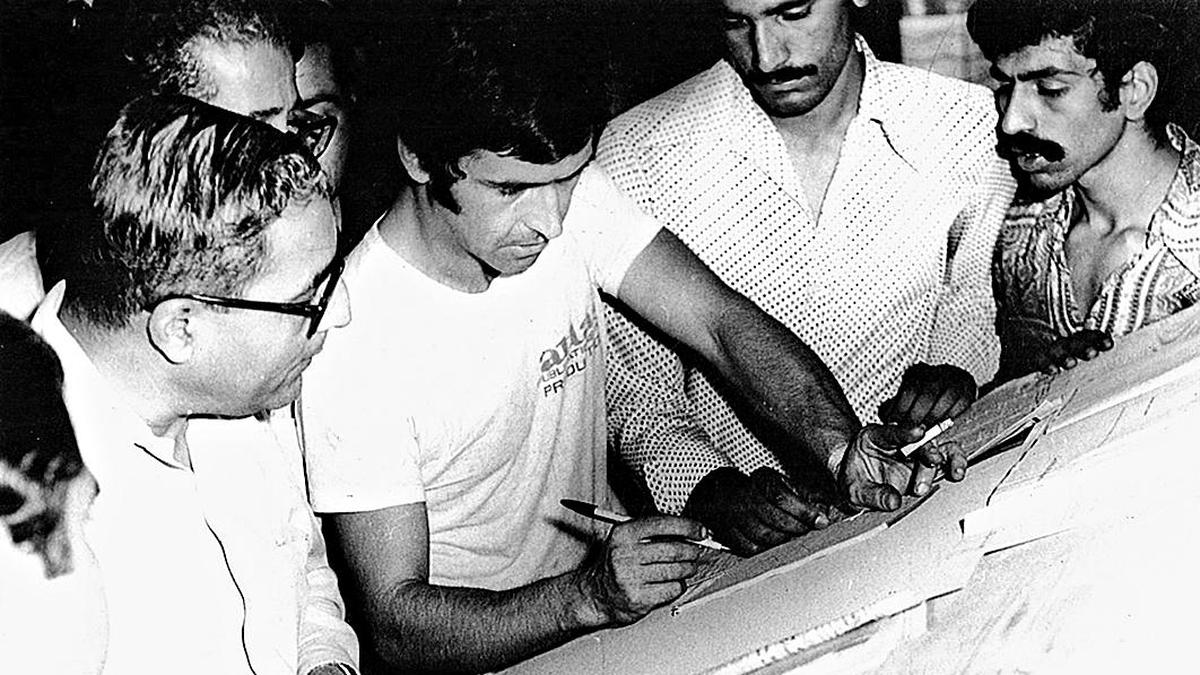
A French engineer setting up the massive offset printing machine in the presence of the then Editor G. Kasturi at the printing press in Hyderabad in 1976. | Photo Credit: THE HINDU ARCHIVES For 76-year-old R. Sekhar, September 3, 1976, remains a memorable page in his life — the night he worked to bring out the first edition of The Hindu printed in Hyderabad, from its new office on Begumpet Public Road. It was also a marker of a printing revolution. The rotary press was giving way to modern four-colour offset printer.“I remember the print run for the first edition was 29,000,” recalls Mr. Sekhar. For Hyderabad, then a city with a population of only a few lakhs, the figure meant that a substantial section of its well-heeled citizens could get hold of the newspaper. The test runs had begun days earlier, on August 20, when the new press was first put through its paces. Mr. Sekhar had begun his career with ITC in Madras before moving to Hyderabad after The Hindu posted him to the city.At the time, The Hindu had three other editions — Madras, Bangalore and Coimbatore. Hyderabad became its fourth. The decision to set up the office at Begumpet was almost a one-day affair. “I and the Chief of Bureau, Rajendra Prasad, went around four sites and identified this one, which was owned by G. Pulla Reddy, just opposite the Blue Moon Hotel,” recalls 87-year-old K. C. Rangaswamy, who was then the newspaper’s Business Representative and had been transferred from Bombay.“One day in January 1976, Mr. G. Kasturi landed at Begumpet Airport. He checked out the other sites at Lakdi-ka-Pul and Malakpet and finally decided on the Begumpet site. Once he gave the nod, Mr. Pulla Reddy reached the place within half an hour with a box of sweets. Another half an hour later, architect B.N. Reddy arrived. He declared the site had perfect vastu. And so it began,” he says.On the day of the launch, a tent was put up at the Begumpet office for the inaugural function. But September, rain and Hyderabad have always gone together — and so it was on the big day. It poured, flooding the open space in front of the Begumpet office, much as heavy rain does even now. The tent offered limited protection, and the dignitaries had to carefully walk over stones laid out to reach the office. But the rain did little to dampen the spirit of the occasion.“Hyderabad had always been a city of great culture and refinement and it was now rapidly developing into a large industrial and commercial metropolitan complex. This project of The Hindu will be part of this great development,” Chief Minister Jalagam Vengal Rao said at that time. The words that can even now be echoed by the present Chief Minister A. Revanth Reddy about Hyderabad being at the cusp of a great leap forward. The launch of The Hindu in Hyderabad was linked to high expectations from the readers.“Till 1958, we supplied the dak edition in Hyderabad (an early edition unlike the city edition). Nobody knew about it. Then we missed the story of Imre Nagy’s assassination and the readers grasped what was happening. Later, The Hindu began distribution of copies by air,” recalls Sadagopan Sampath, whose family was the newspaper’s distributor for 58 years. “I would go to Mahbub College for my studies, pick up the copies at the airport and take them to Basheerbagh,” he says. Basheerbagh was then the hub of The Hindu’s distribution network in the city. “We were staying near the ESI Hospital in Ameerpet and would walk down to the office. We were all young people and bachelors. The road became deserted by evening,” remembers Sekhar who worked in Hyderabad till his retirement in 2010.There were just two cars and three scooters belonging to the small editorial staff.For the launch team that arrived from Madras, however, Hyderabad presented another challenge — language. “None of us knew Hindi or Telugu. So when the rickshaw pullers asked us for adhai rupiya (₹2.50) to go to Charminar, we didn’t understand and sometimes gave them more money than necessary,” Mr. Sekhar recalls with a laugh.The language barrier was not confined to the Madras-based staff.For the Hyderabad launch, The Hindu had acquired a state-of-the-art press from France, manufactured by Creusot-Loire. A French engineer arrived to install the massive offset machine and stayed at the Blue Moon Hotel. The modest scale of the operation was reflected in the office parking lot. The Hindu requisitioned the services of an Osmania University student, Eswar Reddy, to work as the engineer’s translator. By August 20, 1976, the press was ready to roll.The new web-offset printer was among the early machines of its kind in the country. It used a continuous roll of newsprint and printed directly on it, unlike the earlier rotary presses that relied on separate sheets. True to its quality of early adoptees of technology, part of this story was transcribed using an AI note taker.(serish.n@thehindu.co.in) Published - September 04, 2026 05:30 am IST
This day, that age, and a few memories
Full Article
Original Source
Read the full article at Thehindu →KhanList aggregates and links to publicly available news content. We do not host full articles from third-party sources. Always verify important information with original sources.