
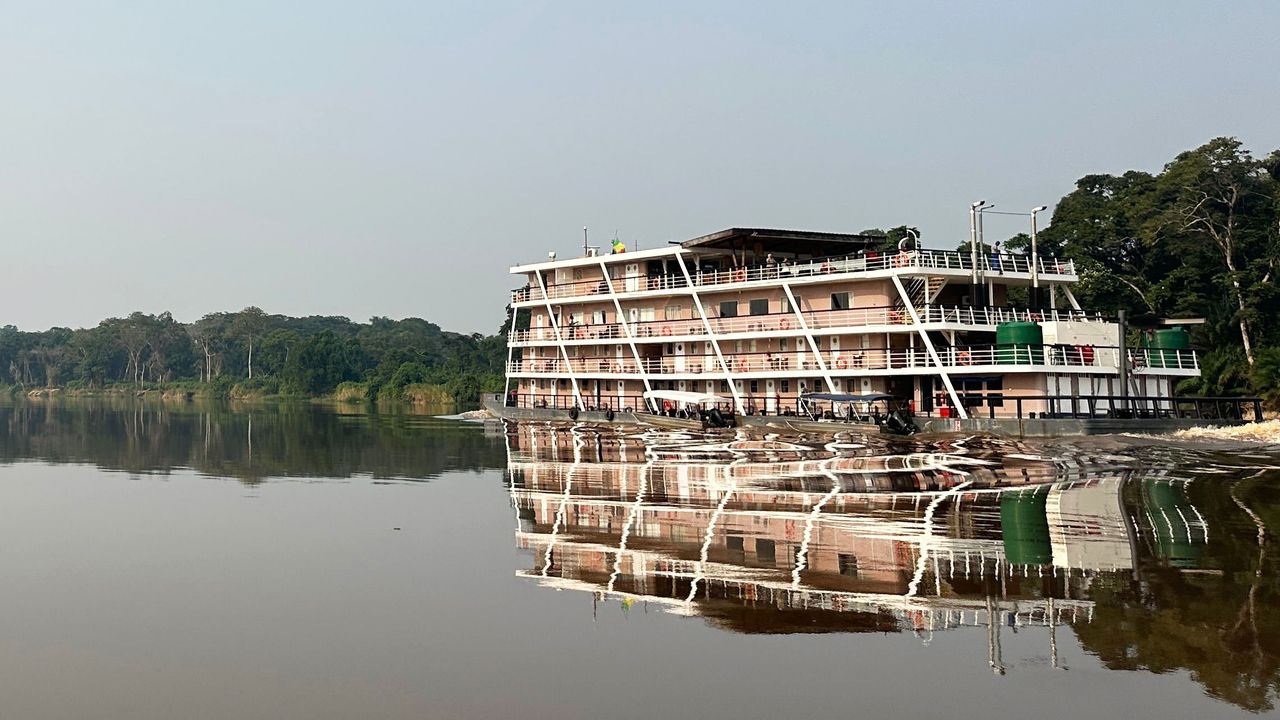
Occasionally, a place will take hold of our collective imagination in much the same way that an unsolved mathematical problem does, or a treasure hunt, or an ancient, coded message found moldering in an attic, beguiling with its mystery, difficulty, and promise of a reward. Few places exert quite this pull like the Congo Basin, a thick block of forest and rivers covering much of Central Africa, home to some 150 ethnic groups, and a raft of extraordinary biodiversity. Despite its size and its importance as a counterbalance to climate change, the region endures a dearth of scientific research funding and conservation efforts. Roughly the size of India, it has inspired and vexed many visitors (even those who might otherwise have claimed to have conquered it).A floating village in the Congo River Basin Expeditions DucretThe idea could be said to originate in the late 19th century, as Europeans made their way into the great forests seeking fortune and glory. The Welsh explorer Henry Morton Stanley, the first to leave a detailed record of his journey across the Basin, claimed that even after a three-year trek (1874-77) it remained “a region of fable and mystery.” That was exactly the mix sought by Polish sailor Józef Korzeniowski, who, as a boy, looked at the map of Africa, then a white space, and “declared that some day I would go there.” Eventually, and not long after Stanley, he did, and with the captaincy of a steamboat on the Congo River, was tasked with collecting one Mr. Klein, an upcountry agent employed by the brutal Belgian trading company. Korzeniowski was horrified by what he saw along the river—colonization and resource extraction at its cruelest and bloodiest—calling it “the vilest scramble for loot that ever disfigured the history of human conscience and geographical exploration.” Later, Józef Korzeniowski became Joseph Conrad, Mr. Klein became Mr. Kurtz, and the rest is literary history.Dzanga Baï, a protected area in the southwestern Central African Republic also known as “the village of elephants.” Expeditions DucretThe latest journeyman to apply themself to the region is another Welshman, Ash Dykes, whose TikTok videos of his journey paddling down the Sangha River (a tributary of the mighty Congo River) have received millions of views. By mid-October, Dykes, who calls himself an extreme athlete, was midway through the 400 miles he hoped to cover. His videos—the anxiety and speculation of his preparation; the amplification of the danger en route—are over-exaggerated, designed to amuse his audience; they are spectacle. Looking bewildered in his state-of-the-art inflatable boat, Dykes is most often met by competent, unaffected locals, paddling their wooden pirogues with balletic grace. And brave though Dykes certainly is, most of what he has accomplished—attending a hunt with the Ba’aka people, seeing the forest elephants in Dzanga Baï, or tracking Western lowland gorillas—can be done by just about anyone.The Princesse Ngalessa, a multi-level riverboat operated by Ducret Expeditions, is the basin's only passenger cruise. Expeditions DucretI, too, was one enchanted by the inscrutability of the Congo Basin, and I dreamt of one day traveling along its rivers and into its forests; in my mind’s eye, I envisioned dusk slipping into night, to the rhythm of a pounding drumbeat. Not long ago, I departed Brazzaville, the capital of the Republic of Congo, aboard the Princesse Ngalessa, a multi-level riverboat operated by Ducret Expeditions. As the only such passenger vessel in the Congo Basin, the crew of the Ngalessa is accustomed to receiving rarefied looks from the riverbank. But just as often, the ship’s approach was greeted with aplomb, for it was an event in the villages and brought goods, along with community support and news from away.The cabins aboard the Ngalessa Expeditions DucretThe ship's observation deck Expeditions DucretIn comparison to the coarse and crowded daka-dakas—flat-topped river barges, stuffed with goods and spewing black, acrid smoke as they chunter between Kinshasa and Kisangani—those of us onboard the Ngalessa traveled in glorious comfort: air-conditioning, three square meals a day, and private bathrooms. We also had the benefit of our local guides and their familiarity with the languages, customs, and faces up and down the river. This included, in the riverside village of Ngabe, the appearance of an Ejengi, a forest spirit made of palm fronds that danced and spun as a crowd of onlookers sang, drummed, and screamed in delight.“Don’t worry,” our guide said. “Look at his dusty bare feet!” Elsewhere, we watched an Indigenous Luma woman cut, strip, and chew twigs into a pulp that could be used as medicinal pain relief. On other days, we kayaked through the flooded forests of the Alima River, and traded with fishermen who brought their slim pirogues against our mammoth ship to hand over smoked fish and fruit.Kayaking through the flooded forests of the Alima River. Expeditions DucretEight days and 600 miles after leaving Brazzaville, we arrived at the outpost of Ouesso on the Sangha River. I journeyed further upon that water by launch boat, into the Central African Republic, and spent days at Sangha Lodge, drinking gin and tonics with local legend Rod Cassidy, an eco-tourism pioneer who has spent years living and working with the local Ba’aka people. It was through him I had the good luck to attend a hunt with those same Ba’aka, and to look on while they divvied up the duiker they snagged in their homemade nets. Afterwards, they whooped and hollered as they carried the meat out and into their village—a feast!In the heightened state of travel, there comes occasionally a moment like falling into an empty space and, as two glancing stones can spark a blaze, a light of comprehension is illuminated. Sometimes this moment manifests itself as love, other times as admiration, or confusion. Conrad left the Congo in spiritual, psychological, and physical shock. “Before the Congo, I was a mere animal,” he wrote after his consequential journey. He was changed, as travelers who go forward with their ears and eyes open (to say nothing of their hearts) are changed. Watching the Ba’aka poised in their hunt, ears tilted to the slightest sound, I felt myself see humanity as it had existed since time immemorial. As they laughed and chatted on their success, the women showing their fangs (chipped with rocks as a show of strength), and the men slapping each other on the back, I could barely remember seeing such happiness elsewhere.The Congo Basin may still be raw and atavistic—great adventures there are still possible—but it is no “heart of darkness” (a title which for Conrad lay not in the location itself, but rather mankind’s ability to exploit and vilify others). What separates it from other places is its independence. It requires protection, yes, but has no need, and few provisions, for any prying visitors; it is not a prize to be conquered. Most incredibly, it remains the home of peoples who have not yet latched themselves to tourism; people who sustain themselves almost wholly from an expanse of forest and the waters that for others can only be the basis of wonder and amazement. And yet, after all the sorrow and misery that colonialism brought to the Congo Basin, the people remain sincere and earnest, and willing to show others the best of their land.A lone kayaker glides underneath a hazy sky. James PattersonOne night, as the Ngalessa drifted northward, from beneath the awning on the ship’s upper deck, I watched a cloud bank clump and darken. Finally, with an incision of lightning, the downpour came, brief but fierce. The sun returned, low in the sky but still warm, and the scent of damp earth rose up. A patter of drumming reached us from somewhere, before being swallowed by the forest. The dinner bell rang, and I thought I never want this trip to end.
This Cruise Proves the Congo is No Heart of Darkness—Or Viral Fad
Full Article
Original Source
Read the full article at Cntraveler →KhanList aggregates and links to publicly available news content. We do not host full articles from third-party sources. Always verify important information with original sources.