
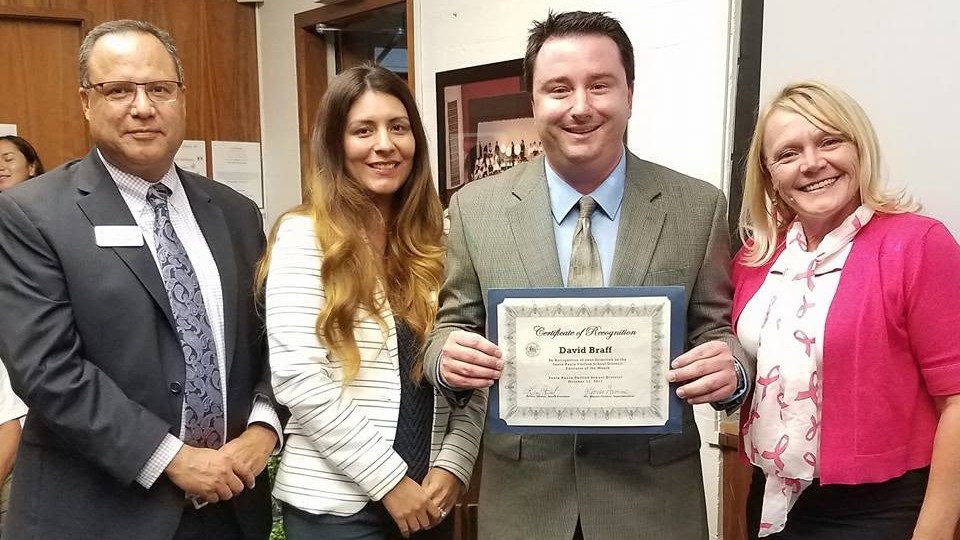
Reporting Highlights Licensed Until Charged: Three educators who were reported to the state for alleged misconduct were allowed to keep working — and to draw new complaints — until they were criminally charged. Incomplete Investigation: One was reported for allegedly touching children inappropriately in 2019. California didn’t suspend his credentials until his 2024 arrest. Lack of Guidelines: California’s educator licensing agency provides no guidelines to the volunteers who review teacher misconduct cases for determining when and how to mete out punishment. These highlights were written by the reporters and editors who worked on this story. Five years before police arrested former elementary school counselor David Braff for allegedly sexually abusing students, complaints had already been sent to the state of California: that Braff had sat students on his lap, rubbed their legs and touched them near their vaginas. But California’s educator licensing agency failed to conduct a thorough investigation after his school district reported Braff to the state in 2019. And the agency allowed Braff to continue working with children. It wasn’t until his 2024 arrest that the agency suspended his credentials. By then, he’d gotten jobs at three more Southern California schools. At one of them, prosecutors allege, another student complained the guidance counselor had touched him, too. The state Commission on Teacher Credentialing also delayed revoking the credentials of two other teachers who were later convicted of sexually abusing students. As with Braff, schools had reported those educators to the agency that determines who can work in California’s public schools. And as with Braff, the commission allowed those teachers to keep teaching — and draw new complaints — until after they were criminally charged, an investigation by KQED and ProPublica found. That includes a middle school math teacher who sent his student a video showing a boy’s genitals and an elementary teacher who touched students’ butts and vaginal areas and placed their hands on his crotch, according to court records. In each of the cases, state investigators did not interview some of the students who had alleged abuse, according to the students, parents and attorneys who spoke to KQED and ProPublica. Several former agency staffers, including investigators, told the news outlets that, at times, the volunteer panel tasked with assessing teacher accusations overlooked evidence of wrongdoing. That perspective from staff members was backed up by two former members of the panel and two people who served on the state commission that ultimately decides teacher discipline. After police arrested Braff in 2024, a parent emailed Jeffrey Weinstein, superintendent at Santa Paula Unified School District, where Braff was first accused of sexually abusing students. “Who dropped the ball and allowed this monster to still be around kids?” the parent wrote, according to public records obtained by the news outlets. (Weinstein was not working at Santa Paula at the time students accused Braff.) In his emailed response, Weinstein blamed the state’s teacher licensing agency. He told the parent that the district had conducted its own investigation and reported the guidance counselor to the state as well as to police. He also said he had reviewed the district’s investigative file and “vehemently disagreed” with the agency’s decision not to revoke Braff’s credentials. “We sent all the evidence we had gathered,” Weinstein said. “The district did everything in its legal capacity it could.” Braff is soon to stand trial for sexually abusing 15 students, including 13 from Santa Paula. He has been in jail since November 2024. He has pleaded not guilty and did not respond to a request for comment sent through the Ventura County Sheriff’s Office’s electronic messaging system. His attorney declined to comment. Braff had previously told Santa Paula Unified administrators that he did not touch students near their private parts or have them sit on his lap — and that he only gave students side hugs, high-fives, fist bumps and taps on the knee, according to the district’s 2019 report to the state. “Mr. Braff described keeping an office environment where kids can move around; and he would not be closer than arm’s length,” the report said, summarizing the district’s interview with Braff. “It was not his intent to make them afraid but rather feel that there was someone in their corner; someone to talk to.” The Santa Paula Unified School District recognized guidance counselor David Braff as employee of the month in 2017. The district reported him to the state for misconduct two years later. Santa Paula Unified School District via Facebook Anita Fitzhugh, a spokesperson for the Commission on Teacher Credentialing, said the state automatically revokes teachers’ credentials when they are convicted of sexual criminal offenses. But she wrote in a statement that “unless the applicant or educator is convicted of a mandatory criminal offense, there are no written criteria that set the level of adverse action for educator discipline matters.” She did not answer questions about specific cases or details of the investigative process. Fitzhugh said the state does not provide any guidelines for those reviewing teacher misconduct cases about when discipline is warranted or the type of punishment that should be meted out. And she said it was the commission’s role to balance “protecting students as well as the legal rights of educators who have been accused but not convicted.” California’s system of disciplining educators dates to the 1970s, Fitzhugh said, and “a deep and comprehensive review of the educator discipline system, prioritizing student safety in the schools, is in order.” “We expect the Commission to take this up in the near future,” she said. Students Not Interviewed In the summer of 2019, California’s Commission on Teacher Credentialing received a detailed report from the Santa Paula school district about Braff’s alleged misconduct at McKevett Elementary School. The state requires districts to report educators when they resign or are fired after allegations of misconduct. Braff, who had been a guidance counselor at the school for four years, had resigned in the midst of the district’s investigation into complaints by at least seven students that he had touched them inappropriately. The district told the state agency that it had contemplated but did not initiate any discipline against Braff before accepting his resignation. The district said it appeared, based on student interviews, that Braff “had engaged in at least inappropriate conduct.” Its report to the state, submitted two months after he resigned, included a 20-page summary of the principal’s interviews with at least seven accusers and two witnesses. It also included Braff’s defense and noted multiple inconsistencies in his account of what had occurred. One fifth grade girl said that during a visit to his office, Braff had locked the door, grabbed her by her hips and forced her to sit on his lap, according to the district’s report to the state of its investigation. She said she did not like being touched and cried every time she had to see him for counseling. The girl requested to transfer to another school, district investigators said, because she wanted to “be away from” Braff. Two other girls alleged Braff touched them near their “privates,” the district reported to the state. Neither girl was aware of the other’s claim. One of them, a fourth grader, told the principal that she had been meeting regularly with Braff for counseling since second grade. During those visits, he would make her sit on his lap. She told the principal that Braff tapped her on the leg with his hand “in a way to try to make her feel like she was doing a good job,” but she said the tapping hurt. After two school years of regular counseling, she alleged he started tapping her higher on the thigh, close to her “private.” In contrast, she said a different teacher pats students on the head when they do a good job, according to the district’s report to the state. The girl, who is now 18, spoke to KQED and ProPublica with her mother and attorney present on the condition that only her first initial, J., be used to protect her privacy. J. said Braff had told her that whatever happened in his office was a secret. She said she had few friends at the school and was terrified of getting in trouble when she reported the person she confided in. A handwritten statement submitted by one of Braff’s student victims in 2018. Santa Paula Unified School District The district’s report to the state included notes from an interview with J.’s former principal, Lydia Olivo, who had left the school before J. and other students complained about Braff. Olivo told Santa Paula investigators that J. was “not always honest,” the report said. Olivo described Braff as a reliable employee who had strong relationships with parents, staff and students. She “seemed surprised that any of this could have occurred while she had been Principal at McKevett,” the district’s report said. Olivo did not respond to calls, emails and texts seeking comment. During the district’s investigation, Braff acknowledged touching students on the knee. “He explained if someone is crying, he taps on the knee to say they are doing a good job to get the sad feelings out,” according to the district’s report to the state. “When asked to demonstrate, Mr. Braff showed a slap on his own knee.” Nonetheless, the educator licensing agency appears not to have attempted to reconcile the very different accounts of Braff’s behavior. Informed of Olivo’s characterization of her complaint, J. and her mother told KQED and ProPublica that no one at the state agency had called to ask them about it or sought to verify any details, even though the district’s report to the state included J.’s contact information along with that of the other students. “If a little girl comes up to you and says something, maybe you should not say that they’re a liar,” J. said. “They should interview students themselves and not just rely on the school district. Do a legit investigation,” said J.’s mother, who did not know that the state had decided not to discipline Braff until the news outlets alerted her. Fitzhugh, the spokesperson for the teacher credentialing agency, did not answer questions as to why J. was not interviewed or whether anyone else was. The case was assigned to a staffer whose job description did not include interviewing victims. At least one other student who had reported Braff for touching her inappropriately also told KQED and ProPublica that no one from the state contacted her about her allegations. A former agency investigator, who reviewed the district’s report to the state at the request of the news outlets, said she believed the students’ accusations because the district’s investigation described multiple children making similar claims. She also noted the contradictions in Braff’s responses. Cases involving allegations of inappropriately touching students should always be assigned to investigators trained to interview victims, she said. “Any claim of sexual misconduct should go to somebody who’s going to be making phone calls,” said the investigator, who spoke on the condition of anonymity to protect her current job. “This man is grooming these children. There’s no other way to look at it to me. Their stories are credible.” Per state law, the agency staff assigned to look into Braff’s case did not make recommendations about whether or how to discipline him. That recommendation is left up to a little-known group of volunteers who meet monthly at the agency’s Sacramento headquarters to weigh reports from state investigators, school districts, police and others. That volunteer panel sends its recommendations to the 19 commissioners of the credentialing body, most of whom are appointed by the governor. If the panel does recommend discipline, the commissioners have the final say. However, if the panel decides that no punishment is warranted, the commissioners do not review that case. Two former investigators at the state agency told the news organizations that the panel’s recommendations did not always align with the evidence they found. “Sometimes, as investigators, we’ll see the recommendations, and we’ll be like, ‘What the hell happened here?’” one former investigator said. “I Was Consistently Shocked” Over three days in December 2020, during the height of the COVID-19 pandemic, members of the volunteer panel, known as the Committee of Credentials, dialed into their monthly phone meeting to address 198 cases of educators accused of misconduct. Among them was Braff, who by then was working in another school. The volunteers included a retired law enforcement officer, a school board member, a school administrator, an education consultant and several teachers. They had been selected by the commissioners for two-year terms. State regulations give the volunteer committee broad latitude when assessing allegations of teacher misconduct and recommending discipline to the commission. Unlike jurors in a criminal trial, who need to believe a case is proven beyond a reasonable doubt in order to convict, the committee only needs to find “probable cause” before recommending a reprimand, a far lower standard. “It’s where a normal and reasonable person would feel that there’s a chance that this person did this,” said Steve Thorpe, the former law enforcement officer who served on the committee when Braff’s case was reviewed. “It’s a low threshold. You know it when you see it.” He declined to comment on Braff’s case. The fact that Braff’s case was not forwarded to the commissioners, former committee members said, meant the majority of the seven-member panel did not see enough evidence in the district’s investigation and the state’s report to discipline Braff. One former committee member, who spoke on the condition of anonymity for fear of repercussions from the teacher licensing agency, said she tends to scrutinize district investigations because administrators can misrepresent the facts or ask children leading questions. Another former committee member who served during the Braff case said that they were generally alarmed to hear some fellow members dismiss children as unreliable sources. The person, who declined to comment on Braff’s case, spoke on the condition of anonymity because they feared professional repercussions. The Committee of Credentials, a volunteer panel, met in March 2026 to review cases involving alleged educator misconduct. A version of the committee met by telephone in 2020 to decide on Braff’s case. Beth LaBerge/KQED “I was consistently shocked,” they said. “To have committee members discuss serious allegations as, ‘Well, you know how girls can be. They say all kinds of things they don’t mean,’ is an unacceptable, antiquated point of view. What if we get this wrong? Who are we allowing in the classroom?” By the time the committee decided against recommending punishment for Braff, he had already been working as a counselor at a different elementary school in Los Angeles for more than a year. (A former student at that charter school would tell police after Braff’s 2024 arrest that the counselor had touched the boy’s thigh near his groin when the two met in his office, according to a court transcript from his criminal case.) In 2022, nearly two years after the state closed Braff’s case, a school administrator reported to the district that one of the girls who had accused Braff of abuse continued to suffer severe anxiety and could not be in rooms alone with men. Another had attempted suicide multiple times and spent a year in residential treatment, she wrote in an email obtained by KQED and ProPublica. In his response, an assistant superintendent informed the administrator that the district had previously filed with the state to have Braff’s credential revoked or suspended but the agency chose not to do so. “At this point, I think pursing this matter legally is the best way to address these issues,” he wrote, referring to following up with Santa Paula police. Santa Paula administrators did not respond to requests for comment. Two Additional Cases KQED and ProPublica identified at least two other educators who, like Braff, were reported by their school districts to the state for sexual misconduct but were allowed to keep teaching until they were criminally charged. Each would draw additional allegations of sexual abuse. As in the Braff case, the volunteer committee in these two cases evaluated much of the same evidence as police, including complaints detailing students’ experiences. And in both cases, investigators with the teacher credentialing agency did not interview some victims. In one, a Southern California school district shared with the state agency screenshots of messages that middle school math teacher Brashawn Washington had sent to his 11-year-old student, who he regularly contacted through the video game Fortnite. Those messages included a TikTok video showing another boy’s penis. (At his trial, Washington told jurors that he did not send the video to his student.) The Romoland School District also shared with the state screenshots of Washington’s Google Hangouts chats asking the student if he worked out, calling him “guapo,” or handsome, and sending him kissing emojis. The boy’s mother had provided the screenshots from her son’s phone to the school in May 2020, according to public records obtained from Romoland. The school district promptly alerted police and began its own investigation, filing a report to the teacher credentialing agency that summer, district records show. The district included in its report the mother’s contact information, records show. But neither the student nor his mother were interviewed, the mother told KQED and ProPublica. Fitzhugh, the credentialing agency spokesperson, did not answer questions about how state investigators decided who, if anyone, to interview. A Romoland administrator who said the district shared the screenshots with the state as part of its report did not answer questions about the state’s response. Washington resigned during the school’s investigation and soon got hired at Pasadena High School starting in the fall of 2020. Washington, teaching virtually at first during the pandemic, continued messaging students over Fortnite despite district policy prohibiting personal contact with students. He had been teaching there for seven months when the volunteer committee recommended a 21-day suspension in March. (Commissioners did not approve the suspension until after school let out.) State law did not require Washington to notify the Pasadena school district of the recommended suspension. Nor did the teacher licensing agency have to alert his new employer of any discipline if it did not know where he was employed. Just as his suspension was set to begin in July 2021, Washington was arrested — and the state suspended his credentials indefinitely. Brashawn Washington at Pasadena High School in April 2021, during his first year as a math teacher there. He had resigned from the Romoland School District in the year prior after a sexual misconduct investigation. Sarah Reingewirtz, Los Angeles Daily News/SCNG The next year, while out on bail, Washington sent a Pasadena High student images of himself having oral sex with another man, among other messages, according to court records. At Washington’s 2024 criminal trial, that student testified that the teacher had also asked him to share naked pictures of himself when he was 16. Washington told jurors that he did not know the student was a minor. He was sentenced to eight years and eight months in prison for multiple sex offenses, including “annoying or molesting” the Romoland student by sending him the video, as well as producing and possessing child sex abuse material related to minors who were not his students. A spokesperson for Pasadena Unified did not respond to questions regarding Washington’s hiring or the state’s recommended discipline, but said in a written statement that the district conducts background checks during the hiring process. Both Washington and his former attorney declined to comment. A similar pattern unfolded with a San Francisco Bay Area elementary teacher, Matthew Shelton, who was convicted of sexually abusing four students last month. Shelton had first been arrested in 2007 on charges of sexually abusing students in Napa Valley. Three third-graders had told police he touched their butts or crotches, or made them touch his penis during class. Shelton was acquitted in that case, but the state’s licensing body did investigate the claims. At the time, Shelton told state investigators that the students had made up the allegations and that he passed a polygraph test, which he had obtained himself. Two of those former students told KQED and ProPublica that state investigators never interviewed them. The agency did not respond to questions about why the students were not interviewed. Matthew Shelton was convicted of sexually abusing four students. Gina Castro/KQED In 2008, the licensing agency issued Shelton a confidential written warning, which was expunged after three years, according to trial testimony. That decision meant Shelton was able to keep teaching for the long term; he had already begun a new job in nearby Benicia. Years later, in 2022, students began accusing Shelton of touching them inappropriately. The Benicia school district and a student’s parents reported him to the state commission in 2023. More students came forward and told police that Shelton had touched their crotch or butt over their clothing; one student said he made her touch his penis when she was in first grade during a school field trip. Shelton resigned but quickly got a job at another school. As with the other cases, the new school said it had no information about the ongoing investigation. It also had no knowledge of his earlier warning, which had been expunged more than a decade earlier. This time around, however, things unfolded differently: While the state did not alert the new school about any problems, a parent did. In September, just weeks into the school year, Shelton’s new employer learned from a Benicia parent about the active police investigation as well as the earlier issues in Napa. Shelton was immediately put on leave. In February 2024, prosecutors charged him, requiring the state licensing agency to automatically suspend his credentials. Unlike in Napa, the agency revoked his license in July 2024 without waiting for a conviction. Shelton did not respond to requests for comment, and his attorney declined to comment. He is due to be sentenced in December. Benicia Superintendent Chris Calabrese declined to comment on Shelton’s hiring. There are significant repercussions when the state fails to take disciplinary action. For one thing, it means that other schools receive no indication of a problem. A red flag typically appears next to an educator’s name in a public database when they are punished by the Commission on Teacher Credentialing. But no such warning appears when a teacher is fired or forced to resign without state discipline, leaving their potential future employers in the dark. Nor would a confidential warning letter like the one Shelton received result in a red flag. California lawmakers have tried to address the gap, but their efforts failed. Student victims, too, suffer long-lasting damage. A handwritten statement from one of Shelton’s victims says he touched their waist during hugs and put his hand on their upper thigh, making them uncomfortable Obtained by KQED and ProPublica One of the students who accused Shelton in Napa told KQED and ProPublica that for years she wished she hadn’t reported him to anyone because she and her classmates were characterized as liars after “we poured out so much.” “It could’ve been stopped with us, but it wasn’t,” she said. “They didn’t believe us.” In Braff’s case, the Santa Paula Unified students who had accused him of abuse continued to struggle in school as their former counselor kept getting new jobs in education. J. told KQED and ProPublica that for years she avoided acknowledging what Braff did to her. “I couldn’t place where all these emotions were coming from. I was blaming everything else except the actual problem,” J. said, referring to the abuse by Braff. “I didn’t want to live anymore.” J., now a high school senior, has been homeschooled by her mother for almost three years. She said she still has nightmares in which Braff yells at her for “telling on him.” And she has long faced doubts from others about her account of what happened to her in elementary school. A few years ago, she recalled, a former classmate told her: “Why would they let him go work somewhere else if he did that to you?”
This Counselor Faces Trial for Sexually Abusing 15 Students. California Has Been Warned About Him for Years.
Full Article
Original Source
Read the full article at Propublica →KhanList aggregates and links to publicly available news content. We do not host full articles from third-party sources. Always verify important information with original sources.