
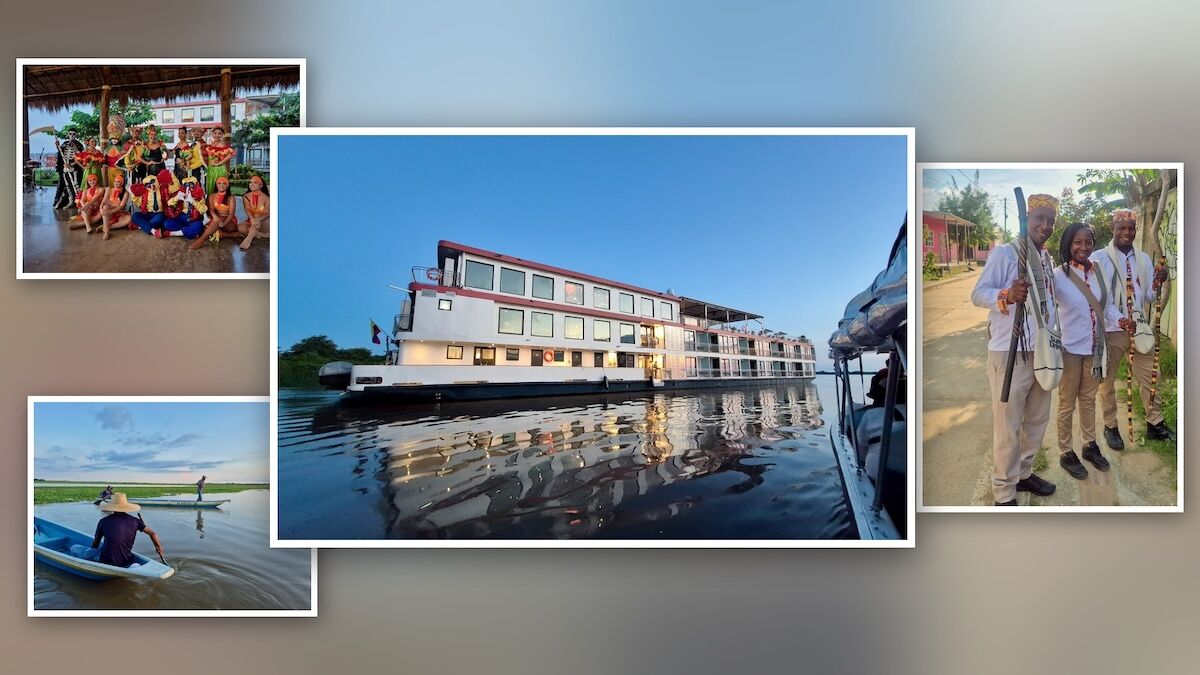
A cruise that became a carnival Photo: Hannah D. Cooper Each year before Lent, Shakira’s home city erupts with street parties, parades, and processions celebrating Colombian folklore, dance, and music; the Carnaval de Barranquilla is one of the world’s largest carnivals with an emphasis on active participation. AmaWaterways, the company opearting the ship I was traveling on, sought inspiration from the four-day event when curating an embarkation extravaganza for the Magic of Colombia, a community-focused river cruise that feels like a floating festival. Clapping along on the riverbank, I was oblivious to the motifs and meanings presented to us. All questions would be answered in the following days: I’d learn how courtship plays out through cumbia’s steps and come to recognize a llamador from a tambora. A mysterious cloaked figure disrupting couples was identified as La Muerte in a representation of the Garabato, a dance of life and death. An especially puzzling cohort of dancers dressed, to my eye, as elephants was unmasked as El Hombre Caimán, the Alligator Man. This comedic fable tells of a man turned into a caiman after spying on women bathing in the river. Karma. A thousand rhythms, a thousand waters Fishermen at the sunrise birdwatching experience. Photo: Hannah D. Cooper Colombia has a river for each of its rhythms. Known interchangeably as the “land of a thousand rhythms” and the “land of a thousand rivers,” there are, go figure, a little over a thousand of each. Although playing a major role in trade and remaining the country’s most important waterway, tourism is new to the Magdalena, and AmaWaterways is its first luxury river cruise line. With the exception of AmaMelodia (sailing Cartagena to Barranquilla), I spotted only the occasional tugboat or barge. Tender trips at sunrise and dusk followed artisanal fishers casting nets in placid canals. Some motored alongside to show us their catch of bocachico and catfish. With fish populations in decline, responsible tourism can bring economic relief; my river guide explained how villagers are taking greater care to preserve these wetlands whose winged inhabitants we were tracking through our binoculars. Days were chockful of rhythm. Cumbia, Colombia’s most well-known style of music, was described by Valerie of Casa Calíbana as a way to express emotion and identity. In El Banco, cumbia’s supposed birthplace, people dance when they’re happy; they dance when they’re sad. Her ensemble navigated four hours of waterways to share their story onboard AmaMagdalena, pinning flowers to our hair and teaching us the steps. We tested out the instruments, hearing how the guache (a metal shaker) mimics ocean waves and the caña de millo reflects the melody of birdsong. In Santa Bárbara de Pinto, Magdalena Department (Colombia is made up of 32 separate departments and its capital district), we witnessed how even a snack can inspire a rhythm. Villagers demonstrated the harvest cycle of bollo limpio — husk-wrapped cornmeal rolls, a popular street food during Barranquilla Carnival — in a sequence portraying laborers in the fields. Calamar and Palenque’s rhythmic finale AmaMagdalena from the stern. The ship has a capacity 60 guests. Photo: Hannah D. Cooper Our penultimate day before reaching Cartagena started in Calamar, a riverside town in the Bolívar Department whose significance faded as roads took prominence. A rickety passage by “Paola” (bicycle taxi) jolted us past fishermen unloading their morning catch and vendors receiving early-bird grocery shoppers. Here we watched a performance of Son de Negro, a dance originating from the colonial era where male dancers painted their bodies black and attached red feathers — symbolic of spilled blood — to their heads. Exaggerated facial expressions mocked Spanish enslavers and reclaimed power in this energetic choreography. The afternoon was spent in San Basilio de Palenque, a hub for the high-stamina Afro-Colombian Mapalé dance and host of the annual Palenque Drum Festival. Founded by those who escaped slavery, this is the first “free” Black town in the Americas; a “palenque” refers to a community of self-liberated slaves. The Guardia Cimarrona, a volunteer group of predominantly women and farmers overseeing law and order, greeted us. Poultry theft, we heard, is the dominant crime, punishable by 12 hours in solitary “reflection” or community service. Palenque is also the home of the palenqueras, women sporting colorful dresses with full skirts (polleras) and balancing bowls laden with fruit on their heads. Many of Palenque’s women commute to Cartagena, where they make a living posing for photos in the walled city and selling candies. It’s respectful to approach the women with “kumo, kusa a tá?” (KOO-moh, KOO-sah ah-TAH), which means “how are you?” before asking for their rate and supporting their work. Our local guide shepherded us from the home of a traditional healer, schooling us further in palenquero, a Spanish-based creole language. Learning that their name translates to “my friends,” we met with Kombilesa Mí, a folk rap band fusing traditional rhythms with hip-hop. A jamming session in their studio was the parting activity from our musical cruise before Capitán Julio dropped anchor. Community-led, non-invasive tourism in Colombia Guardia Cimarrona in San Basilio de Palenque. Photo: Hannah D. Cooper The Magic of Colombia’s soundtrack is set by musicians and birdsong; the route is determined by the river. Since launching in 2025, the crew has needed to adapt each sailing around variable conditions, El Niño-imposed droughts, and those high-flow currents that continuously tricked me into thinking the boat was underway. Fluctuating river levels mean it isn’t always possible to dock overnight at the postcard-pretty riverside town of Santa Cruz de Mompox; access to El Banco is why cumbia artists are instead brought to the ship. Before bringing a boost to river communities through tourism, the riverboats generated employment. Arriving in Cartagena as shells, Colombians were hired in construction, and artisans were commissioned to produce soft furnishings for the AmaMagdalena’s 30 staterooms and for the 32 staterooms of its sistership, the AmaMelodia. The Ama team explored 900 miles of navigable river by canoe, identifying communities interested in welcoming visitors in this overlooked part of Colombia and seeking to understand how the cruise could benefit their people. Our Cruise Manager admitted he had thought the idea of launching a luxury river cruise on the Magdalena ambitious. Residents were equally confused — while wondering what they had to offer tourists, they were clearly taking for granted the region’s natural beauty and its rich cultural heritage. Just as the Barranquilla Carnival is built on active participation, the Magic of Colombia fully immersed me in the sounds, rhythms, and voices of the Magdalena. More like this
This Colombia River Cruise Is Putting Local Communities at the Heart of Travel
Full Article
Original Source
Read the full article at Matadornetwork →KhanList aggregates and links to publicly available news content. We do not host full articles from third-party sources. Always verify important information with original sources.