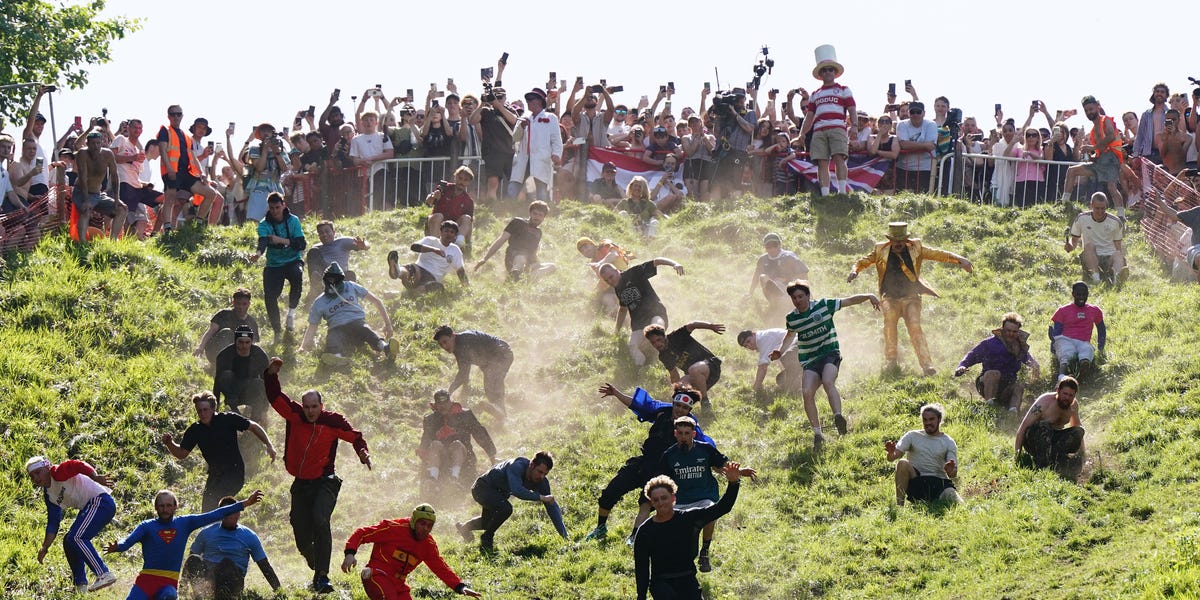
Every spring in Gloucestershire, England, a delegation of gravity's most ardent disciples gathers at the crest of Cooper's Hill and waits for a wheel of cheese to be sent tumbling down ahead of them. The truckle of Double Gloucester, weighing 7 to 9 pounds and reaching speeds up to 80 mph, gets a one-second head start. Upon its release, the field takes off after it, most of them losing their footing within the first few strides, tumbling and somersaulting and occasionally cartwheeling 200 yards down the 1:2 gradient slope, until the first to cross the finish line, upright or not, is declared the winner.Florence Early, who shares the record for most wins by a woman with four, has described the sensation as a kind of ongoing collision—a cumulative battering, with each fall compounding the last. "The feeling would be like if somebody took you from the waist and then dump-tackled you down, and then did it again and again before you've caught your breath," she told Tradfolk. "It's that feeling. Your whole body is off the ground, and you're coming down."Running (we're using the term loosely here) has a long history of inspiring feats of dubious wisdom, and the Cooper's Hill Cheese-Rolling and Wake may be the most foolhardy of them all. Nobody can say for certain when it started; written references to a cheese race on the hill date to 1826, but residents of Brockworth, the village at its base, say the tradition is considerably older. In a 2006 interview with the BBC, one longtime local said her family's memories of the race extended back to the mid-18th century, with nothing to suggest it was new at the time.Whatever its true age, the race has proven remarkably resilient to disruption. Cheese-rolling has survived wars, disease outbreaks, and its own body count. During wartime rationing, when a real wheel of cheese was too dear to risk losing to a crowd of amateurs, organizers rolled a wooden one instead, just to keep the shape of the tradition intact. A foot-and-mouth outbreak closed the hill to competitors in 2001, and the COVID-19 pandemic did the same in 2020 and 2021. In each instance, a single cheese was rolled unofficially to keep the streak alive.The injuries have been just as persistent: 33 people were hurt in a single afternoon in 1997, including a spectator who tumbled 100 feet trying to get out of the cheese's path, and the race was called off the following year. It has been canceled several times since then, always over safety concerns, and it has come back, against all better judgment, every single time.JUSTIN TALLIS//Getty ImagesThe turning point came after 2009, when an estimated 15,000 spectators showed up to a hillside built to hold a third that number, and local officials decided they could no longer put their name to it. A plan was floated to relaunch the race as a ticketed, two-day festival, complete with the kind of safety measures a crowd that size would require. Residents of Brockworth wanted no part of it. The organizers behind the proposal received enough backlash, some of it threatening, that they abandoned the idea entirely.What followed was not a cancellation so much as a change in management—or the absence of one. Roughly 100 people showed up anyway that year and ran the race themselves, without permission and without a plan. It has continued the same way every year since, organized in practice, if not on paper, by Sara Stevens, a Brockworth resident who has coordinated the event informally for more than a decade. Stevens has said she considers the distinction beside the point. The same village runs the same race in the same spot every year, and as far as she's concerned, that is what makes something official.The arrangement suits everyone involved, if not entirely by design. Cooper's Hill Cheese-Rolling has no permit, no safety plan, and no insurance policy, and the local council's Safety Advisory Group has said as much publicly, warning attendees that they take part at their own risk. No governing body wants the liability of sanctioning a race that reliably sends people to the hospital, and no one in Brockworth has shown much interest in waiting for one to change its mind.Despite the setbacks, cancellations, and injuries, the event is still going strong. If anything, the competition has only gotten sharper. This year's race had an added edge, as German YouTuber Tom Kopke, defending his title for a third consecutive year, went up against Chris Anderson, the 23-time record holder from Brockworth, who had come out of retirement specifically for the rematch.Kopke won the race for the third year in a row, helped along by conditions that favored the field: recent rain had softened the grass enough to blunt some of the impact of the fall, Kopke said, though clearly not all of it. Anderson finished second. He was overtaken near the finish line, he said afterward, and by then, there wasn't enough hill left to answer. Ask anyone on the hill what separates the winners from the rest, and the answer tends to be the same: not speed, but balance. Staying upright as long as possible matters more than how fast a runner is moving when they lose their footing, since the race is rarely won by whoever falls fastest.If the rematch didn't go Anderson's way, his family made up for it. The former British Army soldier’s son won one of the children’s uphill races, keeping something of the family's reputation intact even as the elder Anderson's own bid came up short. The second men's race went to Niels Wennemars, 21, of the Netherlands, who arrived with a pedigree of his own, if not quite the kind the hill usually attracts. His father and brother are both world champion speed skaters, and something of that family talent for moving fast without falling over seemed to carry down the hill with him.Asked what drew him to a race that’s been sending participants home in slings for the better part of two centuries, Wennemars offered something closer to a worldview than an answer.“If you live scared,” he said, “you are going to die scared. And that is the worst way to live.”Jeff Kirshman is a writer, editor, and content strategist based in Chicago. His work has appeared in Runner's World, ESPN, The Classical, and the Casper Star-Tribune.
This Chaotic Cheese-Rolling Race Has No Permit, No Insurance, and No Plans to Stop
Full Article
Original Source
Read the full article at Runnersworld →KhanList aggregates and links to publicly available news content. We do not host full articles from third-party sources. Always verify important information with original sources.