
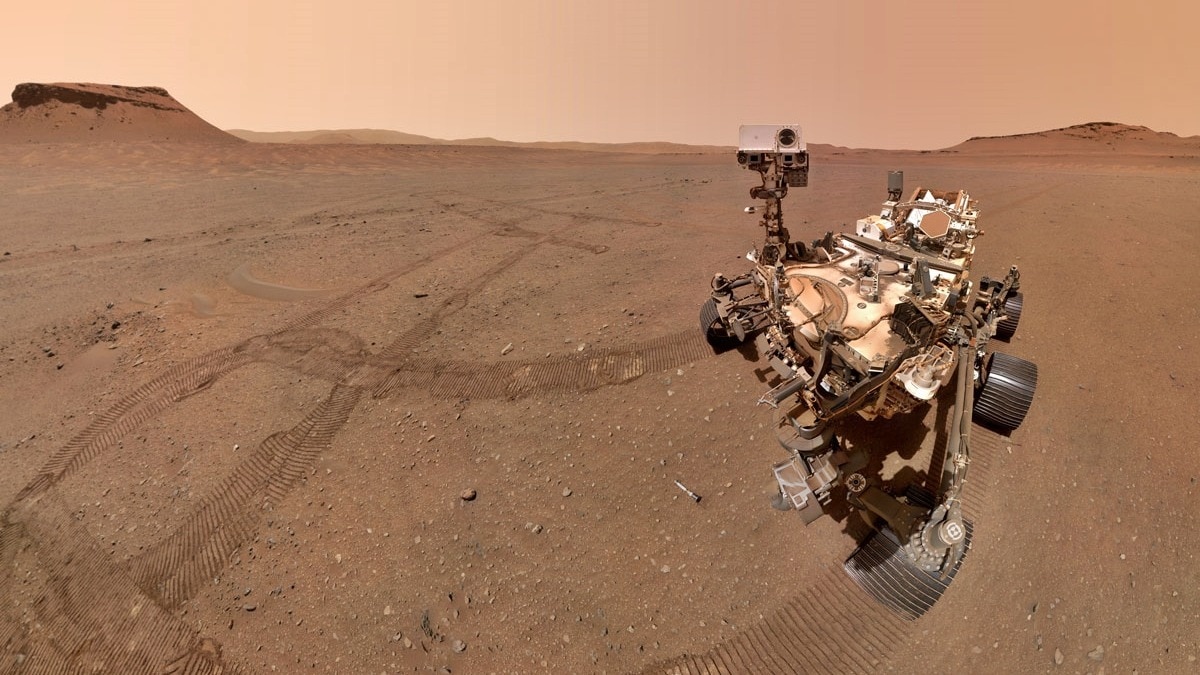
Nasa’s Perseverance rover has driven farther on another world than any vehicle before it, breaking a record held for more than eight years by a fellow Mars explorer.On October 11, the six-wheeled rover’s total driving distance reached 45.22 kilometres, narrowly surpassing the 45.16-kilometre record set by Nasa’s Opportunity rover, which explored Mars from 2004 to 2018. The achievement, announced by Nasa on October 12, highlights how improvements in self-driving technology are helping robotic explorers cover more ground and investigate parts of the Red Planet that were previously difficult to reach.Perseverance has achieved the milestone in about five and a half years, a distance that took Opportunity nearly 15 years to cover. HOW DOES PERSEVERANCE DROVE ACROSS MARS?One of the biggest reasons behind the rover’s progress is its ability to navigate the Martian landscape without waiting for instructions for every movement.Perseverance uses a system called AutoNav that allows it to photograph the ground ahead, create a three-dimensional map of obstacles and choose a safe route between destinations selected by its team on Earth. An illustration of the record-breaking path taken by Perseverance. (Photo: Nasa) In other words, it's a vehicle that can assess rocks, uneven ground and other hazards while moving, rather than stopping each time it encounters unfamiliar terrain.According to Nasa, more than 90% of Perseverance’s total driving distance has been covered using this system. Its navigation technology can assess around 6 lakh points in the terrain with each look, compared with just 20 points assessed by Nasa’s first Mars rover, Sojourner, in 1997.Perseverance just did something it’s never done before. On Dec. 8 and 10, 2025, the Mars rover completed drives planned by generative AI. The first-of-its-kind demonstration hints at a future of more efficient exploration and even more science. https://t.co/RbWmJXeVWi https://t.co/ylLPs4tZq6— NASA JPL (@NASAJPL) January 30, 2026Perseverance can cover as much as 412 metres in a single Martian day, although the distance varies with the terrain and mission requirements.WHY IS PERSEVERANCE'S RECORD SIGNIFICANT?Perseverance landed in Mars’ Jezero Crater on February 18, 2021. An image of Mars' surface captured by one of Perseverance’s navigation cameras. (Photo: Nasa) The reason why scientists chose the location was because it once contained a lake and a river delta, making it a promising place to search for evidence of ancient microbial life.The rover has since travelled across the crater floor, explored rocks deposited by an ancient river and climbed towards the crater’s western rim. It has collected 29 rock and soil samples, which could eventually help scientists investigate Mars’ past in laboratories on Earth.The latest record came as Perseverance travelled through a region known as Lac de Charmes towards an area called Idubi. Spots on a reddish rock nicknamed “Cheyava Falls” in Mars’ Jezero Crater discovered by Perseverance rover. (Photo: Nasa) Scientists hope to examine some of the oldest rocks encountered during the mission, including possible traces of ancient hot-water systems.Nasa has extended the mission through roughly the end of 2028, giving the rover more time to explore the crater rim and investigate new terrain.For scientists, the real prize is both how far Perseverance travels, and what those extra kilometres can reveal about Mars’ ancient environment and whether the planet once supported life.- Ends
This car just broke the record for most-driven vehicle outside Earth
Full Article
Original Source
Read the full article at Indiatoday →KhanList aggregates and links to publicly available news content. We do not host full articles from third-party sources. Always verify important information with original sources.