
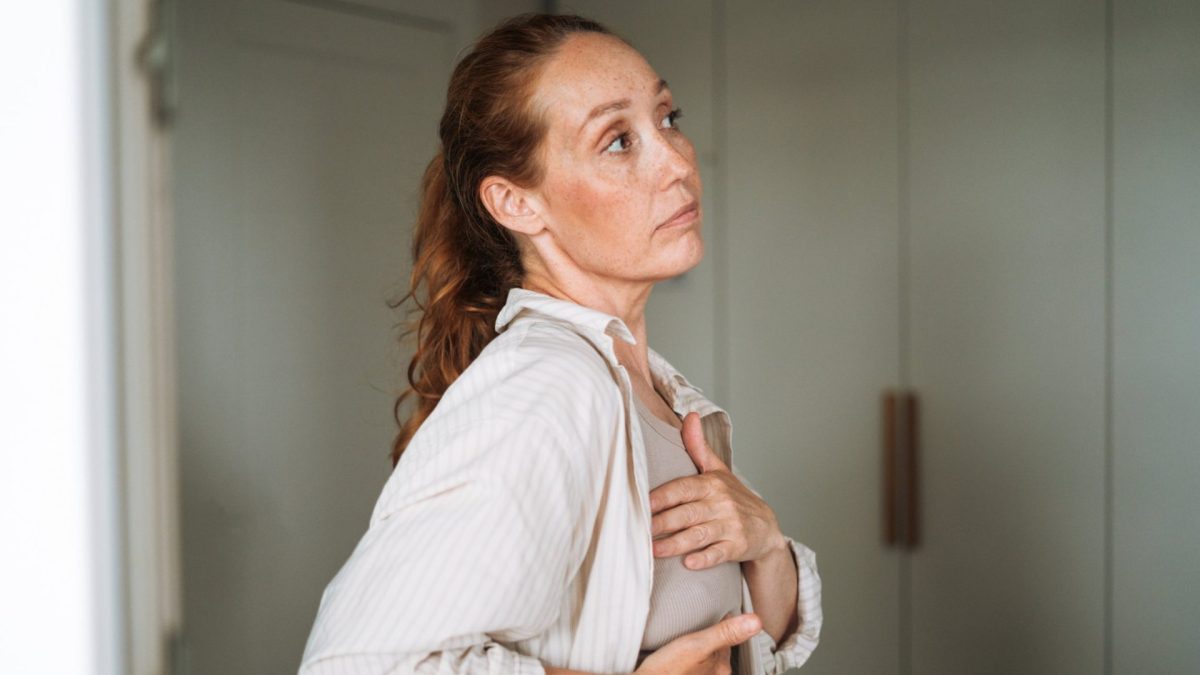
It was late on a Monday night last September, after returning home from dinner with a friend, when I found the first lump. I was putting on my pyjama top when my hand grazed over what felt like a big, juicy grape at the bottom of my right breast. “Oh my god,” I said out loud, as a jolt of terror shot through my body. It must be cancer, I thought as I prodded the smooth, round swelling that rolled around underneath my skin. But then I remembered the interview I’d done a couple of weeks before (I’m a freelance journalist who specialises in health and wellbeing) with a breast cancer surgeon, who’d said most lumps are benign. I knew there was nothing more I could do at 11pm on a Monday, so I tried to put it out of my mind and went to bed, then sprang into action the next morning, quickly booking an appointment at a private hospital – I couldn’t face the prospect of dealing with NHS waiting times. Initially, I was loath to ask AI about the lump in case I read something worrying, but I’m glad I caved the next day. ChatGPT told me that smooth, symmetrical lumps that move around are usually benign, which made me feel better when I discovered a second, smaller lump next to it the next morning, and two more in my other breast. Shorts “I think they will just be cysts, but I will refer you for a mammogram and ultrasound to make sure,” said the doctor when she examined me. By the time the screening appointment came round, I’d found a fourth lump, but as predicted by the doc, they all turned out to be benign cysts, showing up as clear black circles against the white breast tissue on the ultrasound. I burst into tears of relief when I left the screening room. The whole experience was very stressful, but there was one major upside. The screening report revealed that I am one of the 10 per cent of women who have very dense breasts (there are four categories, ascending from A to D), meaning I have an increased risk of breast cancer. I’m 42, and must have annual checks from now on, eight years before I turn 50, the age at which NHS routine screening starts for women who are at average risk of cancer (for those at higher risk due to things like family history or carrying BRCA1 or BRCA2 gene changes, checks can start earlier). Fifty per cent of women over 40 have dense breasts, and you can only identify this through a mammogram. You cannot tell if you have dense breasts through a self-exam; dense breasts are not necessarily firmer. There has been a significant rise in breast cancer incidence rates in under-fifties in recent years, which the Breast Cancer Research Fund calls a “deeply concerning” trend, and some experts argue that routine breast screening should be expanded. Earlier this month, a Cambridge University study revealed that GP breast cancer risk guidelines miss 95 per cent of young women who will go on to develop the disease. And in a paper published last May, researchers found that offering enhanced scans to women with very dense breasts could detect 3,500 more cases and save 700 lives a year in the UK. In response, the UK National Screening Committee said it is reviewing evidence that women with dense breasts should be offered additional screening appointments. Concerned by what she had been seeing in her clinic, oncology nurse Gemma Reeves set up a petition last year asking the government to lower the starting age for mammograms from 50 to 40 and make them annual instead of every three years. “I noticed a rise in younger patients coming through the door with breast cancer and having to sit for gruelling hours of chemotherapy,” Reeves says. “I looked into it and realised that the breast screening age had not been lowered since 1988, and I thought, ‘I need to try and do something about it.’” Gemma Reeves set up a petition last year asking the government to lower the starting age for mammograms from 50 to 40 and make them annual instead of every three years After garnering 106,000 signatures, the petition was debated in Parliament. MPs at the debate commended Reeves for her initiative, but said no decision could be made until the National Screening Committee has received the results of the long-running AgeX study, due in 2027. One arm of this clinical trial, which started in 2009, aims to assess the pros and cons of offering breast screening for women aged 47 to 49 (the other focuses on women aged 70 to 73). “The evidence will be looked at and, if it is strong enough, things will change,” said Labour MP Sharon Hodgson, who at the time was parliamentary under-secretary of state for public health and prevention, at the debate. But Reeves thinks 47 is still too late to begin screening. “My argument is you don’t know you’ve got dense breast tissue until you have your first screening.” Dense breasts (those in the C and D categories) contain a higher proportion of fibrous tissue than fat, explains Dr Teri Brew, GP and medical director of preventative health at cancer care provider Perci Health. “If you have C or D density, you have an increased risk of breast cancer and mammograms are less sensitive, so it’s harder to pick cancers up.” Tumours and fibrous tissue both appear white on scans, which is why ultrasound or MRI are used as an additional diagnostic tool. Brew points out that in some other countries, breast cancer screening begins earlier and happens every two years. “The US in 2024 commissioned a big systematic review and decided to lower the age of screening from 50 to 40, and Sweden starts screening from 40 as well. There is an increasing rate of more aggressive cancers developing in the 40 to 50 age group, and there is an argument to definitely look at starting screening earlier.” Despite the setback in Parliament, Reeves was encouraged by Sharon Hodgson, who came up to her after the debate and told her not to give up on her mission. “I’m not going to,” she says, and in the meantime, she wants to remind women that self-checking is a very important part of breast cancer prevention. “Once a month is enough, and allows patients to assess changes during the menstrual cycle,” says Katerina Micha, breast surgeon at New Victoria Hospital. Changes to look and feel for include lumps, changes in breast size, nipple discharge, and changes in the skin such as indentations, from the breasts all the way up to the armpits. “Finding a lump in most cases is not cancer. However, it is something that requires examination,” Micha says. If it does turn out to be a cancerous tumour, early detection is better, she adds. “The earlier the cancer is found, the more treatment options we have, and the better outcomes we have.” As I discovered, finding breast lumps can be scary, but I’m glad that I didn’t delay in getting mine checked out. I’d encourage others to do the same, and to set a reminder in their calendar to check their chest at the same time every month (women and men, as both can get breast cancer). Or you could sign up for the handy Coppafeel! text reminders. While there’s no guarantee the Government will change its breast cancer screening policy in future, keeping an eye – and a hand – on your boobs might just save your life.
This breast type raises your risk of cancer – every woman over 40 should know it
Full Article
Original Source
Read the full article at Inews →KhanList aggregates and links to publicly available news content. We do not host full articles from third-party sources. Always verify important information with original sources.