
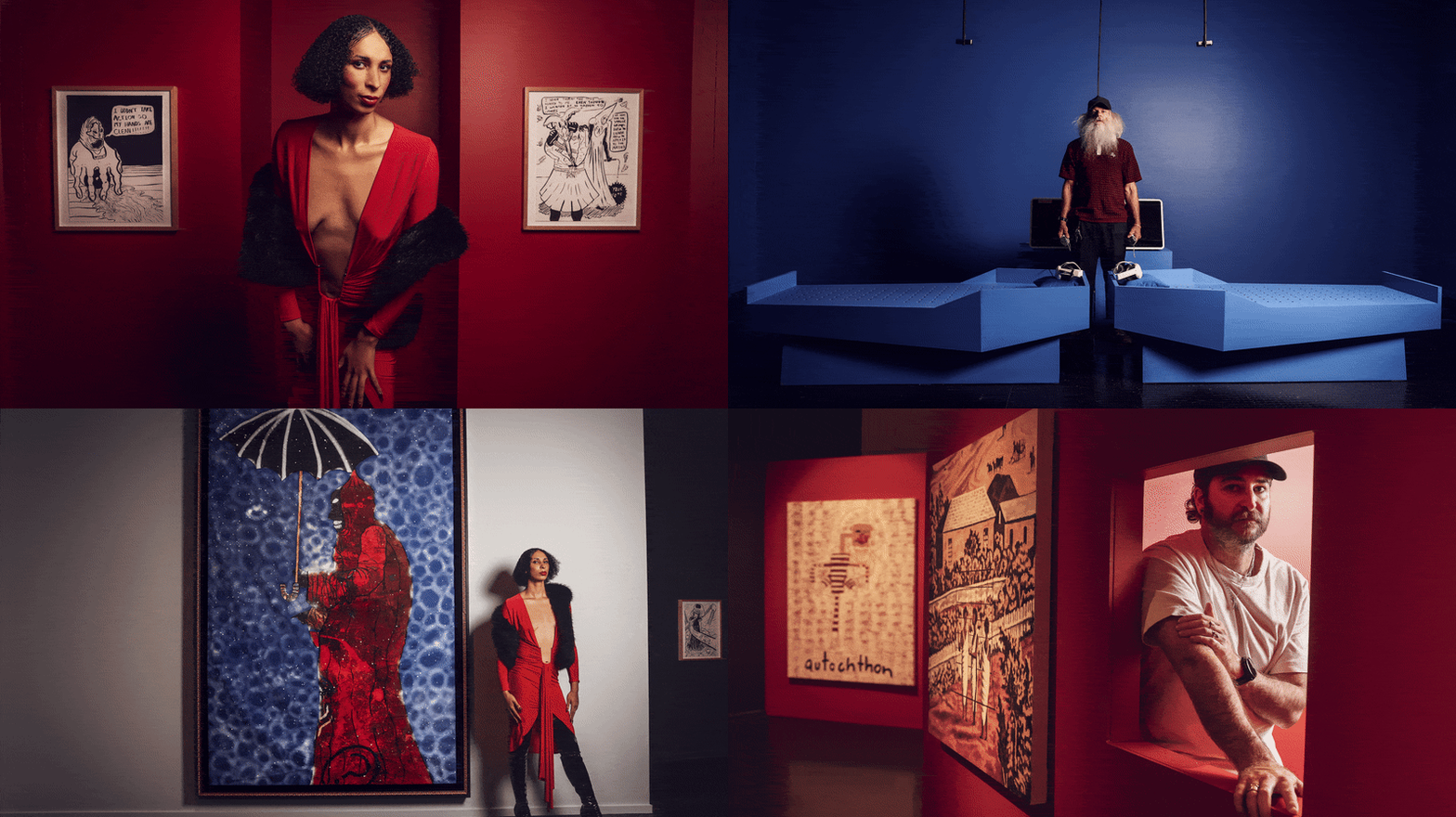
November 13, 2026 — 3:45pmBritish artist Danielle Brathwaite-Shirley is at the frontier of the contemporary, working in interactive installations and video games. Her CV is global: she has exhibited in prominent galleries in London, Los Angeles, Berlin, and now Warrnambool.The last one seems incongruous. But the blurb of her new show opening this weekend at Warrnambool Art Gallery highlights that as a point of pride: it’s “a collision between artists whose practices, on the surface, seem incongruent”.British artist Danielle Brathwaite-Shirley with one of her works at Warrnambool Art Gallery.Nicole ClearyThe show, titled Dreaming myself into a future that was worth living, features the work of Brathwaite-Shirley alongside two Australian artists – Sydney-based video performance artist Shaun Gladwell, and the late Birri Gubba and Darumbal painter Gordon Bennett.Brathwaite-Shirley says she ended up in Warrnambool simply because director and curator Aaron Bradbrook reached out to her, and offered an irresistible proposition. “Aaron said, ‘Sure, you can experiment, and basically do whatever you want,’” she says. “I could do things I’ve never done before.”The result is an energising mix of voices revelling in discomfort and atonal harmony. “I like this notion of a collision of ideas,” says Bradbrook. “I like bringing in artists who have completely divergent practices.”Here, Brathwaite-Shirley largely steps away from her video game practice. Her main contribution is the architecture of the gallery itself: a bright-red labyrinth that disorients you as soon as you step in. The show is presented in several rooms with no order, and no labels. Paintings are hung too low. Walls are oddly shaped. Spaces connect strangely. Bennett and Brathwaite-Shirley’s works are mixed in together.Brathwaite-Shirley opens one of the small and impractical doors in her exhibition that lead on to other rooms.Nicole Cleary“Other people’s artwork is the medium that I’m using,” she says. “It’s like every piece is kind of interrupting the room.”Brathwaite-Shirley cites contemporary horror as an inspiration – Kane Parsons’ film Backrooms, of course, for its liminal, eerie nowhereness; Mark Z. Danielewski’s novel House of Leaves; and Steve Nelson’s Doom-based video game MyHouse.wad.One room hides two Bennett paintings, Terra Nullius (1989) and Study for Possession Island (1991), around awkward corners. They’re outside an inner room, apparently accessed by several impractical doors – one locked, one tiny, knee-high, another open a fraction, but immovable – which houses two 19th century colonial landscapes from J. H. Carse and Eugene von Guérard, and a bronze bust of Queen Victoria. The room and its surrounding Bennett pieces form a Brathwaite-Shirley work in itself, called THE ROOM THAT STAYS OPEN (2026). Bennett talks to the colony, and Brathwaite-Shirley to Bennett.Bennett is well represented, including several of his Basquiat-inspired paintings, and colonial critiques shot through with violence and anger. A cowboy on a horse whips a black figure to the ground in a swirl of dots and Pollock-esque drips. Black bodies are held within black lines of graphs and charts. A white, blonde child assembles blocks spelling slurs while an anonymous pipe-smoking adult looks on.Warrnambool Art Gallery director Aaron Bradbrook with some of the works by the late Indigenous artist Gordon Bennett featured in the exhibition.Nicole ClearyThese sit snugly alongside Brathwaite-Shirley’s forays into drawing – frenetic, absurd, political cartoon-style works in calligraphy ink – and painting: huge collage-infused canvases, colourful and ferocious scenes from another world.“These are big because I want you to feel small,” Brathwaite-Shirley says.She also contributes a four-channel video work, in which video-game references form part of a scrambled, interior digital life. It’s unsettling, a bit sexy, and a bit absurd.Shaun Gladwell’s contribution, Passing Electrical Storms (detail) (2022-23), brings us closer to death. The visitor lies down on a hard bed, dons a VR headset, and sees themselves dying in hospital, before floating from the world – 10 metres, a hundred, a million, across the universe. It’s the most immediately interactive work, and also the one that makes you feel the most cosmically insignificant, but with Gladwell’s warmth and playfulness, which ties it to Brathwaite-Shirley’s work.Shaun Gladwell with his work Passing Electrical Storms.Nicole ClearyIt was Bradbrook who selected the title. He came across it in the writings of writer and artist Morgan M. Page.Page is a trans woman, as is Brathwaite-Shirley. In a 2017 essay, Page described her work delving into online archives for lost trans and queer history as “open[ing] a whole world of possibilities for dreaming myself into a future that was worth living”.“I thought it was a really beautiful description,” says Bradbrook. “But then I also liked the idea of turning it on its head and making it about death.”For Brathwaite-Shirley, the show is a space for new ideas to form.Brathwaite-Shirley with works from her exhibition Dreaming myself into a future.Nicole Cleary“Something that I love about video games is that they wait for you,” she says. “You activate them. What you do changes how you experience it, but also how the person behind you experiences it. And then you’d leave with a series of choices that you made.“I don’t like it when people say, ‘Oh, what a beautiful show.’ I much prefer when someone says, ‘This made me feel really odd,’ or ‘I felt squished.’ I want people to leave with a feeling they can interrogate.”Will Cox writes fiction and arts criticism. He's based in Merri-bek.From our partners
This artist wants you to leave her exhibition feeling odd – and ‘squished’
Full Article
Original Source
Read the full article at Smh →KhanList aggregates and links to publicly available news content. We do not host full articles from third-party sources. Always verify important information with original sources.