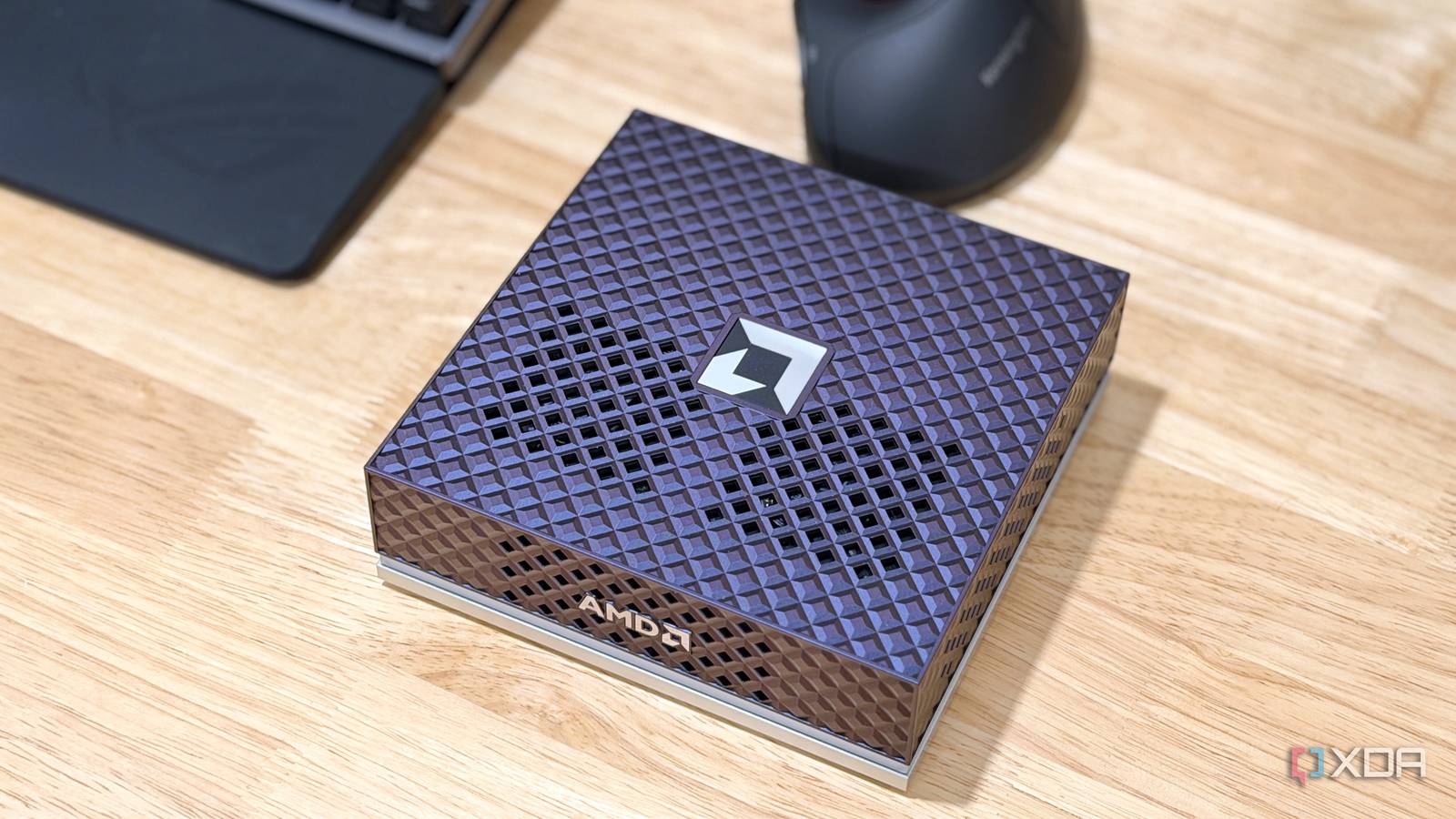
Published Aug 2, 2026, 8:30 AM EDT Maker, meme-r, and unabashed geek, Joe has been writing about technology since starting his career in 2018 at KnowTechie. He's covered everything from Apple to apps and crowdfunding and loves getting to the bottom of complicated topics. In that time, he's also written for SlashGear and numerous corporate clients before finding his home at XDA in the spring of 2023. He was the kid who took apart every toy to see how it worked, even if it didn't exactly go back together afterward. That's given him a solid background for explaining how complex systems work together, and he promises he's gotten better at the putting things back together stage since then. I’ve had Lemonade Server running on my Ryzen AI Max+ 395 mini PC for months, and until this week I’d have described it in five words: it serves models to things. It became my default model server when Nvidia support landed, and it’s been boringly efficient since then. And then version 11 arrived a couple of weeks ago, adding text-to-speech, an image-to-3D pipeline, and model routing. This turned the already capable server into more than just a chat replacement. And when I started poking around the release, I saw way more than the announced features. One request, and it wrote, drew, and narrated a tavern I didn't ask for most of this to happen, but it was a wonderful surprise One of the first things I did was information gathering, and buried in the model list was RPG-HaloTales-V1, which comes from AMD’s own repository and isn’t a model at all. It’s a collection of four components across four different backends: Qwen3.6-27B for text, Flux for images, Whisper for listening, and Kokoro for speech. This turns it into a multimodal beast, and it takes only seconds to load into memory. I sent it a chat request, “describe the tavern I just walked into, and show me what I see.” I thought I’d get a paragraph or two of text as a result, but I got far more. I got narration, a firelit oil-painting scene, and 21 seconds of audio reading that narration aloud. One request. One endpoint. Three modalities. The routing decided to create the image and audio, without me asking. And it kept a cast bible too. Locked art direction, physical descriptions of everyone it’s introduced, and the layout of the room. This makes the scarred barkeep the same in turn 12 as he was in turn one. It doesn’t rerun image generation; it keeps the first description as the truth. AMD clearly meant for this to be a demo, and it’s a powerful one. Under the roleplaying skin is a four-model, four-backend pipeline that can be addressed as a single OpenAI-compatible model ID. Lemonade Lemonade AI server is now an orchestrator for your AI models, so you can build complex multi-modal workflows. The router that picks your model has a privacy gate, and it fails open One field fixes it, and you should change it Lemonade 11 can also route. You download the models for your needs, then define a Hybrid Router to use them. This dispatches requests to the most suitable model, either by a smaller LLM reading the prompts or based on boolean rules, which you can set up with a visual builder with regex conditions. I created a Hybrid Router with three models of differing capacity, and ran five test prompts through the creation tool. The “hello” prompt went to the smallest in the list, a 3B model. A Python question went to the mid-size coder model. A proof to GPT-OSS-120 B. But “what is a segfault?” also went to the 120B model, the largest in the group being picked to answer something the smallest could have handled. The default routing prompt says to pick the “best” model, and that’s often the largest when cost isn’t in the equation. One line to prefer the smallest model that can answer well, and the question went to the 3B model. Then I found the classifiers. A router can gate on the output of an ONNX classifier, a semantic similarity check, or a small LLM acting as a judge, with the label field pre-filled with PII and NO_PII. The reason? Lemonade can route requests to a local model if the prompt has personal data, or out to a cloud provider if it doesn’t. That’s a smart design except for one thing. The error policy defaults to match_false, which fails open. That would pass personal data to the cloud, and the sane default should be match_true. It should also use the LLM signal type, so that’s two defaults set to the wrong values. It makes 3D models but not the kind you're picturing Great from the front, paper thin from the side I tested the image-to-3D pipeline with the tavern scene the mini PC had generated, using a fully local chain. It didn’t take long. In under two minutes, I had a textured glTF file created from a flat image. I didn’t know what it would create from the tavern image, and the odd result was down to a misunderstanding on my part. Instead of making a 3D tavern, it decided to remove the background and keep two cloaked figures. It then turned those into not-quite-flat figures, but as you can see, they’re not full models. They’re convincing enough from the front, but as soon as you move the viewpoint, they start looking decidedly 2D. Trellis only had one viewpoint and no other information to go on, so the front-facing relief was about the best it could do. If you want game-ready assets, look at the side view first, and note that the background removal setting determines what the subject is. The NPU is the slowest way to run a model on this machine And the iGPU doesn't even sweat it when running six things at once AMD sells this platform on its NPU. I’d already tested the NPU against the iGPU when reviewing the Ryzen AI Halo, but I ran the tests again to get fresh data using the same 8B model on both hardware components. Qwen3-8B Generation Time to first token Radeon 8060S (iGPU) 37.7 tok/s 0.08 s Ryzen AI NPU (FastFlowLM) 10.9 tok/s 1.50 s The integrated GPU is 3.4x faster to generate and roughly 19x faster to the first token. To be fair to the NPU, I only tested throughput this time. No thermals, power usage, or other metrics. It’s consistent, hitting 10.87 tok/s across four runs, while the iGPU varied more between 36.4 and 38. From my review testing, it’s there to run a small model while the iGPU runs another, and the speed doesn’t really matter for that. What I did test was how much this box can hold at once. By the end of testing, I had six live backends: Flux, Whisper, the speech model, the router’s LLM, gpt-oss-120b with a 128K context window, and the 3D pipeline. That’s 117GB used of the 128GB total memory that the Strix Halo comes with, without evicting any of the backends while generating 3D models. I came to test four features and found a different piece of software The cluster of things AMD announced all work, more or less as described. But the things that haven’t been announced are the interesting ones. Image editing. Upscaling. Music generation. Sound effects. Embeddings and reranking, which is half of a retrieval stack. Lemonade has eleven capability families, nine backends, one binary, and a release note that covers four of them. This is much more than a simple model router; it’s an orchestrator for deep AI work.
This AMD Strix Halo mini PC generates 3D models, images, and speech without touching the cloud
Full Article
Original Source
Read the full article at Xda-developers →KhanList aggregates and links to publicly available news content. We do not host full articles from third-party sources. Always verify important information with original sources.