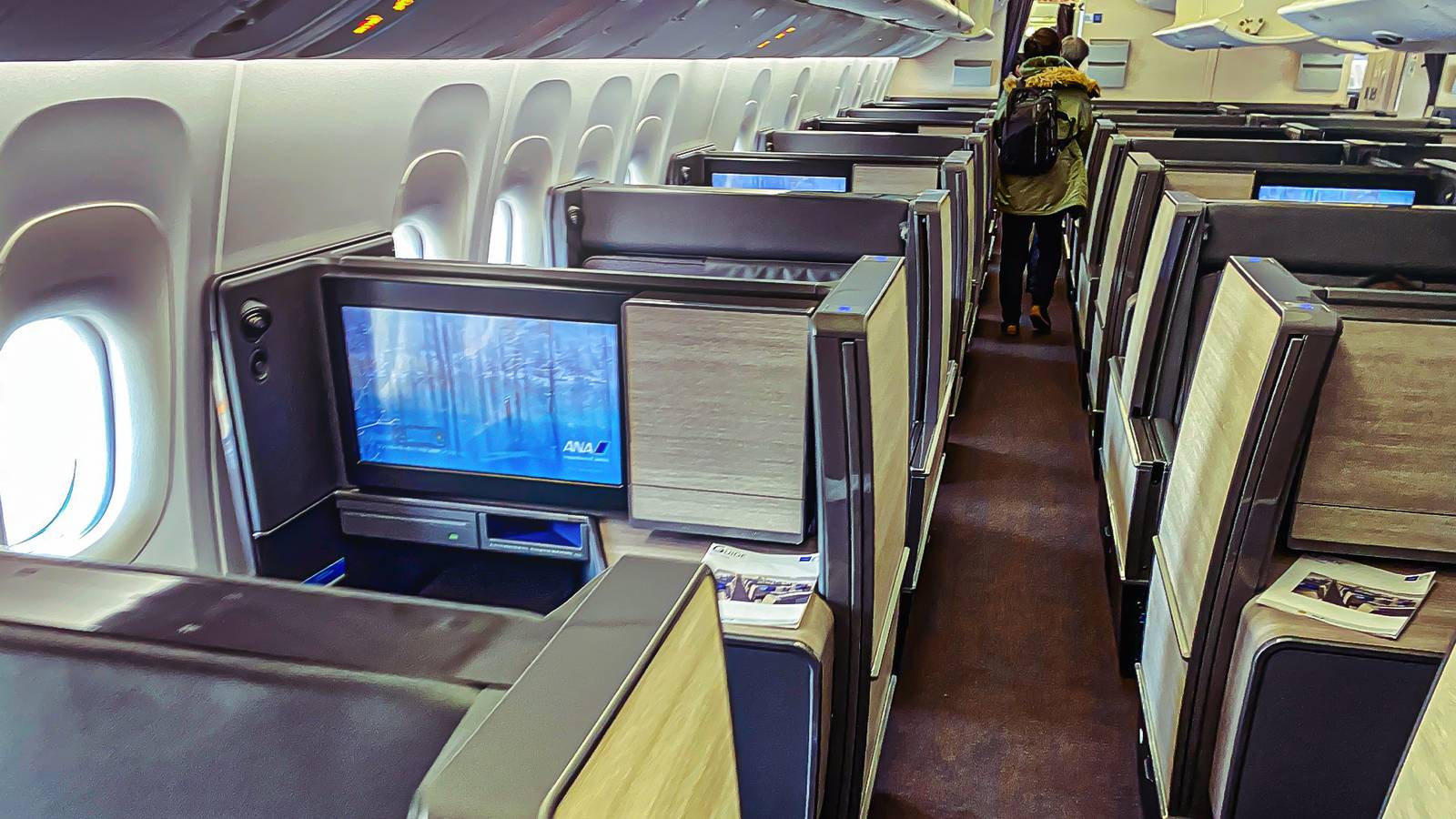
Published Jul 29, 2026, 3:00 PM EDT Airline and Airport Management Graduate, Student Commercial Pilot and Commercial Aviation Writer. Based in London & Nagoya Qatar Airways' Qsuite has maintained an undisputed grip on the international business class benchmark for some time now. Celebrated for introducing sliding privacy doors and quad-seating configurations to commercial long-haul aircraft, the Middle Eastern carrier set a standard that rival airlines have struggled to replicate. However, when All Nippon Airways (ANA) unveiled its completely overhauled Boeing 777-300ER cabin interior, the Japanese flag carrier shifted the focus of premium aviation architecture from mere enclosure to raw personal spatial freedom. Collaborating with renowned architects and drawing inspiration from the preferences of its most loyal and regular customers, ANA created a business class suite known as The Room. Rather than simply matching existing industry standards, the engineering team doubled the traditional seat width to deliver a living area that rivals many international first class cabins. This analysis examines how ANA engineered a bed wider than Qatar Airways' Qsuite and whether that extra width actually translates into a superior long-haul experience. Rooted In Tradition Credit: Shutterstock The original architectural philosophy behind The Room stems from traditional Japanese spatial design, where functional utility and perceived open space must coexist harmoniously within constrained physical boundaries. ANA commissioned Kengo Kuma, a world-renowned architect and a pioneer of wooden architecture, to lead the cabin aesthetics. The objective was not merely to install a wider chair, but to reproduce the feel of a modern Japanese sofa, ensuring the focus could truly be on comfort through removing as many spatial restrictions as possible. Manufactured by Tokyo-based aircraft interior specialist Jamco Corporation, the seat frame utilizes an alternating forward-and-aft-facing staggered layout across a 1-2-1 configuration, maximizing every millimeter of the 777-300ER fuselage cross-section. The alternating seating arrangement is precisely what enables the dramatic expansion in upper-body seat width. In forward-facing seats, the wide shoulder area aligns with the widest part of the suite, while rearward-facing seats interlock seamlessly alongside the central console. Aviation Wire noted during the cabin rollout that this structural interlocking allowed engineers to expand the seat cushion width to an unprecedented 38 inches (96.5 cm). By contrast, Qatar Airways' Qsuite offers a seat cushion width of 21.5 inches (54.6 cm). The visual environment inside the suite further reflects this architectural heritage. Kengo Kuma selected three distinct wood-grain finishes inspired by traditional Japanese homes, paired with subtle matte surfaces that reduce cabin glare under ambient lighting. Rather than feeling boxed in behind tall privacy doors, passengers experience an expansive horizontal plane that feels significantly broader than traditional commercial aircraft seats. Freedom Of Movement Credit: All Nippon Airways When it comes to curating a business class product, the focus of East Asian carriers, particularly those in Japan, is often rather different to what is seen in the rest of the world. In Western commercial aviation design, business class seats are optimized primarily for two static positions: sitting upright with feet flat on the floor, or lying straight down on a narrow bed. Customers in Japan, however, strongly emphasize the desire to sit cross-legged comfortably during long-haul flights and at the very least have the option to do so if they desire. In various trip logs and flight reviews, travelers frequently highlight that The Room functions more like a wide tatami-style couch than a rigid aircraft chair. Passengers can easily shift positions, curl their legs up, or sit cross-legged while working on laptops or enjoying inflight dining without hitting their knees against armrests or side consoles. Freedom of movement is enhanced by the custom bedding developed in partnership with Japanese sleep technology specialist Nishikawa Corporation. ANA utilizes a bespoke air layer mattress pad engineered to distribute body pressure evenly across the wide cushion surface. Qatar Airways' Qsuite still provides exceptional padding and luxury turn-down service, but its narrower frame restricts lateral movement, forcing passengers into a more disciplined sleeping alignment throughout 12-hour flights. Both Products Are As Good As Each Other? When you compare the two flagship business class products side by side, it is clear they serve vastly different objectives. Qatar Airways went all out on the wow factor, providing a level of modularity and soft product additions that instantly leave a lasting impression and have helped the airline achieve the top spot for many years now. ANA instead prioritized individual horizontal space and high-definition personal entertainment display areas, much less flashy, but a core focus that is rooted in reason. The reality is that, while equally large, ANA and Qatar have very different business strategies, which come from their different geographies and cultural philosophies. For ANA in particular, the airline has to meet not only the demands of corporate customers on transpacific routes to the US, but also the demands of the modern Japanese traveler, one who is not used to the highly segmented and unbundled landscape of the more Western airline industry. For that reason, ANA had to make sure its product was unlike anything else seen on other carriers, and fairly reflected what its passengers would be willing to pay for. ANA holds a commanding lead in both seat width and monitor surface area over Qatar Airways, offering a 43-inch (109 cm) 4K screen that is exactly double the size of Qatar's 21.5-inch (54.6 cm) display. In terms of bed length, Qatar Airways maintains a slight advantage, offering 79 inches (200.7 cm) compared to ANA's 76 inches (193 cm). It is a marginal difference, but it can be a deciding factor for taller passengers who do not want to risk being cramped in what is marketed as the most spacious business class product on the market. The Target Audiences Credit: Shutterstock Operating out of Doha Hamad International Airport, Qatar Airways functions as a global mega-connector hub, shuttling passengers between more than 160 international destinations. As a result, Qsuite was engineered specifically to accommodate a diverse demographic blend that includes high-net-worth family groups, couples traveling together, and transit passengers on multi-leg routes lasting up to 17 hours. To capture this market, Qatar introduced its modular central quad layout, allowing four center seats to join together into a shared dining room or double bed, a social engineering capability that an open 1-2-1 single-passenger floorplan would struggle to accommodate. Conversely, ANA operates a point-to-point transpacific and European flagship network heavily reliant on high-yield corporate travelers flying out of Tokyo Haneda Airport and Tokyo Narita Airport to major financial centers like New York, San Francisco, and London. Corporate business travelers flying solo on these key routes prioritize productive desk space, lateral elbow room, and seamless transitions between working and sleeping. Rather than adding the structural weight and mechanical complexity of quad-suite divider walls, ANA focused every available millimeter on expanding the individual passenger's personal footprint to its maximum potential. This split in target audience explains why both products excel in their respective markets. Qatar Airways prioritized visual privacy doors and group versatility to appeal to global connecting traffic, and ANA took to Japanese spatial principles to create a mobile corporate office that doubles as a residential sofa. Neither approach is inherently superior; rather, each reflects a calculated response to the specific commercial demands of Middle Eastern hub transit versus East Asian transpacific point-to-point operations. The Next Generation Credit: All Nippon Airways Of course, limiting the best business class discussion to just two carriers would be completely unfair, as other carriers are innovating the business class experience in their own unique ways. On its 777-300ER and A350-900 fleets, Singapore Airlines pioneered extra-wide seat backs measuring up to 30 inches (76.2 cm) across, where passengers could flip the seatback forward to reveal a flat sleeping surface. Meanwhile, ANA's main competitor, Japan Airlines (JAL), introduced high-wall sliding doors on its A350-1000 Safran seats, offering 22 inches (55.8 cm) of seat width alongside headrest-integrated speakers, reflecting a growing industry divide between motorized recline mechanisms and fixed spatial structures. To extend its wide-bed philosophy across its mid-sized widebody fleet, ANA unveiled its next-generation suite, branded as The Room FX, developed in partnership with Safran Seats and Acumen for the Boeing 787-9. Operating on a narrower fuselage width of 18 feet (5.5 m) compared to 19 feet, 3 inches (5.9 m) on the Boeing 777-300ER, The Room FX removes heavy motorized recline mechanisms entirely in favor of a fixed, pre-reclined sofa shell similar to Finnair's AirLounge concept. ANA opted for an adjustable leg rest panel that flips upward to create a flat 76.5-inch (194 cm) sleeping surface, achieving a maximum width of 41.5 inches (105 cm) at the shoulder, making it 3.2 inches (8.1 cm) wider than the original 777 product while reducing total seat weight. Suite Product Aircraft Platform Max Bed Width Max Bed Length Door Height / Privacy ANA The Room Boeing 777-300ER 38 inches (97 cm) 76 inches (193 cm) Mid-Height Sliding Door ANA The Room FX Boeing 787-9 41.5 inches (105 cm) 76.5 inches (194 cm) 52-inch (132 cm) Full Door Qatar Airways Qsuite Airbus A350 / B777 30 inches (76.2 cm) 79 inches (200.7 cm) 50-inch (127 cm) Full Door Singapore Airlines Business Airbus A350 / B777 30 inches (76.2 cm) 78 inches (198 cm) Open Shell (No Door) JAL Business Suite Airbus A350-1000 22 inches (55.8 cm) 78 inches (198 cm) High-Wall Privacy Door By incorporating 52-inch (132 cm) high sliding privacy doors, 24-inch (61 cm) 4K entertainment screens, wireless device charging, and Bluetooth audio, The Room FX demonstrates how airlines can maximize interior real estate on narrower twin-engine jets without compromising sleeping area. Also of note, eliminating motorized recline tracks not only improves long-term reliability and reduces fuel burn through weight savings, but also provides a more natural, curved backrest wall contoured to the human spine when lounging upright. Answering Back With Its Own Upgrades Credit: Shutterstock With ANA making these incredible strides with its latest generation, it would seem that the carrier has finally edged Qatar in almost all categories, but not quite. Qatar is also developing its own updated product, known as Qsuite Next Gen, which is set to begin on its A350-1000 fleet while the carrier awaits its new Boeing 777-9 aircraft. The product will build on the original metrics, improving across the board to push the Qsuite experience even further ahead of rival new business class products. For side-sleepers who bend their knees or travelers who prefer to curl up, ANA's 38 -inch (97 cm) width on the 777 and 41.5-inch (105 cm) width on the 787-9 still offer unmatched lateral freedom, and passengers can adjust positions freely without bumping against side consoles. However, taller travelers reaching 6 feet (183 cm) or above should note that both The Room and The Room FX feature footwell cubbies that taper toward the aircraft bulkhead. Lying completely flat on your back in a 76-inch (193 cm) bed can feel slightly snug around the feet, whereas Qatar Airways' Qsuite provides 79 inches (200.7 cm) of linear length, giving taller flyers additional vertical headroom. What is for sure is that the days of Qsuite being the clear and obvious favorite are no more, as ANA's business class curation has moved further and further toward the pinnacle of what is possible for a premium product. While it may not be stealing the awards just yet, it is clear that travelers are becoming more and more impressed by what ANA has managed to achieve within the confines of an aircraft cabin, showing just what is possible when you apply a small bit of ingenuity.
This Airline's Business Class Has A Wider Bed Than Award-Winning Qatar Airways' Qsuite
Full Article
Original Source
Read the full article at Simpleflying →KhanList aggregates and links to publicly available news content. We do not host full articles from third-party sources. Always verify important information with original sources.