
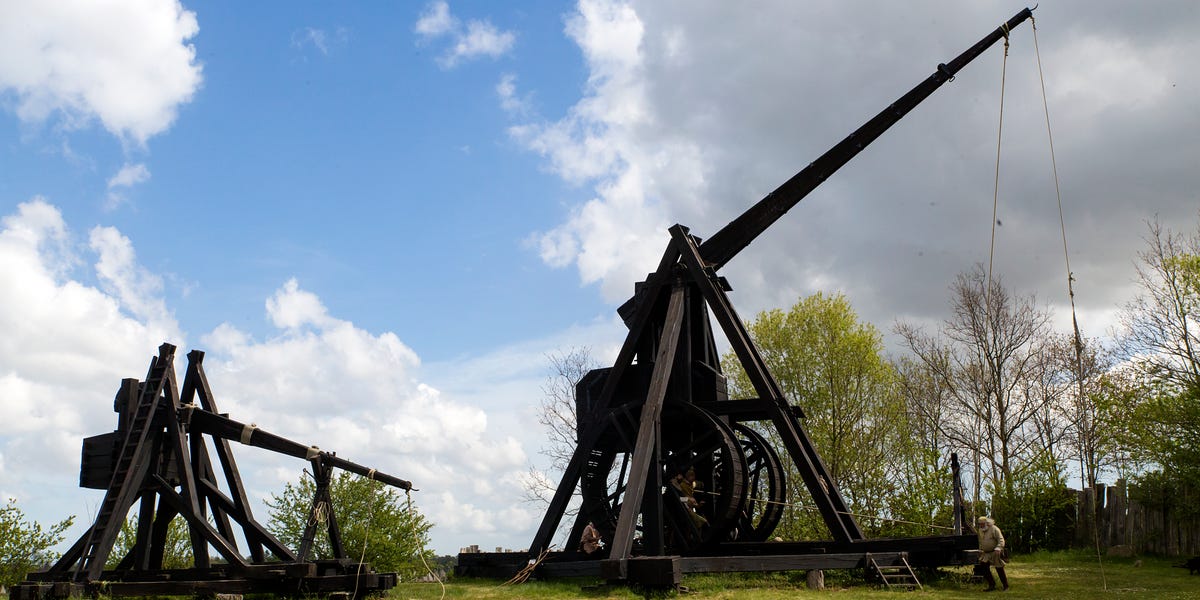
3 min readHere’s what you’ll learn when you read this story:Extensive research into a 700-year-old skeleton in Scotland has resulted in what an expert calls the first confirmed evidence of trebuchet trauma. Buried in the 1300s at Scotland’s Stirling Castle, the skeleton was first discovered in 1997.Modern research found more than 160 fractures on the skeleton—including 61 breaks in the skull—and archaeologists theorize they were caused by a medieval catapult. Skeleton 150, buried under Scotland’s Stirling Castle in the 1300s, likely would take no solace in finding out that 700 years after his violent death, he’s been named the first person in recorded history to be killed by trebuchet trauma.Jo Buckberry, a bioarchaeologist at the University of Bradford, presented a paper on the “first evidence of trebuchet trauma in the archaeological record” during the 25th European Paleopathology meeting in Berlin this month, noting how the extensive damage to Skeleton 150, a male aged between 22 and 34 years old, featured unique patterning not typically found in the 1300s. Her observations point to the use of a trebuchet, a gravity-powered catapult. And the body’s age lines up with a famous 1304 siege at the Stirling Castle.During the Scottish Wars of Independence—two separate conflicts, the first of which ran from 1296 to 1328, and the second from 1332 to 1357—the castle, located just north of Edinburgh and Glasgow, played a pivotal role as a key stronghold in the fighting. Edward I famously used siege engines in his campaigns, notably in 1304 by debuting the War Wolf, the largest trebuchet ever constructed, with eyewitness accounts proclaiming that 300-pound stones ripped through the castle’s stone walls “as an arrow would fly through a piece of cloth.”Skeleton 150 may have been a casualty of that immense force. The body was first discovered buried in the castle’s chapel in 1997 alongside eight others who died evidently violent deaths. The skeleton in question suffered 161 peri-mortem fractures, Buckberry wrote, ranging from the top of his head to his knees. Detailed analysis confirms all were blunt force blows, and the patterns indicate the focus of impact was around the right shoulder and the back of the head, with a higher fragmentation in this area (including a shattered shoulder and 60 fractures on the skull).“Comparison with known forensic cases indicates this trauma was the result of a single, high-velocity impact, probably to a living individual with forearms flexed in front of the body and bearing weight through the lower limbs and feet,” Buckberry wrote.Lukas Waltenberger, a forensic osteologist at Vilnius University who was not part of the current research, told Science.com the case is convincing. “It seems like a high-velocity, high-force, high-speed impact in a short amount of time,” he said.Buckberry wrote that skeletal evidence of medieval warfare is characterized by sharp force trauma and that “while the use of siege engines is well documented, we believe this is the first evidence of trebuchet trauma in the archeological record.”The boulder smashed the roughly 5-foot-5 male into the ground, and the multiple zigzagging breaks across his body, from his shoulder to his ribs, along with a broken leg, don’t line up with any other type of death, such as a fall from castle walls or trampling by horses. Skeleton 150’s injuries most closely match someone hit by a train. “But how do you get from there to a guy in medieval Scotland?” Buckberry asked. “What is large and moving very, very quickly in 1304? It’s likely the individual was killed by a siege engine.”Waltenberger agreed that it took only milliseconds to deliver a huge amount of energy. “In skeletons from past times you rarely see this,” he said. The trebuchet, likely invented in the 12th century, could sling 200-pound boulders well over 300 feet.Along with the distinct injuries, the burial location inside the castle walls added another clue. Typically, soldiers were buried outside the walls, but could an ongoing battle have made bringing mangled bodies outside the castle for burial unsafe and unnecessary?No matter the exact nature of events, Buckberry wrote that the research “highlights the brutality of medieval warfare.”Tim Newcomb is a journalist based in the Pacific Northwest. He covers stadiums, sneakers, gear, infrastructure, and more for a variety of publications, including Popular Mechanics. His favorite interviews have included sit-downs with Roger Federer in Switzerland, Kobe Bryant in Los Angeles, and Tinker Hatfield in Portland.
This 700-Year-Old Skeleton May Be the First Man in History Smashed by a Giant Catapult
Full Article
Original Source
Read the full article at Popularmechanics →KhanList aggregates and links to publicly available news content. We do not host full articles from third-party sources. Always verify important information with original sources.