
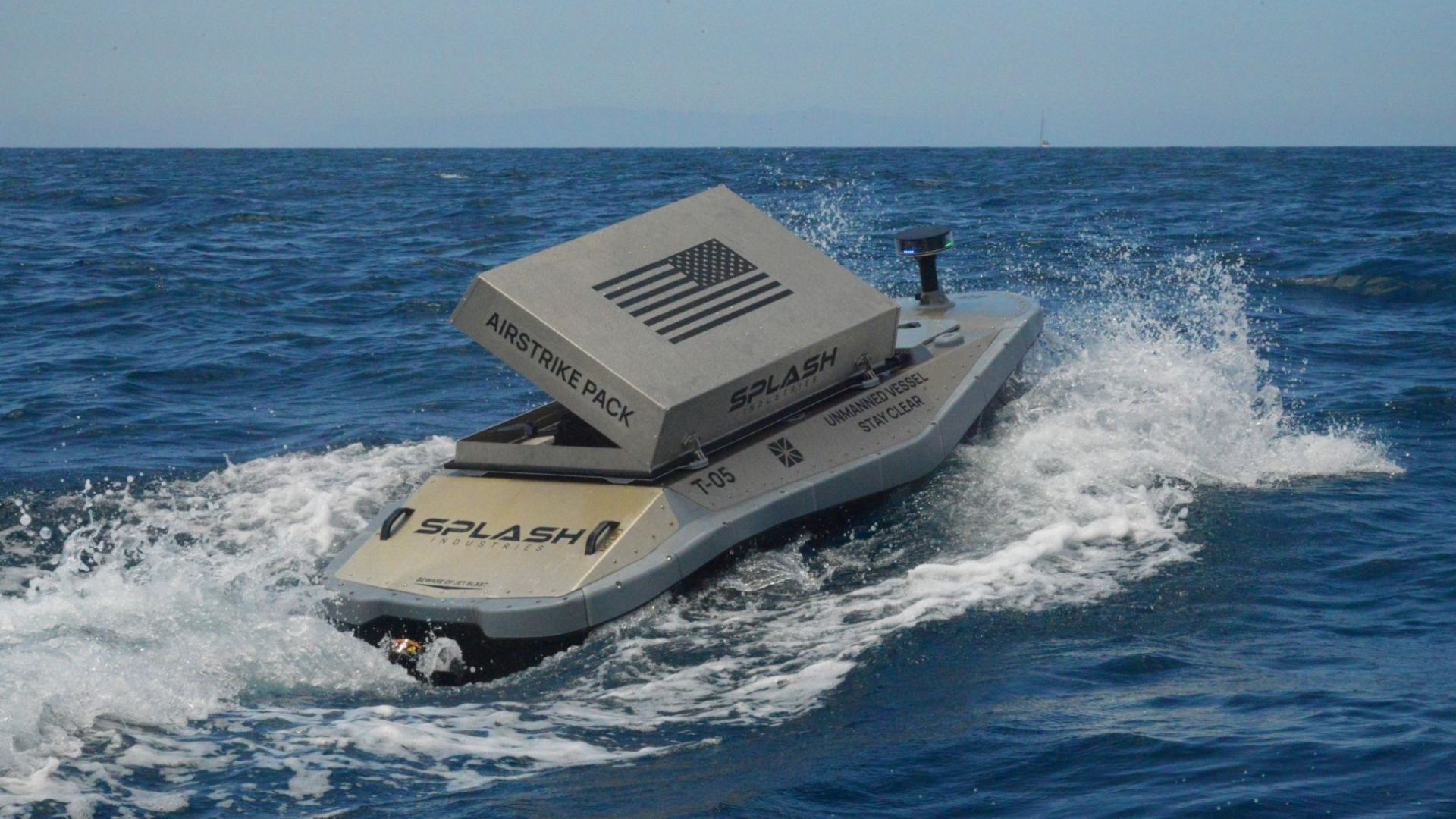
A small uncrewed surface vessel built for missions ranging from maritime surveillance to cargo delivery has gained a new capability: launching one-way aerial drones directly from the sea. California-based Splash Industries has unveiled the Airstrike Pack, a modular payload for its Typhoon uncrewed surface vessel (USV) that allows operators to deploy aerial drones through the company’s Splash C2 command-and-control software. The concept adds another layer to the growing trend of combining autonomous systems across domains. In this case, a fast robotic boat can potentially carry aerial drones closer to an area of operation before launching them, rather than requiring the aircraft to travel their entire mission from land or a conventional ship. A drone launcher built into a robot boat According to Defense Blog, the Airstrike Pack allows operators to deploy one-way aerial drones with what Splash describes as the press of a button through its proprietary Splash C2 software. Splash said the module has already been tested during a force-on-force exercise, although the company has not disclosed details about the number of drones it can carry or the size, weight, range, or capabilities of the aerial systems. The company says its vertically integrated approach, developing electronics and software in-house, helps reduce the system’s cost and complexity. “By taking this vertically-integrated approach, we’re able to provide an industry-leading UAV deployment capability at a tenth of the price of our nearest competitor,” Splash said in its announcement. The Airstrike Pack is the latest example of the modular approach built into the Typhoon platform. Instead of creating a different vessel for every mission, the 11-foot boat is designed with a configurable deck that can carry different cargo, sensors, and now aerial drone payloads. Small boat, high speed Despite measuring just 11 feet, or around 3.4 meters, the Typhoon is designed to cover significant distances autonomously. Splash says the vessel has an operational range of more than 600 nautical miles, or approximately 1,111 kilometers. It can sustain speeds above 50 knots and has exceeded 70 knots during testing. Those figures could make the platform useful for missions in which speed, range, and a relatively small physical footprint are more important than the carrying capacity of a larger uncrewed vessel. The addition of aerial drones potentially expands its role further. A USV carrying drones can act as a mobile launch platform, moving the aerial systems closer to an operational area before deployment. Typhoon has already tested autonomous Navy resupply The new drone-launching capability follows another notable demonstration involving the Typhoon during the Rim of the Pacific, or RIMPAC, exercise near Hawaii. In July, Splash said a Typhoon USV completed what it described as the first fully autonomous underway resupply of a US Navy warship. The vessel delivered parts to the amphibious assault ship USS Essex and, according to the company, navigated the ship’s wake and entered its flooded well deck without receiving radio or satellite commands during the operation. The Naval Postgraduate School’s Consortium for Advanced Manufacturing Research and Education oversaw the demonstration. During the same 24-hour period, another Typhoon reportedly transported uncrewed aerial system components manufactured aboard the USS Essex by US Marine Corps personnel back to shore. From supply boat to multi-domain drone platform The Airstrike Pack suggests Splash sees the Typhoon as more than an autonomous cargo vessel. By combining a modular surface platform with aerial drones, the company is exploring how relatively small robotic systems could perform multiple functions across the maritime battlespace. The company has also said it is preparing a larger USV called Tempest for US Navy testing. Typhoon’s newest mission module highlights a shift in uncrewed warfare where autonomous boats are increasingly becoming platforms that can carry, deploy, and support other robotic systems, not just operate alone. Get the latest in engineering, tech, space & science - delivered daily to your inbox.Kaif Shaikh is a journalist and writer passionate about turning complex information into clear, impactful stories. His writing covers technology, sustainability, geopolitics, and occasionally fiction. A graduate in Journalism and Mass Communication, his work has appeared in the Times of India and beyond. After a near-fatal experience, Kaif began seeing both stories and silences differently. Outside work, he juggles far too many projects and passions, but always makes time to read, reflect, and hold onto the thread of wonder.
This 600 mile range robot boat can now launch a swarm of one-way attack drones
Full Article
Original Source
Read the full article at Interestingengineering →KhanList aggregates and links to publicly available news content. We do not host full articles from third-party sources. Always verify important information with original sources.