
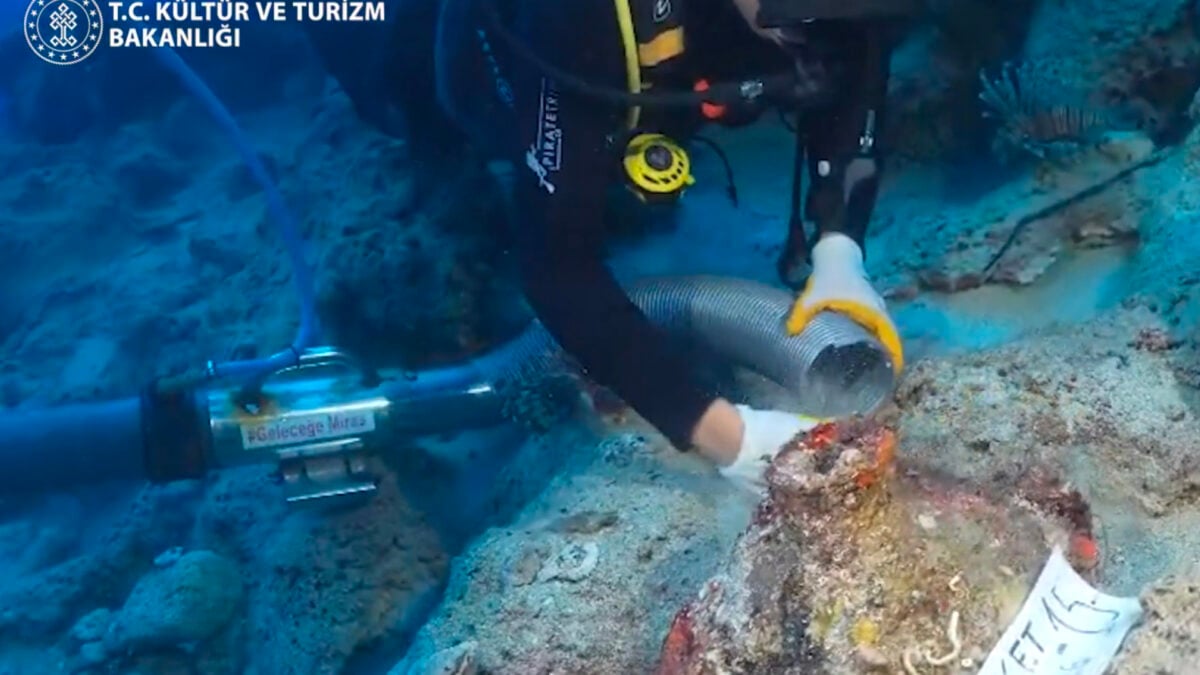
Marine archaeologists have encountered yet another ancient shipwreck, this time in Kekova, southwestern Türkiye. This particular discovery might be the world’s oldest shipwreck—carrying relics from the Early Bronze Age, roughly between 4,400 and 4,700 years ago. Mehmet Nuri Ersoy, Türkiye’s minister of culture and tourism, detailed the find in a social media post earlier today. According to Ersoy, the amphorae unearthed during the investigations likely carried olive oil or wine and shed more light on regional maritime trade from thousands of years ago. The ship was discovered in 2024 and first described in a preliminary report published this past July in the Journal of Maritime Archaeology by lead investigator Hakan Öniz, an archaeologist at Akdeniz University, Türkiye. Key details about the find are only coming to light now. As the ship’s wooden elements weren’t preserved, the team wasn’t able to conduct radiocarbon dating. However, the style of the ship’s cargo strongly suggests that it sank sometime during the Early Bronze Age. If true, the Kekova vessel would be the oldest known shipwreck in the world. Amphorae fragments identified at the shipwreck site. Credit: Türkiye Ministry of Culture and Tourism (Screenshot of video) “We continue to illuminate the history of Anatolia’s maritime trade with new findings and to pass on our cultural heritage underwater to future generations,” Ersoy remarked in his post. On the brink of discovery A map of the area up for investigation by archaeologists. © Öniz et al., 2026 According to the preliminary report, in the past 15 years authorities have recorded a whopping 420 shipwrecks of “archaeological significance” along Türkiye’s Mediterranean coasts. Most of these are from the Roman and Byzantine periods, and just three—including the Kekova shipwreck—can be attributed to the Bronze Age. Overall, the discoveries show that the area was a clear hotspot for maritime trade for thousands of years. Archaeologists encountered the Kekova shipwreck two years ago at depths between 65 and 78 feet (20 and 24 meters). Between 2024 and 2025, the team identified about 18 amphorae—a type of storage jar—with flat bottoms and side handles that follow a technique associated with designs from between 3050 BCE and 2450 BCE. From the evidence, the team explained it was highly likely that the shipwreck came from the Bronze Age, although it added that the planned summer excavations should make things clearer. A sunken time capsule Clearly, those summer excavations were eye-opening. In an interview with the BBC, Öniz called the shipwreck a “time capsule at the bottom of the sea.” Although the wooden elements of the ship didn’t survive, the ceramic amphorae miraculously preserved small traces of whatever used to be inside the pot. Images of amphorae recovered from the wreck, accompanied by drawings to represent their structure. © Öniz et al., 2026 “I looked inside and nearly fainted. I could not believe how much [residue] was visible. It wasn’t just like spots… a lot of this material was still remaining,” Karin Sowada, an archaeologist from Macquarie University in Australia who studied the residue, told the BBC. “It could be olive oil, it could be wine, it could be tree resins,” she said. In his post, Ersoy added that the amphorae were likely produced in workshops at Jordan Valley, as there is evidence of similarly shaped pots in Egypt, Troy, and Crete. One particular amphora had nine markings and two holes on its body, which sailors might have used to produce their own cheese or butter during long journeys. Stories lost to time As Öniz wrote in the preliminary report, it’s “beyond the nature of archaeology to assume that everything is known and published about the production of amphorae and amphora-like vessels during the Early Bronze Age, a period lasting approximately 1600 years.” Nevertheless, the discovery offers some fascinating windows into the extensive, lively trade networks in the Mediterranean from thousands of years ago. And, importantly, a shipwreck points to the stories of sailors who perhaps never made it back. Researchers at work at the shipwreck site. Credit: Türkiye Ministry of Culture and Tourism (Screenshot of video) “We are the first humans who [have] touched these objects after 5,000 years,” Öniz told the BBC. “We are always thinking of the sailors… the producers of the amphora and the person who carried the amphora on their shoulders to the ship, and the women who were waiting for their husbands, and they unfortunately couldn’t go back.”
This 4,700-Year-Old Shipwreck Could Be the Oldest Ever Found—and Its Jars Still Have Residue Inside
Full Article
Original Source
Read the full article at Gizmodo →KhanList aggregates and links to publicly available news content. We do not host full articles from third-party sources. Always verify important information with original sources.