
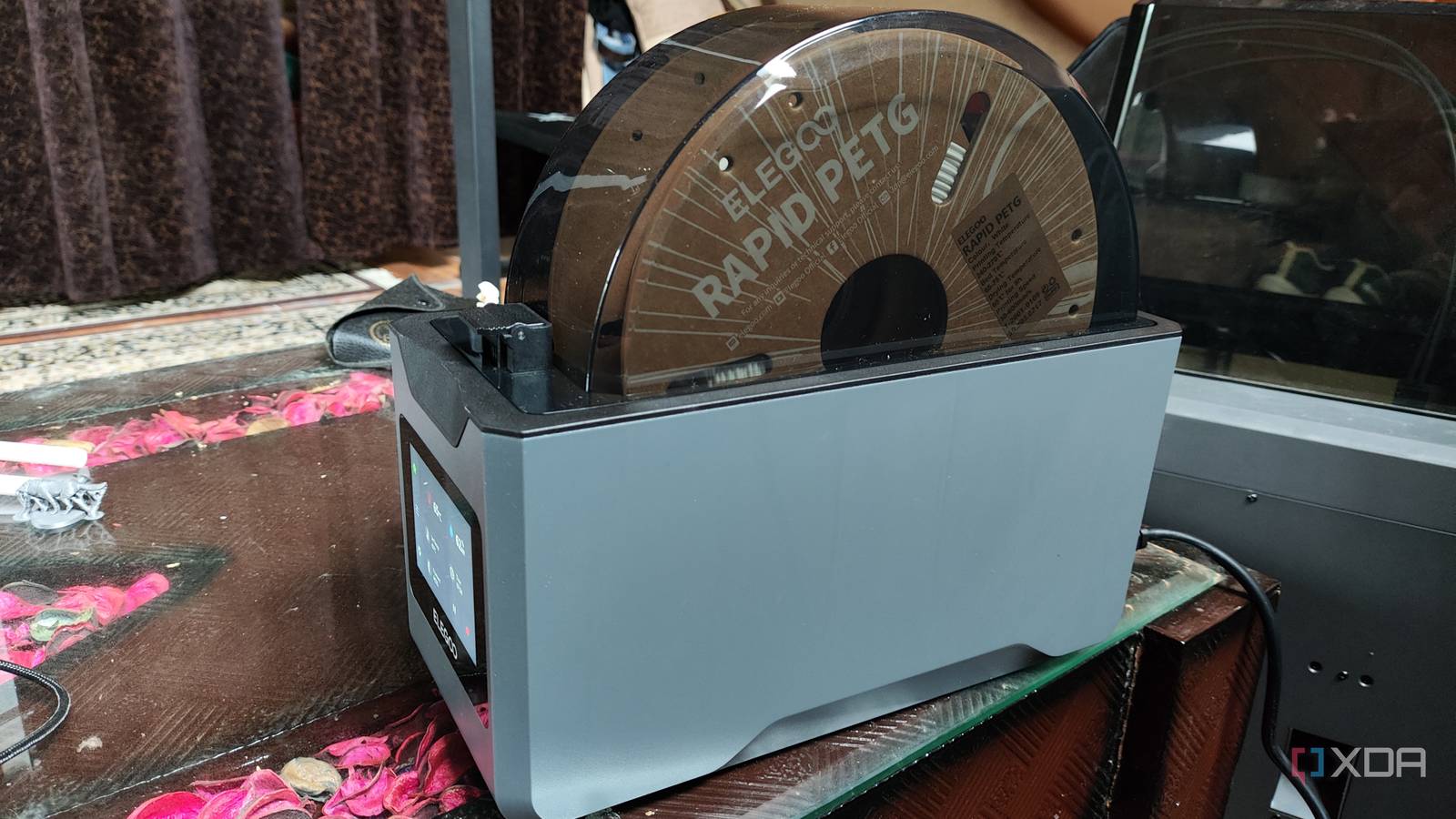
Published Aug 18, 2026, 11:00 AM EDT Ayush Pande is a PC hardware and gaming writer. When he's not working on a new article, you can find him with his head stuck inside a PC or tinkering with a server operating system. Besides computing, his interests include spending hours in long RPGs, yelling at his friends in co-op games, and practicing guitar. Ever since I got my hands on my first 3D printer, I’ve always kept an eye out for upgrades that could bolster its capabilities, with bonus points if they’re affordable and don’t require disassembling the entire chassis. Heck, between spool holders, purge buckets, tool holders, and PTFE tube splitters, I’ve built some much-needed QoL accessories using my 3D printers themselves. While my upgrades did solve some annoyances with budget-friendly printers, I still had one massive issue: any unspent filaments that I’d swap out of my printers would absorb too much moisture and cause stringing issues if I tried creating functional parts with them. So, when Elegoo contacted me about the H1 HT filament dryer, I agreed without a second thought. Now that I’ve been using it for a few weeks, I have to admit that despite some minor quirks, it’s good at ensuring my filament spools remain nice and dry, even more so when the printers in question have an open-air design. About this article: Elegoo sent me the H1 HT for testing purposes, but the company had no input into the contents of this article. Keeping my filaments moisture-free has always been a headache Especially since my Centauri Carbon printers leave the filaments exposed at all times With functional prints replacing novelty character models and custom action figures in my home lab, I’ve started using PETG and TPU pretty often as of late. Unfortunately, PETG and TPU are really hygroscopic, meaning they're a lot more sensitive to moisture than, say, PLA. Considering that the relative humidity levels in my backwater town can go past 80% when it rains, ensuring my semi-used filaments don’t get ruined by moisture has been a real hassle. The high humidity in my area is especially terrible for my budget-friendly Centauri Carbon 1 and 2 units, as Elegoo designed the printers to leave the filament spools hanging on the side as opposed to housing them within an enclosure. So, you can see why I was desperately on the lookout for a way to dry my filaments before I could use them to create tangible models from painstakingly created STL files. The H1 HT counters the open-air spool layout on my CC printers It can even feed my filaments directly to them Adding a filament dryer like the H1 HT to the equation made the exposed spool design of the Centauri Carbon 1 and 2 a lot more manageable. That’s because the H1 HT can not only dry the filaments once I remove them from packaging, but it can even send them directly to my 3D printers once I attach a PTFE tube to a rear filament opening. For my stringing test models, I shoved a PETG roll into the H1 HT and left it running at the default temperature settings of 65°C for 8 hours. Within 3.5 hours, the filament had gotten fairly warm, but since I didn’t want to tamper with the results, I left it be for the entire 8-hour period. The left model was printed with dried PETG, while the right one was made with an old (somewhat damp) PETG filament Once I fed the filament directly from the heater to my CC2, I had zero stringing on the test models. On novelty prints such as my D&D figurine, the dried PETG roll only had a little stringing around the weapon, which is pretty neat compared to the mess I got from a semi-used roll I’d left in my damp storeroom for a few days. My functional 3D prints were just as clean, with only one featuring some minor overhangs (though that was more of a model issue than a moisture-induced one). As for the drying performance, the H1 HT can hit up to 85°C, and that’s more than enough for getting rid of moisture on most materials supported by consumer-centric 3D printers. Better yet, it has built-in profiles for said materials, though I can also tweak the temperature and heating duration to accommodate off-brand spools without accidentally damaging them during the drying process. The H1 HT also doesn’t generate too much noise even when I leave it running at the max temperature, and I appreciate that it rotates the spool while it works its dehumidification magic instead of just heating a specific part of the filament roll. Too bad it only has a single filament slot without an air-tight chassis Despite its perks, the H1 HT still has some minor quirks that can be a bit of a problem for hardcore 3D printing enthusiasts. The first one is that it can only hold a single spool. It’s not really a big deal for non-AMS setups where you only have a single filament roll hooked up to the printer. But when you’ve got an AMS module (or CANVAS, as Elegoo calls its multi-material printing utility) armed with four or more filament rolls, the single-slot design of the H1 HT becomes a big bottleneck, and you’ll have to invest in more of these if you want to dehumidify more than one spool simultaneously for multi-color prints. Then there’s the fact that it’s not air-tight, so I can just leave my spools within the H1 HT for days when they’re finished drying. Credit where it’s due, Elegoo includes a desiccant slot for the filament heater, but it’s still better to use a vacuum-sealed bag after drying a roll to store it long-term. All that said, I’m still satisfied with the H1 HT. Just like the Centauri Carbon lineup, it has some quirks. But considering its affordable price tag, simple UI, and all the other QoL features, I’d say it’s a worthwhile purchase for any enthusiast looking to stop their filament spools from getting exposed to moisture on an open-air 3D printer. Elegoo H1 HT
This 3D printer accessory makes my semi-used filaments last longer
Full Article
Original Source
Read the full article at Xda-developers →KhanList aggregates and links to publicly available news content. We do not host full articles from third-party sources. Always verify important information with original sources.