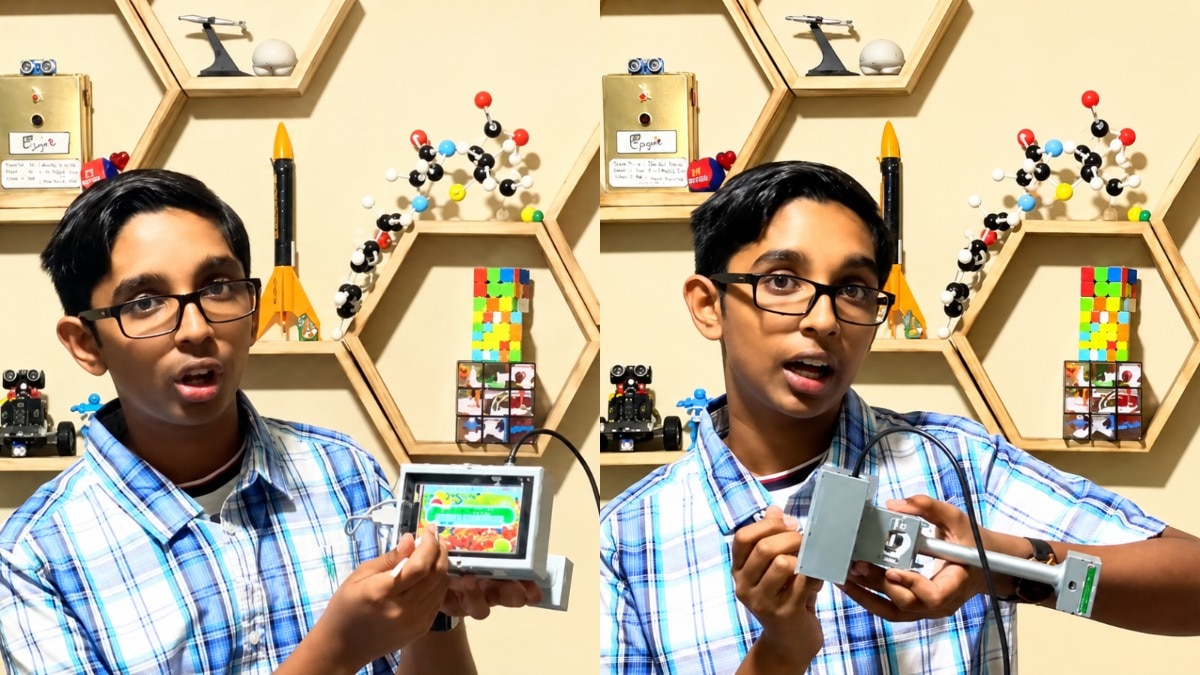
Concerned about pesticide residues on fruits and vegetables, 13-year-old Sirish Subash designed PestiScand, an AI-powered handheld detector that can identify pesticides without cutting or damaging produce. The 3M Young Scientist Challenge finalist hopes the device could one day become as simple as a phone attachment.Concerned about pesticide residues on fruits and vegetables, 13-year-old Sirish Subash designed PestiScand, an AI-powered handheld detector. (Photos: youngscientistlab.com | video screenshots)Every time you buy fresh fruits or vegetables, there's one question you probably can't answer: How much pesticide is still on them?That question inspired 13-year-old Sirish Subash, an eighth-grade student from Alton C Crews Middle School in Snellville, Georgia, to build PestiScand, an AI-powered handheld device designed to detect pesticide residue on produce without damaging it.His invention has earned him a place among the finalists of the 3M Young Scientist Challenge, one of the world's best-known student innovation competitions.WHY HE BUILT ITAccording to Sirish, existing home pesticide tests often require people to chop up fruits or vegetables and apply chemicals, making the food unusable. In his presentation, he explains that while laboratory methods are accurate, they are expensive and inaccessible for everyday families."That's why I designed PestiCon, a handheld AI-based pesticide detector," he says. His goal was simple: create a portable device anyone could use before eating fresh produce.HOW PESTISCAND WORKSInstead of using chemicals, PestiScand relies on spectrometry, a technique that shines different wavelengths of light onto fruits or vegetables and analyses the light reflected back.Every substance reflects light differently because of its chemical composition. Sirish trained an AI model to recognise reflection patterns associated with pesticide residues.Users simply point the device at a fruit or vegetable and tap "Measure." Within seconds, the AI analyses the scan and displays whether pesticide residue has been detected.Because nothing touches or damages the produce, it remains safe to eat after testing.THE NEXT VERSION IS ALREADY PLANNEDSirish isn't stopping with the current prototype.He plans to improve the sensor for greater accuracy, expand the AI model using more pesticide samples and different types of produce, and eventually turn PestiScand into a smartphone accessory.His vision is a compact scanner that clips onto the back of a phone, allowing users to check fruits and vegetables with a single tap before buying or eating them.SCIENCE WITH A PURPOSESirish says he entered the 3M Young Scientist Challenge because he wanted expert mentorship to transform a promising idea into technology that could genuinely improve lives."In 15 years, I hope to be designing and building devices that can help make the world a better place, especially with climate change and environmental issues," he says.For now, PestiScand remains a student prototype. But it also offers a glimpse of how artificial intelligence and simple engineering could make food safety more accessible for everyone.The 3M Young Scientist Challenge, organised by 3M and Discovery Education, invites students in Grades 5 to 8 across the US to develop science and engineering solutions for real-world problems. The competition is open to eligible students from all 50 states and the District of Columbia.- EndsPublished On: Aug 9, 2026 13:51 IST
This 13-year-old built an AI device that can detect pesticides on fruits in seconds
Full Article
Original Source
Read the full article at Indiatoday →KhanList aggregates and links to publicly available news content. We do not host full articles from third-party sources. Always verify important information with original sources.