
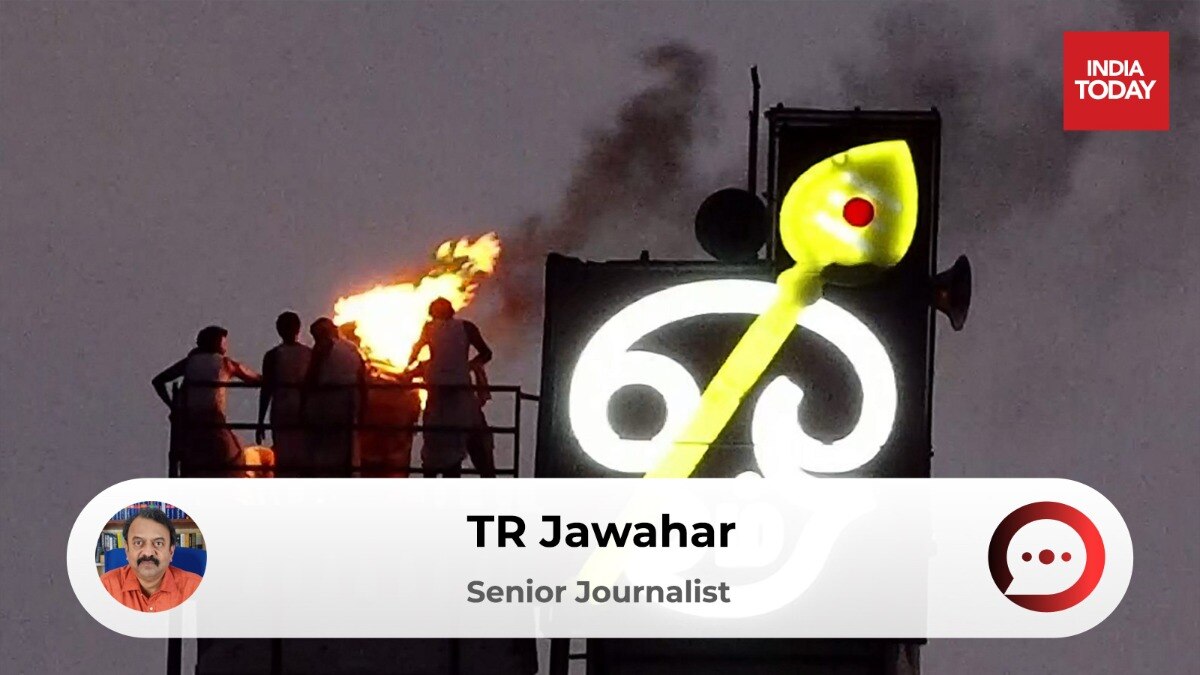
If Mohammed will not go to the mountain, the mountain must come to Mohammed, goes the old saying. At Thirupparankundram, Murugan, Muslim worshippers and the mountain itself have all ended up in court. And between the Lord and the Lordships, an entire apparatus of government has become entangled in the lighting of a lamp.The Supreme Court's intervention on Friday in the Karthigai Deepam dispute has consequences far beyond the range of illumination of a ceremonial flame. The Board of Trustees has been displaced from temple administration, senior bureaucrats and police officials face contempt notices, two retired judges have been appointed as receivers and a central paramilitary force has been entrusted with the security of the temple and the hill. The flame is to travel from the customary mandapam to the disputed Deepathoon on Saturday, subject to arrangements prescribed by the Court.The original dispute, meanwhile, survives remarkably intact. The Court is presently dealing with the failure to implement its order rather than finally adjudicating the competing religious and proprietary claims that occasioned it. The battle over the lamp has produced another battle over the law, even before the battle over the land has been settled.THE PRICE OF NON-COMPLIANCEThe proceedings before Justices Aravind Kumar and Vipul M. Pancholi on Friday marked a dramatic departure from the carefully calibrated interim arrangement of November 20. That order had permitted a one-time lighting at the Deepathoon, prescribed elaborate administrative safeguards and protected the competing legal claims. The Madurai Bench subsequently recorded the Collector's assurance of compliance. Yet the Deepathoon remained dark on November 24. The judicial language on Friday was considerably more consequential than the earlier debate over permit and shall. The Bench described the conduct before it, prima facie, in terms of wilful and flagrant disobedience, warned of constitutional chaos and spoke of the necessity of dealing with such a situation with an “iron hand”.The Collector's formal apology and explanation that the temple trustees had decided against the additional ceremony did not persuade the Court to close the matter. Contempt notices have followed, with December 15 reported as the next date of proceedings. There is another setback for the State. The Supreme Court has vacated its November 20 stay of the High Court judgment, citing the failure to implement its interim order. The precise consequences for the High Court's findings will become clearer when the written order is available. But the irony is already evident: the government had obtained interim judicial protection while contesting the High Court judgment. Its subsequent conduct has cost it that protection.Vijay inherited the dispute over the lamp. His administration has acquired the dispute over the law.THE PORTFOLIOS AND THE NOTICESPerhaps the most politically consequential aspect of Friday's proceedings is the scrutiny that now extends beyond the Madurai Collectorate to the higher reaches of the State administration. The Chief Secretary has been directed to appear personally and furnish details of communications between officials, including emails, telephone calls and messages.The inquiry could consequently establish not merely who failed to implement the order, but how the decisions were taken, communicated and executed. The political executive has the portfolios; the permanent executive now has the notices.The Court's reported observation that executive authorities “seem to have acted at the dictates of their political bosses” is particularly significant. The qualifying word seem matters. No minister has been identified in that observation, and no evidence presently establishes that Chief Minister Vijay personally issued instructions to frustrate the ceremony. Contempt liability is individual, and the proceedings must establish wilfulness before determining guilt. Political responsibility, however, has a wider circumference.In government, files normally travel upwards for approval. At Thirupparankundram, responsibility appears to have travelled downwards. The Collector pointed towards the trustees, while the precise role of the higher administrative and political establishment awaits examination.The All India Services Conduct Rules contain an interesting safeguard in this context. Rule 3(3) envisages written confirmation of oral instructions from official superiors. The bureaucrat's file, so often caricatured as a refuge from responsibility, may now become his best defence.Article 144 of the Constitution requires civil and judicial authorities to act in aid of the Supreme Court, while Article 129 empowers the Court to punish contempt of itself. A civil servant's administrative obligation to his government operates within this constitutional framework. The Thirupparankundram proceedings could become an instructive case study in bureaucratic accountability, particularly when the demands of political authority and judicial authority appear to diverge.For Vijay, the political predicament is equally uncomfortable. A government that came to power promising a different administrative culture now finds the country's highest court examining the communications within that administration.ARANGAVALARS, AGAMAS AND AUHTORITYThe displacement of the temple's Board of Trustees opens another fascinating chapter in the long and contentious history of government administration of Hindu temples in Tamil Nadu.An arangavalar is, literally, a guardian of aram, a Tamil word encompassing virtue, righteousness and moral duty. The five trustees at Thirupparankundram were reportedly appointed through a government order issued on November 13. Barely a fortnight later, their administration has been entrusted to two former judges, Justices S. Vaidyanathan and V. Parthiban, appointed as receivers by the Supreme Court.The trustees had invoked Agamic prescriptions, historical records and the views of the temple's Sthanikars to justify retaining the customary location. The administration subsequently invoked the trustees to explain its inability to implement the Court's arrangement. The guardians of religious tradition now find themselves answering questions concerning constitutional duty.The Tamil Nadu Hindu Religious and Charitable Endowments Act, 1959, contains an elaborate framework for temple administration. Section 28 requires trustees to administer institutions in accordance with the terms of the trust, institutional usage and lawful directions. Section 49-B provides a mechanism for the Executive Officer or chairman to withhold implementation of resolutions considered unlawful, beyond statutory powers or likely to disturb public peace.Was that mechanism available in the circumstances of November 24? Was it considered or exercised? These questions acquire particular relevance because the temple's own administrative machinery might have provided a means of addressing the contentious resolution before the controversy reached its present proportions.Section 53 separately provides for suspension, removal or dismissal of trustees through statutory disciplinary proceedings, with safeguards including charges and an opportunity to respond. Its provision concerning disobedience of orders specifically refers to orders issued under the Act. The present judicial receivership is a different exercise of authority, arising from proceedings concerning compliance with a Supreme Court order.The distinction opens a wider jurisprudential inquiry. Article 142 empowers the Supreme Court to do complete justice, while its 1998 judgment in Supreme Court Bar Association v. Union of India examined the limits of that extraordinary power in relation to substantive statutory law. The scope, duration and precise terms of the present receivership will therefore be of considerable interest to administrators of religious institutions.There is also the constitutional distinction, articulated in the celebrated Shirur Mutt judgment of 1954, between religious affairs and the secular administration associated with religious institutions. Articles 25 and 26 provide the larger constitutional framework for that distinction.The receivers have reportedly been directed to administer the temple in keeping with its traditions, rituals and applicable law. The management has changed; the religious traditions are expressly protected. The retired judges have been entrusted with administration, not the administration of theology.A HILL UNDER FEDERAL GUARDFor Tamil Nadu, with its long history of asserting State autonomy, the deployment of the Central Reserve Police Force at Thirupparankundram introduces a particularly striking federal dimension.Public order and police ordinarily fall within the State's constitutional domain, while the deployment of Union forces in aid of civil power has its own constitutional framework. In this instance, however, the Centre has entered the scene through a judicial door rather than a political one.The CRPF has reportedly been entrusted with the security of the temple and the entire hill, including the protection of the dargah and the unobstructed access of Muslim worshippers. The latter direction is as important as the former. The central force is being assigned responsibility for the security of a shared sacred landscape, not merely the performance of a Hindu ritual.There is another interesting departure from the November 20 arrangement. The earlier order envisaged a restricted Devasthanam-authorised team. The latest directions contemplate wider participation by devotees, subject to security considerations and restrictions concerning proximity to the dargah. The precise modalities will determine how that permission operates on Saturday.The government's resistance to the earlier, tightly restricted arrangement has thus culminated in a potentially wider religious observance under a different administrative and security dispensation. The flame is local, the controversy communal, the litigation national and the security now federal.The BJP and Hindu outfits will undoubtedly celebrate the development. Vijay's allies, who had defended the customary practice and opposed what they regarded as communal mobilisation, will have their own interpretation. Yet a judicial intervention to enforce compliance is not necessarily a vindication of every historical or religious assertion made by the successful applicants.WHEN THEOLOGY MEETS TOPOGRAPHYStrip Thirupparankundram of its contemporary political accretions and one encounters, at the foundation of the controversy, a substantial property dispute. The legal questions concerning the hill's ownership, boundaries and access have occupied courts for more than a century. The Privy Council's 1931 decision itself dealt with competing claims over different portions of the sacred landscape.God may be omnipresent, but the law still requires a survey number. Where exactly does the disputed pillar stand? Who owns the land beneath and around it? Is it a ceremonial lampstand or, as the government contends, a colonial survey marker? What historical evidence establishes the claimed ritual at that particular location?These are questions capable of examination through property records, historical documents, archaeological evidence and established legal principles. They have acquired a religious intensity far exceeding their geographical dimensions.Ownership, moreover, does not automatically establish religious custom, just as evidence of religious usage does not necessarily confer ownership. Section 63(e) of the HR&CE Act itself recognises the determination of established institutional usage as a distinct statutory question. When theology meets topography, even devotion acquires a boundary.The danger of allowing the underlying controversy to fester is that every Karthigai could acquire its own calendar of litigation, political mobilisation, prohibitory orders and police deployment. A place of pilgrimage could gradually become a permanent theatre of competing assertions.There is also a distinction between the religious precedent and the institutional precedent of Friday's proceedings. The Supreme Court's earlier order had expressly protected the parties against the creation of permanent customary or proprietary rights through the interim ceremony. The precise operation of those safeguards following the vacation of the stay awaits clarity.The institutional consequences, however, are already striking. The proceedings demonstrate how failure to implement a particular judicial arrangement can lead to scrutiny of official communications, displacement of existing management and reassignment of security responsibilities. An exceptional interim intervention need not become a universally applicable legal precedent for its administrative repercussions to be felt elsewhere.The Court can fix a date for lighting a lamp. History is less amenable to a deadline. So, tomorrow, Saturday, may bring only illumination without any resolution.THE LORD AND HIS DEVOTEEThe pilgrim goes to Thirupparankundram in search of grace. The politician has discovered grievance, and the lawyer has found grounds. Somewhere between these competing pursuits lies the ordinary devotee's uncomplicated relationship with Murugan, just as the Muslim worshipper's visit to the dargah need not constitute a declaration of territorial or political ambition.Tomorrow, the flame is expected to travel from Uchipillaiyar's mandapam to the Deepathoon under the protection of a central force and the authority of the country's highest court. Tamil Nadu's bureaucrats will have their explanations to submit, the trustees their legal battles to fight, the politicians their victories to proclaim and the lawyers their arguments to prepare. The lamp may burn, but the questions of property, practice and possession will survive its glow.The Tamil poets took Murugan to the hills, and successive generations of pilgrims went there to find him. The ordinary devotee still seeks a darshan, not a declaration of title, and has little appetite for affidavits, Agamic arguments or electoral arithmetic. The Lord and the Lordships have occupied enough of his religious calendar.Thirupparankundram may finally have its flame tomorrow. What it is still waiting for is the freedom to be a place of pilgrimage rather than a permanent place of litigation.- Ends
Thiruparankundram: The lord, the lordships and the limits of power
Full Article
Original Source
Read the full article at Indiatoday →KhanList aggregates and links to publicly available news content. We do not host full articles from third-party sources. Always verify important information with original sources.