
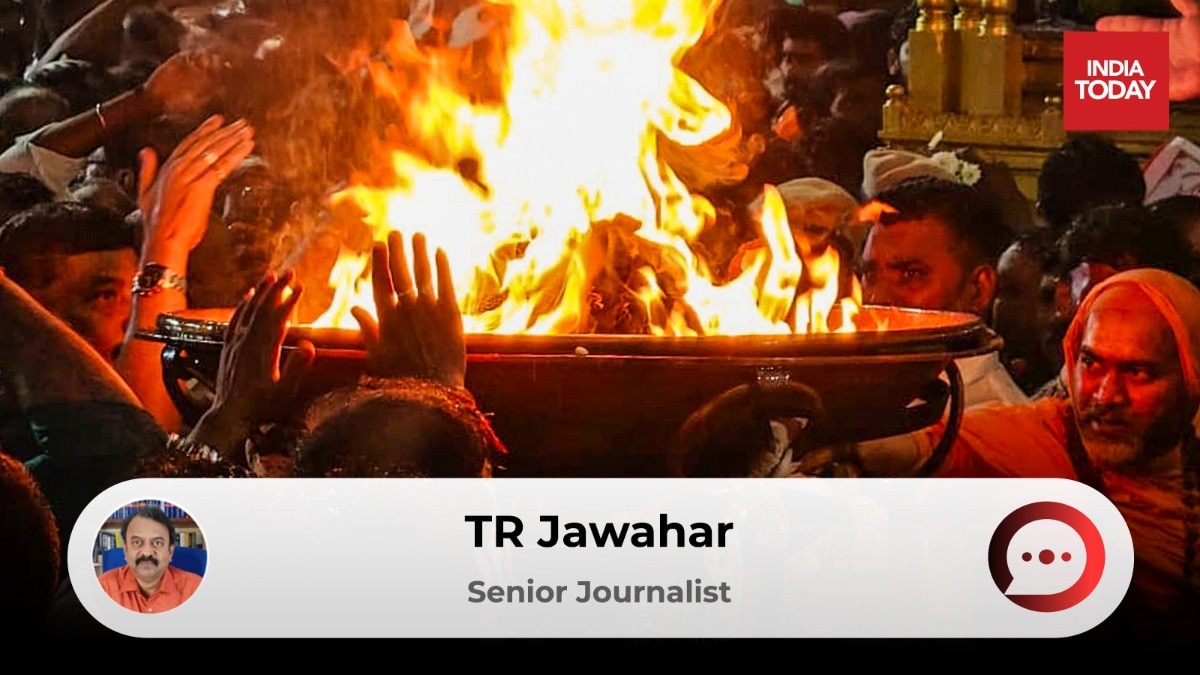
In Tamil Nadu, even a lamp must now carry a legal brief. At Thiruparankundram, near Madurai, the approaching Karthigai Deepam festival has brought the Supreme Court into a dispute involving a temple, a dargah, an ancient hill, a government department and, inevitably, politicians eager to claim the light. On November 20, the court permitted the ceremonial lamp to be lit at the disputed Deepathoon pillar on November 24, but only for this year. It stayed the Madras High Court's findings on the larger dispute and left the competing claims open.The court has permitted a flame without handing over the hill. That distinction has become the latest complication in a controversy where devotion, possession and political ambition have acquired remarkably similar vocabularies. What began as a disagreement over the location of a lamp now raises questions about religious custom, property, temple administration and the authority to speak for the faithful. The festival will last an evening. The argument has already lasted generations.A HILL WITH MANY HISTORIESThiruparankundram is one of Murugan's six celebrated abodes, the Arupadai Veedu, and its rock-cut Subramaniaswamy temple occupies an important place in Tamil religious life. But the hill has accommodated more than one spiritual tradition. Jain beds and inscriptions recall an older ascetic presence, while the dargah of Hazrat Sultan Sikandar Badusha Auliya marks its Islamic association. The granite outcrop has witnessed centuries of worship and changing authority. Its religious history is considerably older and more complicated than the slogans now circulating around it.The legal geography is equally instructive. A civil suit filed in 1920 produced a decree in 1923 recognising the temple's rights over most of the unoccupied hill and pilgrim pathway, while identifying the summit, mosque precincts, Nellithope and the approach to the mosque as Muslim property. Subsequent appeals culminated in the Privy Council restoring the trial court's arrangement in 1931. The settlement established that neither religious institution could simply claim the entire landscape. One hill had acquired two legally recognised sacred presences, with the older Jain remains providing a quiet reminder that history rarely confines itself to contemporary political categories.The present controversy concerns a stone pillar near the summit, roughly 50 metres from the dargah. Petitioners describe it as the Deepathoon, intended for ceremonial illumination. Tamil Nadu's Hindu Religious and Charitable Endowments department disputes the claimed custom, maintaining that the established location is the Deepa Mandapam near the Uchipillaiyar temple. The quarrel is hardly new. Records describe attempts to light lamps near the summit in 1862 and 1912, while the Madras High Court's 1996 ruling retained the customary mandapam and allowed consideration of alternative sites subject to safeguards. The law has been circling this hill almost as faithfully as the pilgrims.WHEN THE FLAME REACHED THE COURTThe latest round began with petitions seeking permission to light the Deepam at the hilltop pillar. In December 2025, Justice G. R. Swaminathan of the Madras High Court allowed the request, directing the temple authorities to conduct the ritual with police protection. The order triggered further litigation, administrative resistance and controversy over its implementation.A Division Bench upheld the direction in January 2026, while restricting access to a small official team. The Tamil Nadu government challenged the ruling, arguing that the proposed location lacked an established ritual tradition and disturbed existing arrangements.The State's most intriguing argument concerned the pillar itself. It maintained that the supposed Deepathoon was actually a survey stone associated with colonial-era mapping, not an ancient ceremonial lampstand. Survey markers dot hills and high points across the country, its counsel argued, warning that a judicial endorsement could transform thousands of ordinary survey pillars into religious sites.The worshippers countered that the stone's carved depression was designed to hold oil, ghee and wicks. The Madras High Court had accepted that interpretation and rejected the survey-marker claim. The Supreme Court has now stayed those findings without settling the stone's identity. A dispute over illumination has thus reached the extraordinary stage of debating whether the object to be illuminated was ever intended to hold a flame.The Supreme Court has fashioned a narrower solution. Justices Aravind Kumar and Vipul M. Pancholi permitted authorised temple representatives and government officials to light the lamp on November 24. The Madurai Collector will coordinate arrangements with the temple Executive Officer, the Archaeological Survey of India and the Police Commissioner. Public access, processions and demonstrations at the site are prohibited.The judges recognised an unusual difficulty. A festival missed this year cannot be recreated after the litigation ends. Equally, a ceremony performed cannot be undone. Their solution permits the occasion without allowing it to manufacture a legal precedent. The permission establishes neither a customary right nor future access or ownership.The court has allowed the light while keeping the legal claims in the dark for further examination.THE RAJ'S RELIGIOUS PAPERWORKThe controversy also exposes an old peculiarity of Indian secularism. Tamil Nadu's government administers thousands of Hindu religious institutions through the HR&CE department, whose administrative ancestry reaches back to colonial Madras.The East India Company's Regulation VII of 1817 brought religious endowments under official supervision. The Religious Endowments Act of 1863 subsequently transferred important responsibilities away from direct government management. Later legislation, notably the Madras Hindu Religious Endowments Act of 1926 and the post-Independence Tamil Nadu HR&CE framework, established the modern regulatory system.The Raj left the throne, but much of its paperwork remained.Temple administration was never a simple contest between religious freedom and State interference. Temples possessed land, received donations, employed personnel and performed public functions. Their management could involve disputes over hereditary privileges, accountability, caste access and financial misuse. Regulation arose partly from those problems, while creating fresh arguments about the government's authority over religious institutions.The contrast with the management of mosques, churches and other religious bodies remains politically contentious, although those institutions also operate under their own statutory arrangements. Tamil Nadu's model places the State deeply inside Hindu temple administration while requiring it to remain constitutionally impartial between religions.At Thiruparankundram, the government invokes the temple's established rights and customary practice to resist a demand made in the name of Hindu devotion. Its opponents accuse it of obstructing that very devotion. Both sides claim to protect the institution, while disagreeing over who should decide what protection means.THE PARTY OF PIETYThe BJP and Hindu outfits have seized upon the dispute as evidence of what they call the TVK government's hostility towards Hindu religious sentiment. They have pressed for the Deepam to be lit at the disputed pillar, portraying the issue as a test of religious rights and political resolve.Yet the argument has proved less accommodating than the familiar slogans. Vijay's government is not opposing Karthigai Deepam itself. It is defending the existing ritual location, the temple administration's position and an established arrangement involving the dargah. Its opponents want an additional site recognised, while the Supreme Court has allowed that site to be used without endorsing the historical claim.The party of piety has consequently encountered a rather inconvenient rival. TVK can invoke Murugan, temple rights, Tamil custom and local religious sentiment without adopting the BJP's political interpretation. The contest is no longer between a party proclaiming devotion and an administration professing indifference. It is between competing claims to religious legitimacy.The BJP's wider difficulty in Tamil Nadu has often been its inability to convert national prominence into a commanding regional electoral presence. Here, too, the language of faith must negotiate local histories, temple institutions and traditions that do not necessarily follow national party scripts.Vijay has his own calculations. A Chief Minister who cultivates religious respectability while distancing himself from the BJP cannot afford either the appearance of hostility towards Hindu worship or a confrontation with Muslim rights. The government has chosen the language of custom and administration. Its opponents have chosen the language of religious assertion. The Supreme Court has declined to endorse either political narrative.The BJP came seeking a contest over piety. It found a dispute over possession, precedent and the peculiar politics of Tamil Nadu's temple administration.WHO OWNS THE SACRED?The larger question reaches beyond the BJP and TVK. Indian politics increasingly treats religious heritage as a source of contemporary authority. A temple festival becomes a political demonstration, an old property decree acquires fresh electoral relevance, and an ancient monument is summoned to satisfy new political appetites.Thiruparankundram offers a particularly revealing example because its past cannot be reduced to a single convenient story. Hindu worship, Jain antiquity and Islamic devotion have left their marks upon the same landscape. Their histories have not always been free of conflict, but neither can they be erased by the political urgency of the present.There is also a distinction between religious sentiment and the legal proof of religious practice. A devotee may sincerely believe that a ritual belongs at a particular site. A temple administration may cite a different custom. A court must examine evidence, rights and statutory authority. Political parties, meanwhile, operate under the less demanding rules of public mobilisation.The Supreme Court's reference to unresolved constitutional questions under Articles 25 and 26 places this local dispute within India's larger debate over individual religious freedom, denominational rights and judicial intervention in matters of faith. Those questions extend from Tamil Nadu to Sabarimala and other contested religious institutions across the country.The present order leaves them open. Its restraint also denies politicians the easy satisfaction of claiming a complete judicial victory.THE LIGHT AND THE LONG SHADOWOn November 24, a small authorised team is expected to climb towards the Deepathoon and light the ceremonial lamp. Worship at the customary mandapam will continue, and access to the dargah must remain undisturbed. The ceremony will take place under official supervision, without the crowds and slogans that have accompanied the political controversy.For one evening, the hill will carry a flame whose legal meaning the Supreme Court has deliberately left undecided. That is the remarkable outcome of a dispute in which almost everyone has sought to establish something larger than the ritual itself.The temple has its traditions, the dargah its recognised rights, the government its statutory responsibilities and the courts their constitutional obligations. Political parties have discovered that the same sacred landscape can illuminate several competing ambitions.Thiruparankundram's history has survived kings, colonial administrators, religious disputes and generations of litigation. It will survive the present controversy too. The more immediate question is whether those seeking political advantage can resist claiming ownership of every sacred symbol that enters public life.A lamp may illuminate a temple, a hill or a dargah. In Tamil Nadu's crowded political theatre, it has also become a searchlight trained upon the voter. The Supreme Court has permitted the flame without awarding its glow to anyone.The light will burn for an evening. The politics of possession may prove considerably harder to extinguish.(Views expressed in this opinion piece are those of the author)- Ends
Thiruparankundram: A lamp, a hill and the politics of possession
Full Article
Original Source
Read the full article at Indiatoday →KhanList aggregates and links to publicly available news content. We do not host full articles from third-party sources. Always verify important information with original sources.