
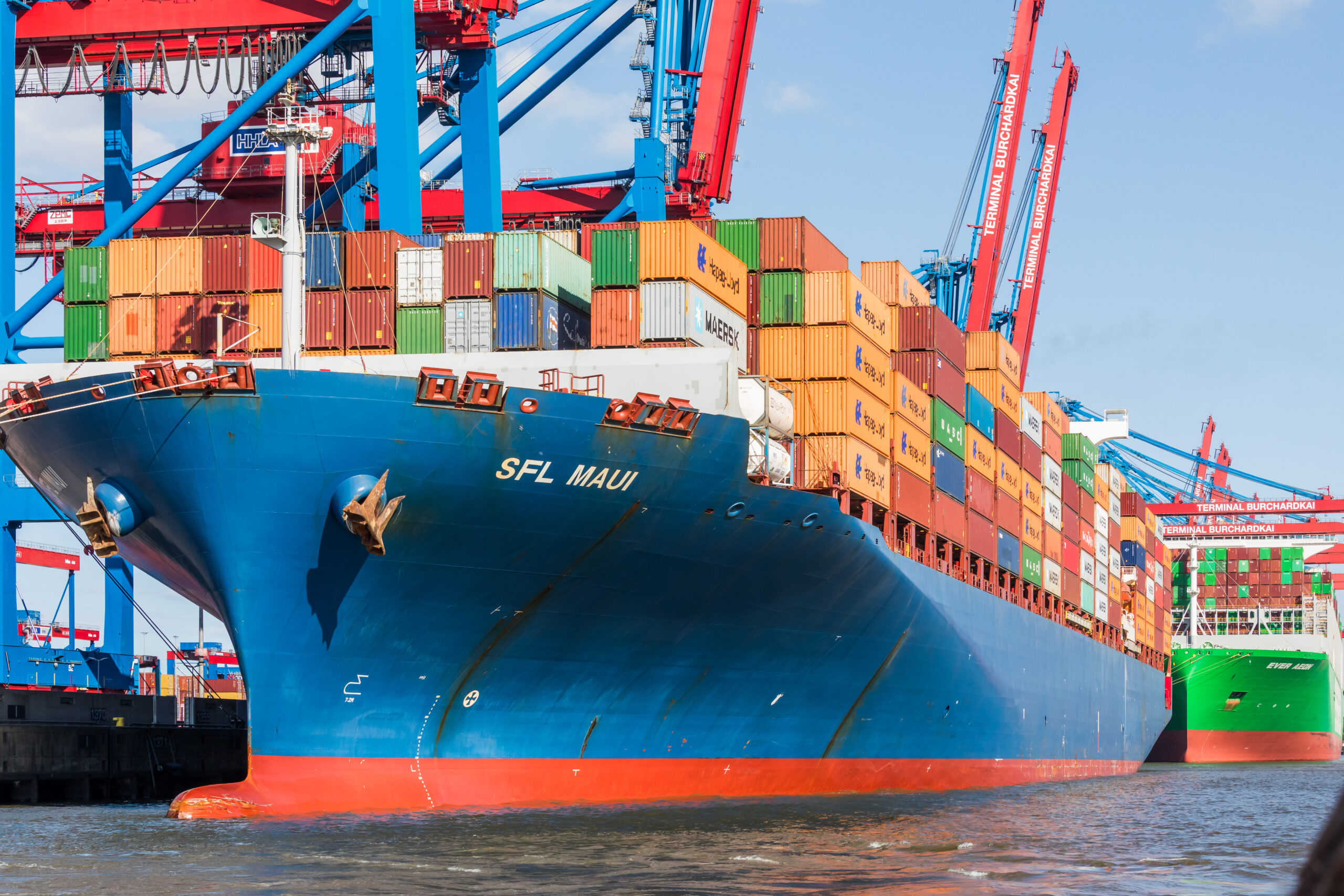
November 16, 2026 • 12:46 pm ET Elisabeth Braw Bottom lines up front Attacks on shipping have become pervasive in the Strait of Hormuz, the Persian Gulf, the Red Sea, the Bab el-Mandeb, the Black Sea, and the Sea of Azov, making the oceans as unsafe as they have ever been in the last 30 years.Russia, Iran, the Houthi rebels, and others now deliberately target merchant shipping in these waters as a tool of geopolitics.Far from suspending operations, the shipping sector has adjusted to the violence: In the Strait of Hormuz, shipping companies risking the transit charge significant premiums. The United Nations Convention on the Law of the Sea (UNCLOS), which was adopted in 1982 and came into force in 1994, governs a wide range of aspects concerning the world’s oceans. Navigation is among them. Specifically, UNCLOS codifies all vessels’ right to freedom of navigation, including through straits. Although a few countries—such as the United States, Iran, and Israel—have not ratified UNCLOS, they have mostly adhered to its rules. So have countries that have ratified the convention. As the UNCLOS negotiators intended, the resulting order has allowed global shipping to operate extremely efficiently. This efficiency, in turn, has resulted in lower transportation costs for any cargo traveling by sea, which is more than 80 percent of all cargo.1“Review of Maritime Transport 2025,” United Nations Conference on Trade and Development, 2025, https://unctad.org/system/files/official-document/rmt2025_en.pdf. Until 2022, this freedom of navigation worked remarkably well. Even when conflicts erupted between countries or other parties, shipping tended to be spared. Indeed, between the implementation of UNCLOS and 2022, the most serious threat to global shipping was Somali piracy in the early 2000s, which a group of the world’s nations—led by Western nations but also including China—came together to defeat in the early 2010s. To be sure, China systematically violated UNCLOS by building artificial islands and refusing to acknowledge UNCLOS’s mandatory dispute-resolution mechanism, but armed attacks on shipping were rare. That changed with Russia’s full-scale invasion of Ukraine in February 2022. As its soldiers poured into the neighboring nation, Russia also declared what it labeled a blockade in parts of the Black Sea.2Gregory Noone, et al., “Conceptualizing IHL: Legality of the Targeting of Merchant Ships,” Center for Civil Liberties, August 19, 2024, https://ccl.org.ua/en/positions/conceptualizing-ihl-legality-of-the-targeting-of-merchant-ships/. In subsequent days and weeks, several merchant vessels without military links were attacked in the Black Sea; these attacks have been widely attributed to Russia.3Ibid. This was a violation of the laws of naval warfare, which are most recently laid down in the San Remo Manual from 1994. In Article 60, the manual, which codifies the Geneva Conventions and other rules and conventions, states, “the following activities may make enemy merchant vessels into military objectives: engaging in belligerent acts on behalf of the enemy, e.g., laying mines, minesweeping, cutting undersea cables and pipelines, engaging in visit and search of neutral merchant vessels or attacking other merchant vessels; acting as an auxiliary to an enemy’s armed forces, e.g., carrying troops or replenishing warships; being incorporated into or assisting the enemy’s intelligence gathering system, e.g., engaging in reconnaissance, early warning, surveillance, or command, control and communications missions; sailing under convoy of enemy warships or military aircraft; refusing an order to stop or actively resisting visit, search or capture; being armed to an extent that they could inflict damage to a warship; this excludes light individual weapons for the defense of personnel, e.g., against pirates, and purely deflective systems such as chaff; or otherwise making an effective contribution to military action, e.g., carrying military materials.”4Ibid. Article 67 of the San Remo Manual stipulates that merchant vessels flying the flag of neutral states cannot be attacked unless they “are believed on reasonable grounds to be carrying contraband or breaching a blockade, and after prior warning, they intentionally and clearly refuse to stop, or intentionally and clearly resist visit, search or capture; engage in belligerent acts on behalf of the enemy; act as auxiliaries to the enemy’s armed forces; are incorporated into or assist the enemy’s intelligence system; sail under convoy of enemy warships or military aircraft; or otherwise make an effective contribution to the enemy’s military action, e.g., by carrying military materials, and it is not feasible for the attacking forces to first place passengers and crew in a place of safety. Unless circumstances do not permit, they are to be given a warning, so that they can re-route, off-load, or take other precautions.”5Ibid. Later in 2022, the United Nations and Turkey managed to negotiate a “grain corridor” with Russia and Ukraine that would allow ships carrying crucial Ukrainian grain to transit the Black Sea and reach world markets, but Russia left the agreement in July 2023. The same month, the Russian Defense Ministry declared that it would treat all vessels sailing to Ukrainian ports as permissible targets, regardless of the ships’ cargoes or flags.6“Russia Threatens Black Sea Ships after Grain Deal Exit,” Le Monde and Agence France-Presse, July 20, 2023, https://www.lemonde.fr/en/international/article/2023/07/20/moscow-threatens-black-sea-ships-after-grain-deal-exit_6059930_4.html#. This was a violation of international humanitarian law. Indeed, because Russia has still not declared war against Ukraine, one could argue that the laws and conventions of peacetime still apply. Either way, Russia’s attacks on the vessels were illegal. Russia’s attacks on ships in 2022 and 2023 were, however, just a prelude to the explosion in attacks on merchant vessels that began in November 2023 and has continued ever since. Indeed, these attacks are accelerating and now encompass the Black Sea, the Sea of Azov, the Strait of Hormuz, the Persian Gulf, the Red Sea, and the Bab el-Mandeb. With merchant shipping under regular attack in these crucial waters and the global community unable to stem the violence, the attacks can easily spread further as nations and other actors decide it is in their interest to attack select merchant vessels. A new era of attacks on shipping The Houthis’ first round In November 2023, days into Israel’s war in Gaza, Yemen’s Houthi rebels hijacked the Bahamas-flagged ship Galaxy Leader in the Red Sea, declaring that it was a demonstration of support for “the oppressed Palestinian people.”7Matina Stevis-Gridneff and Aaron Boxerman, “Yemen’s Houthis Hijack a Ship in the Red Sea,” New York Times, November 19, 2023, https://www.nytimes.com/2023/11/19/world/middleeast/israel-yemen-houthis-hijacked-red-sea-ship.html?smid=url-share. A few hours before the attack, the militia had threatened to target Israeli-flagged, -owned, and -operated ships traversing the Red Sea. (The Galaxy Leader’s owner was a British company ultimately owned by an Israeli entrepreneur.) The attack was the first in what would become a lengthy and devastating string of attacks on merchant vessels in the crucial Red Sea. Even though the European Union (EU) dispatched a force to protect shipping and the United States and the United Kingdom (UK) launched a coalition of countries that protected ships in the Red Sea and also sought to weaken the Houthis through attacks on their land bases, the strikes on merchant vessels continued. Most Western-linked ships rerouted away from the Red Sea and the adjacent Suez Canal to the Cape of Good Hope route. This had a dramatic effect on the Suez Canal. In the second quarter of 2023, 6,856 ships had transited the canal; in the second quarter of 2024, only 3,278 ships did.8“Navigation Statistics,” Suez Canal Authority, last visited October 21, 2026, https://www.suezcanal.gov.eg/English/Navigation/Pages/NavigationStatistics.aspx. (The author has discussed the Houthis’ attacks extensively in several reports for the Atlantic Council.9See, for example: Elisabeth Braw, “What Attacks on Shipping Mean for the Global Maritime Order,” Atlantic Council, August 9, 2024, https://www.atlanticcouncil.org/in-depth-research-reports/report/what-attacks-on-shipping-mean-for-the-global-maritime-order/#history-of-attacks-on-shipping.) Yet despite the highly dangerous state in the Red Sea and the significant resources the United States and European countries needed to allocate to ascertain some degree of passage there (without assistance from other major nations such and Russia and China), the effect on shipping was manageable because freedom of navigation was guaranteed elsewhere. To be sure, the route around the Cape of Good Hope was much longer and therefore more costly, but shipping companies could pass on the cost to their customers. Then, in November 2025, the Houthis announced that they would end their attacks on shipping in recognition of the recently announced ceasefire in Gaza.10Abby Rogers, “Yemen’s Houthis Appear to Pull Back from Red Sea Shipping Attacks,” Al Jazeera, November 11, 2025, https://www.aljazeera.com/news/2025/11/11/yemens-houthis-appear-to-pull-back-from-red-sea-shipping-attacks. The Strait of Hormuz The relative calm on the oceans did not last long: On February 28, 2026, the United States and Israel attacked Iran, which responded by attacking and threatening ships in the Strait of Hormuz. It was widely known that Iran would respond in precisely this way if faced with an existential war, as a blockage of traffic in the Strait of Hormuz would cripple the export of oil and gas from Gulf countries. The author has written extensively about the war, Iran’s attacks on shipping in the Strait of Hormuz, and the United States’ efforts to thwart the Iranian hold on Hormuz. This report instead focuses on the war’s longer-term effects on shipping in Hormuz and other crucial bodies of water. At the time of writing, traffic in the Strait of Hormuz has gone from a handful of vessels per day in the early weeks of the war to larger numbers. “A shuttle fleet carries most of [the crude oil] that crosses. In August, more than 70 percent of the crude crossing the strait changed tankers off Fujairah or Sohar. Most of the shuttles are very large crude carriers making round trips every 16 days or so,” the intelligence firm Kpler reported in early October.11Emmanuel Belostrino, “Explainer: How Mideast Gulf Crude Exports Returned to Pre-War Levels,” Kpler, last visited October 21, 2026, https://www.kpler.com/blog/explainer-how-mideast-gulf-crude-exports-returned-to-pre-war-levels. Indeed, traffic through Hormuz has grown even though Iran has continued, and even accelerated, its attacks. On October 9, for example, a ship was hit by a projectile just outside the United Arab Emirates’ territorial waters.12“Report Incidents,” United Kingdom Maritime Trade Operations, last visited October 21, 2026, https://www.ukmto.org/recent-incidents. Two days earlier, a ship was hit by several projectiles fifty-one nautical miles off the coast of Qatar, which resulted in casualties. On October 6, a tanker was hit while attempting to transit the Strait of Hormuz. One day earlier, on October 5, two tankers were struck in Hormuz. Also on October 5, in Omani territorial waters, “a tanker transiting the Strait of Hormuz inbound was hailed by the IRGC [the Iranian Revolutionary Guard Corps] and instructed to turn back or the vessel would be targeted. The Master of the tanker has confirmed that they have complied with the instruction,” noted the UK Maritime Trade Operations Centre, which serves as a hub for maritime incident reports.13Ibid. In August, September, and October, there were incidents in and around the Strait of Hormuz nearly every day; on many occasions, there was more than one incident per day. On October 11, a remarkable six ships were hit.14“UKMTO Reports Six Strikes in One Day on Tankers in the Mideast,” Maritime Executive, October 12, 2026, https://maritime-executive.com/article/ukmto-reports-third-strike-in-a-day-on-a-tanker-in-the-mideast. An oil tanker hit in the night between October 9 and 10 spilled oil along Hormuz and the coast of the United Arab Emirates.15Thomas Copeland, Mark Poynting and Tom Spencer, BBC Verify, October 23, 2026, https://www.bbc.co.uk/news/articles/c6rey3n974g5o Most of the incidents during this latest round of attacks have involved Iranian projectiles fired at vessels attempting to transit Hormuz outside the lane Iran now operates along its coast. Oman now also operates a separate lane, of which Iran does not approve, while Iran has mined the official lane in the middle of the strait, through which all traffic passed until February 28. On October 10, an oil tanker hit a mine in Hormuz, the IRGC reported.16“Super Oil Tanker Catches Fire after Hitting Sea Mine in Strait of Hormuz,” Tasnim News Agency, October 11, 2025, https://www.tasnimnews.ir/en/news/2026/10/11/3719675/super-oil-tanker-catches-fire-after-hitting-sea-mine-in-strait-of-hormuz. US President Donald Trump declared in August that the US Navy had “completely demined” the strait. Although the Navy had removed the mines it had located, Trump’s claim was not accurate simply because the Navy could only remove the mines it had found and Iran has naturally not provided the United States with the coordinates of its mines.17Paulin Kola and Joe Coughlan, “Trump Says All Mines Cleared from Strait of Hormuz,” BBC, August 25, 2026,https://www.bbc.co.uk/news/articles/cwyzw836d05o. The tanker hit in the strait on October 10 instead appears to have been hit by a projectile fired by Iran, but ships attempting the journey through the central lane could indeed hit a mine. This seems to be precisely the message the IRGC wants to convey. Either way, the intensified Iranian attacks on ships in and around the Strait of Hormuz make the growing traffic even more remarkable. They also belie Trump’s assertions at various points since the beginning of the war that the strait is “completely open.” On November 12, the president announced that the United States will no longer seek to negotiate a peace agreement with Iran. “We’ve got their money, Hundreds of Billions of Dollars, and we’ve got their Strait!” he wrote on Truth Social.18Kevin Breuninger, “Trump says ‘we don’t need a deal with Iran’,” CNBC, November 12, 2026, https://www.cnbc.com/2026/11/12/trump-iran-deal-hormuz-strait.html On November 11 and 12, three crude-oil tankers were hit around the Strait of Hormuz.19“Three Tankers Attacked in Two Days in Strait of Hormuz Crisis,” Maritime Executive, November 12, 2026, https://maritime-executive.com/article/three-tankers-attacked-in-two-days-in-strait-of-hormuz-crisis Yet the seemingly baffling traffic under constant fire has an explanation: now that the dangers in and around Hormuz have become a long-term feature, rather than one that shipping firms can wait out, the shipping sector is adapting. “Commercially speaking, there is appetite for companies to do those trades,” said Joshua Hutchinson, chief commercial officer at the maritime risk company Ambrey. “They’re now further rewarded than ever before to carry out those trades, and that’s the difference. As risk increases, so does the commercial benefit.”20Interview with the author, October 8, 2026. Perhaps unsurprisingly given the importance of global shipping, and especially of crude from the Persian Gulf, the companies and seafarers who dare to risk transiting Hormuz can charge significantly higher prices and receive significantly higher wages, respectively. In the shipping industry, the figure making the rounds is that crews on ships that risk the transit receive wages up to 250 percent higher than they would ordinarily receive. Captains are offered monthly pay of $100,000 to transit Hormuz, the Australian Broadcasting Company (ABC) reported in early October.21Lucia Stein and Som Patidar, “Shipping Companies Offering Captains $US100k a Month to Transit Strait of Hormuz,” Australian Broadcasting Company,October 11, 2026, https://www.abc.net.au/news/2026-10-11/sailors-offered-bonuses-to-cross-strait-of-hormuz-in-iran-war/107248044. This commercial incentive, which is based on increased risk, has triggered the seemingly paradoxical increase in transits. Hutchinson added: “Everyone is now identifying the commercial benefit of where we’re at. For the insurers, the rates go up. For the operators, the rates go up. For the crew, the rates go up. Everyone going through the Strait of Hormuz is taking a commercial decision, the seafarers included; they’re accepting those risks. The only negative will be the consumer at a point in time.”22Interview with the author, October 8, 2026. Many of the ships attempting the journey request escort from the US Navy, but the Navy cannot provide such support to every vessel and, even when it escorts, this does not guarantee that Iran will not strike. Even so, and despite the very real risks, the commercial benefits of transiting are so significant that ships are willing to go through. “In a state of war, the pressure on trade creates such an intensity that things like UNCLOS move further down the priority. That’s a horrible thing to say, because we’re talking about seafarers’ lives, we’re talking about environmental impact, we’re talking about all those things,” Hutchinson said.23Ibid. Yet it is undeniable that transits have increased since the early weeks of the war. In fact, the shipping industry is making plans on the basis that UNCLOS and freedom of navigation will not return to Hormuz anytime soon. “They’re putting infrastructure in place to prepare for a continued rise of vessel casualties,” Hutchinson observed. “They’re investing in making sure that responses are quicker and salvage equipment is retained, because they are going the only way we can move this trade is by continuing. That is a huge mind shift.”24Interview with the author, October 8, 2026. Shipping companies’ longer-term plans for Hormuz are also unsurprising given that negotiations between Iran and the United States are only making slow progress; in reality, they are not negotiations but an exchange of messages through mediators. In early October, Iran made it clear that it will keep up its attacks until the United States has fulfilled seven conditions of the ceasefire to which the two countries agreed in June.25“Security Chief: US Response to Iran’s 7 Conditions ‘Insufficient,’” Islamic Republic News Agency, October 11, 2026, https://en.irna.ir/news/86289861/Security-chief-US-response-to-Iran-s-7-conditions-insufficient. Major General Mohsen Rezaei, secretary of Iran’s Supreme National Security Council, also told Iranian state media that Iran plans to maintain management of the Strait of Hormuz: “Our management of the Strait of Hormuz is a great national wealth and a great national asset. We do not mean merely collecting fees; the matter is bigger than that. We can do good economic work in the Strait of Hormuz and collect security, insurance, and environmental costs from ships that pass through. But the value of managing the Strait of Hormuz for us is much greater than these—it is control of security.”26Ibid. He added: “The Strait of Hormuz was open before the war and had no problem. Therefore, we will have management of the Strait of Hormuz from now on, and this Strait will be under our management so that peace and security are established in the region. We will not back down from this.”27Ibid. UNCLOS, in other words, no longer applies in one of the world’s most important maritime passageways. “In many ways, it’s unprecedented. There have been problems, particularly in the Persian Gulf area, in the past, during times of great destabilization, like the Iran–Iraq War, and certainly during the US conflicts with Iraq. But this is different in scale and scope,” said Jonathan Benner, one of the United States’ most prominent maritime lawyers. “Now we are in a situation where the unthinkable has occurred and Pandora’s box has been opened. It will be very hard to get back to a position where transit is completely free and unimpeded in the Strait of Hormuz.”28Interview with the author, October 6, 2026. In the current situation, “whether it’s naval escorts or whether the payment of fees that some shipping companies are reportedly making to the Iranian authorities, this is unsustainable,” Benner said. “The international petroleum industry and the maritime transport of petroleum cannot sustain this indefinitely. The United States cannot sustain these naval escorts indefinitely. This is precisely why we have UNCLOS, to eliminate the need for naval escort.”29Ibid. The Red Sea and the Bab el-Mandeb On July 20, 2026, the Houthis declared a “naval navigation blockade on the criminal Saudi enemy according to the equation of siege for siege,” a spokesman announced.30Ismaeel Naar, “Iran-Backed Houthis Expand Conflict with Red Sea Blockade,” New York Times, July 20, 2026, https://www.nytimes.com/live/2026/07/20/world/iran-war-strikes-trump-hormuz/efcb8b44-4015-5f20-90b7-efd1db53ad5f. Since then, the Yemeni militia has attacked a series of ships it considers Saudi linked in the Red Sea and the Bab el-Mandeb, the narrow passageway at the southern end of the Red Sea. On July 22, for example, two ships were hit by a powerful combination of drones, cruise missiles, and ballistic missiles.31Ali Mustafa with Al Jazeera Staff and Reuters, “Yemen’s Houthis Claim Attack on Two Saudi Oil Tankers,” Al Jazeera, July 22, 2026, https://www.aljazeera.com/news/2026/7/22/yemens-houthis-claim-attack-on-two-saudi-oil-tankers. On August 11, the militia attacked an Egyptian cargo ship with ballistic missiles; four seafarers were killed. In mid-September, the militia also captured two strategic islands in the Bab el-Mandeb. In September and then October, the Houthis had achieved such success at sea that they began striking Saudi targets on land, including Riyadh’s international airport.32Samy Magdy, Cara Anna, and Julia Frankel, “Saudi Airport Passenger Terminal Is Struck Again, a Day after 12 Were Killed,” Associated Press, October 11, 2026, https://apnews.com/article/saudi-yemen-houthi-riyadh-airport-d2e0868ffb18d883c16465d7d6a87ccb. At the time of writing, some ships are transiting the Bab el-Mandeb, many using their identification details to communicate to the Houthis that they should not be attacked. These messages, inserted where the ship’s destination should be indicated, have included “China crew,” “No link to Israel,” “Armed guard on board,” “Russia officer & guard,” and “Mumbai, armed guard.”33Ships observed on Marinetraffic.com. “The real constraint on the movement of goods by sea, whether it’s the Strait of Hormuz or whether it’s the Bab-el-Mandeb, is uncertainty, and it doesn’t take much kinetic activity by military forces to create uncertainty,” Benner said.34Interview with the author, October 6, 2026. The uncertainty, combined with the risk, has prompted the shipping business to adjust—at a higher price for the customer—as waiting for a return to order in the Strait of Hormuz, the Red Sea, or the Bab el-Mandeb looks to be lengthy. Indeed, a return to UNCLOS-governed order as it existed until this decade might be impossible. The Black Sea and the Sea of Azov The summer of 2026 featured a return of attacks on ships in the Black Sea; indeed, there were far more of them. In a radical shift, in the summer of 2026 Ukraine—which had so far mostly refrained from attacking merchant vessels—began attacking shadow vessels and other ships linked to Russia. Kyiv appears to have decided that, with Russia systematically violating rules governing both peace and war, it was not going to adhere to the rules governing merchant vessels. In July 2026, Ukraine launched what turned out to be an astonishing string of attacks on merchant vessels in the Black Sea and the Sea of Azov. Within a period of twelve days during the summer, the Ukrainian military hit no fewer than one hundred and seventy-two ships there.35Figures provided to the author. Unlike Iran, Russia, and the Houthis, who have used missiles in their attacks on merchant vessels, Ukraine exclusively used drones, which hit their targets much more precisely and did not claim human lives in the process. Indeed, the attacks were intended not to take lives but to force Russia to spend more money and resources on the protection of vessels. Some of the ships were shadow vessels, but others were not. Although Ukraine would maintain that ships carrying cargo to and from Russia sustain the Russian war effort, its attacks on this broad range of merchant vessels were controversial. In August, it significantly reduced the attacks. Russia, by contrast, has intensified its attacks on merchant vessels. It uses both missiles and drones though, in the case of the latter, the targeting is so inaccurate that crews are regularly injured or even killed. On May 24, for example, Russia struck a cargo ship en route to Odesa to load grain. Five days later, a Russian drone hit another cargo ship, causing a fire and injuring crew members. Another strike two weeks later killed five Azerbaijani sailors. A month after that, a ship unloading fertilizer at Odesa was struck in an attack that killed five and injured ten. On July 19, a ship carrying more than 6,000 tons of corn was attacked while leaving the port of Chornomorsk. Nine crew members and a Ukrainian pilot were killed and the ship subsequently sank.36Gary Howard, “Golden Leo Sinks after Deadly Russian Missile Strike,” Seatrade Maritime News, July 27, 2026, https://www.seatrade-maritime.com/security/golden-leo-sinks-after-deadly-russian-missile-strike. Similar attacks continued throughout the summer. On August 21, Ukraine filed a complaint with the International Maritime Organization, stating, “[d]uring July and the first half of August 2026 alone, Russia attacked 52 civilian vessels. These included vessels carrying food and other cargo to or from Ukrainian ports, as well as vessels located directly in ports.”37“Ukraine Appealed to the IMO over Russian Attacks on Civilian Vessels in the Black Sea,” UNN, August 21, 2026, https://unn.ua/en/news/ukraine-appealed-to-the-imo-over-russian-attacks-on-civilian-vessels-in-the-black-sea. Yet the attacks have continued and have even spread to the exclusive economic zones (EEZ) of NATO members Romania and Bulgaria. In early October, two merchant vessels in Bulgaria’s EEZ were hit by sea and aerial drones. One of the ships sank, killing all its crew members. Then, on October 13, two merchant vessels were also hit by drones in Bulgaria’s EEZ; several crew members could not be rescued.38Jaroslav Lukiv, “Bulgaria Summons Russian Ambassador after Ship Sinks in Black Sea Drone Attack,” BBC, October 13, 2026, https://www.bbc.co.uk/news/articles/cmn06w5x9g25o. On October 26, statistics from Ambrey showed that more than 570 vessels had been struck in the Black Sea since the beginning of the year. The attacks had killed at least forty sailors, compared with twenty-four deaths in the Strait of Hormuz.39Alice Hancock, Susannah Savage, Nassos Stylianou, and Steven Bernard, “Black Sea is now the world’s deadliest shipping route,” Financial Times, October 25, 2026, https://www.ft.com/content/8c874f60-0041-476d-9c53-8524c374443f?syn-25a6b1a6=1 Between July and September, nearly 390 ships were hit: a fivefold increase compared to the previous quarter, the Financial Times reported. In September and October, 90 percent of the attacks were carried out by Russia.40Alice Hancock, Susannah Savage, Nassos Stylianou, and Steven Bernard, “Black Sea is now the world’s deadliest shipping route,” Financial Times, October 25, 2026, https://www.ft.com/content/8c874f60-0041-476d-9c53-8524c374443f?syn-25a6b1a6=1 The rights UNCLOS grants merchant vessels, especially freedom of navigation, appeared to have vanished in the Black Sea. The disappearance of freedom of navigation “The legal rights of commercial shipping are not altered by the disintegration,” Benner noted. “The international legal frameworks within which commercial shipping takes place still exist, but it still requires compliant national action to give these international treaties meaning. Even though the rules still exist, the operational realities for shipping are most certainly altered.”41Interview with the author, October 6, 2026. He added: “Yes, shipping companies can adjust to the situation and raise their prices, but mariners are getting killed out here, and these are people who are not combatants. They are the people who man the ships. That cannot be compensated by any insurance structures.”42Ibid. This is precisely the problem facing shipping and therefore the world. Ever since the days of ancient Greece and Rome, empires, countries, and city-states have known that trade depends on safe shipping. Codifying freedom of the seas and freedom of navigation was the great achievement of the diplomats who negotiated UNCLOS. Now, however, UNCLOS is being systematically violated and shipping has no choice but to adjust to that reality. “UNCLOS is becoming like Camelot,” Benner concluded. “It’s a bright and shiny thing from a past that we may never be able to get back to, even though we all desire to.”43Ibid. The resulting higher costs will eventually be passed on to consumers, and the door is now open for other countries to violate UNCLOS because they are not fond of the treaty, of international treaties altogether, or because they believe that violating UNCLOS brings tactical advantages. These violations undermine not just the freedom of the seas but the construct of international order writ large. About the author Featured Project Related reading Explore the program The Transatlantic Security Initiative aims to reinforce the strong and resilient transatlantic relationship that is prepared to deter and defend, succeed in strategic competition, and harness emerging capabilities to address future threats and opportunities. Image: © Raimond Spekking / CC BY-SA 4.0 (via Wikimedia Commons), CC BY-SA 4.0, via Wikimedia Commons. Container ship SFL Maui - IMO 9635688 - moored at Eurogate Container Terminal Hamburg
Thirty years of progress, lost at sea
Full Article
Original Source
Read the full article at Atlanticcouncil →KhanList aggregates and links to publicly available news content. We do not host full articles from third-party sources. Always verify important information with original sources.