
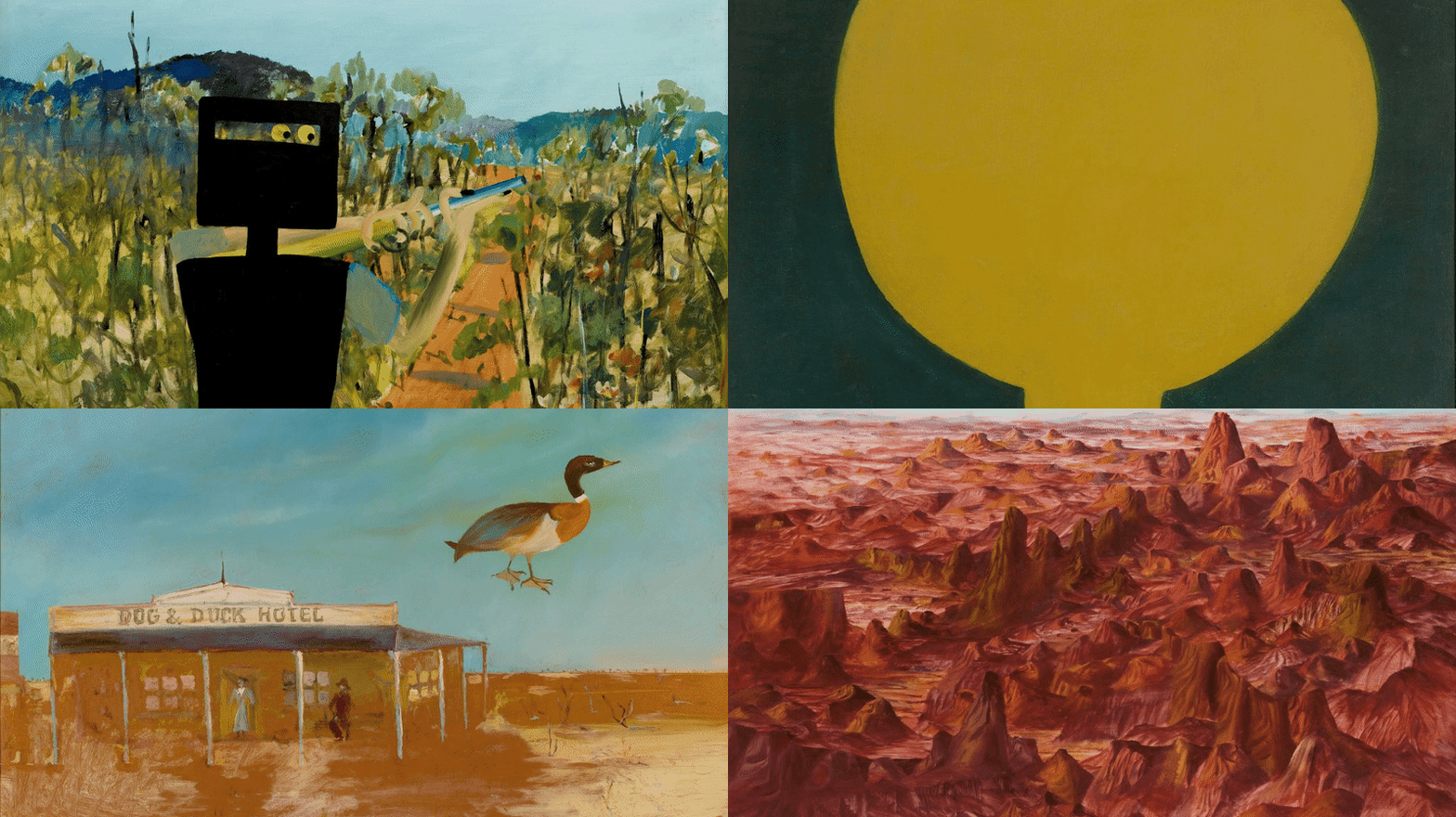
“He seems to hover on that thread between terrible and great painting,” Richard Lewer, winner of the 2026 Archibald Prize, says of artist Sidney Nolan. “Between mystery and naivety. And there is a humour within the figuration. It’s not overly conscious, but there is a playfulness there.”“I think his approach to Australian history and identity still gives us a lot to unpack,” says Archibald and Sulman finalist Tom Polo. “He continually pushed his subjects into something more ambiguous and psychologically charged. The work doesn’t give you everything at once.”Ned Kelly (1946) by Sidney Nolan, copyright The Sidney Nolan Trust.National Gallery of Australia, Canberra“Something I’ve thought about a lot in my own work is how you can paint a landscape that is recognisably Australian, but make it operate psychologically, rather than descriptively,” says artist Fiona Lowry. “I think Nolan opened up that possibility for a lot of Australian artists.”Asked separately for three words to describe Nolan’s work, Polo offers psychological, restless and layered. Lowry suggests psychological, restless and strange. Denise Mimmocchi, curator of Nolan: Origins, a chronological sweep of more than 150 works from the artist’s formative years at the Art Gallery of NSW, describes Nolan’s paintings as “nebulous landscapes of his own psyche”.And you thought they were about Ned Kelly.Dog and Duck Hotel (1948) by Sidney Nolan. Copyright The Sidney Nolan Trust.Jesse Hunniford, MONA “If Sidney Nolan were still alive and working, his new work would be worth nothing,” MONA’s David Walsh, the country’s most enthusiastic private collector of Nolan’s work, has said. “I say that because, essentially, the earlier in his career a piece comes from, the more valuable it is. Since I own some later work, that annoys me.”Walsh, who built his entire Hobart museum around Nolan’s multi-panel, early 1970s artwork Snake, also owns some of the artist’s old stuff. Four of Walsh’s works, including Robe Street, St Kilda (1945), and Dog and Duck Hotel (1948), are on loan to the AGNSW exhibition. They are among the more than 30,000 artworks Nolan is thought to have made in his lifetime.The Kelly is about meSidney Nolan painting ‘Unnamed ridge, Central Australia’ in Wahroonga in 1949.AL FrazerBy the time Nolan began the first charcoal sketches of what would in time become his best known series of paintings, the tram driver’s son from St Kilda had left school at 14, worked as an illustrator for a hat factory, married fellow art student Elizabeth Paterson, dropped out of art school, discovered the poetry of Rimbaud and Rilke, the paintings of Picasso, Matisse and Malevich, and held his first solo exhibition of weirdly abstract pictures, in which he sold nothing and had several works splattered with green paint by an unknown assailant.He’d also abandoned Paterson (and their infant daughter), moved in with his much older lover, muse and patron Sunday Reed (and her husband), ridden his pushbike from Melbourne to Sydney (and back), stowed away on a ship bound for Europe, been kicked off it before it left Australian waters, lost his soldier brother in a drowning accident, been conscripted into the army, stationed in the Wimmera, deserted, gone on the run, hidden in an inner-Melbourne loft and turned 28.An installation view of Nolan: Origins at the Art Gallery of New South Wales. All artworks copyright The Sidney Nolan Trust.Diana Panuccio, Art Gallery of New South Wales.Bristling with artistic ambition, trapped in Australia by World War II and under siege from his early forays into adulthood, it’s perhaps unsurprising that the figure that began to take shape on the canvas resembled an armour-clad outlaw whose violent and deadly stand-off at Glenrowan in 1880 was, by 1946, the stuff of legend.“In the Ned Kelly paintings, Nolan’s personal life and art came together,” curator Lesley Harding writes in the catalogue to Nolan: Origins. “[Nolan’s] feelings of entrapment and status as a fugitive played out in his striking images of the popular folktale and its hero … within Ned Kelly’s story lay universal themes of betrayal, power, injustice, love, loss and innocence – themes that resonated deeply with the artist’s own life.”Or, as Nolan would later put it, “the Kelly is really about me”.A bizarre creature from the planet whereverFirst-class marksman (1946) by Sidney Nolan. Copyright The Sidney Nolan Trust.Art Gallery of New South Wales“Ultimately, the works themselves remain really arresting and alluring and enigmatic,” Mimmocchi says in response to why Nolan and why now. “One of the beauties of Nolan is that sometimes we don’t totally know what he’s on about. Sometimes it’s a vibe, but it’s an interesting vibe, and that’s the sort of thing that makes you re-look at things. That multi-levelled, complex meaning can continue to resonate in the present day.“If we’re looking at the idea of an artist painting around questions of Australia, its landscapes, its Country, these are questions that need to be rethought and reconsidered. Nolan is a way of looking at that. These questions are ongoing. It’s not resolved. What Australia is, is a story that continues.”“Like most Australians, I knew Nolan through the Kelly paintings when I was a teenager,” says Lowry, who included late-career spray paintings by Nolan in Searchers, an exhibition she curated at the National Art School this year. In that show, works by Nolan appeared alongside contemporary artists such as Khaled Sabsabi, Shaun Gladwell, Joan Ross and Reko Rennie, but also street artists, including TAVEN, one of Sydney’s best-known graffiti artists.“Kelly is the great mythologised Australian outlaw, while TAVEN comes out of an actual contemporary outlaw culture where painting can involve trespass, risk, speed and getting away with it, or not,” Lowry says. “They’re obviously not equivalent. But putting them together opened up questions about permission, legitimacy and who or what gets absorbed into official culture.”Installation view of the exhibition Searchers, at the National Art School, which included work by Sidney Nolan, left.Zan WimberleyLowry, whose portrait of Penelope Seidler won the 2014 Archibald Prize, describes Nolan as “a much stranger artist than his familiarity allows us to see. The Kelly paintings are a good example. We’ve seen that black helmet so many times it has almost become a logo. But it’s an extraordinarily weird pictorial invention. There’s this beautifully articulated landscape and then a black geometric void where a human being should be.”“Where on earth does something like this even come from?” asked Pulitzer Prize-winning New York art critic Jerry Saltz, gesturing wildly on Instagram in front of Nolan’s First-class marksman (1946), when he was in Sydney to appear at Vivid in June. “You walk around a museum and you see abstraction, representation, geometry and then suddenly this bizarre creature from the planet wherever … from the 45th century.”A painter making paintingsSelf portrait (1943) by Sidney Nolan. Copyright The Sidney Nolan Trust.Jenni Carter, Art Gallery of New South WalesA video still from Sometimes I Miss the Applause by Dean Cross. Christian CapurroAnyone standing in front of Nolan’s Boy and the moon (c.1939-40), in1940s Australia, might have had a similar reaction. That painting, also included in Nolan: Origins, has since been compared to a toilet seat, a mushroom cloud and the Japanese flag. For First Nations artist Dean Cross, Boy and the moon is also a reminder that he was a painter first and foremost, despite the stories often found underpinning Nolan’s work, from Kelly to doomed explorers Burke and Wills or shipwreck survivor Eliza Frazer (what Mimmocchi dubs the “Australian Gothic”).“While Nolan’s story has all these reverberations, it’s also a story of a painter making paintings. Look at Boy and the moon. There’s no form. It’s a big yellow circle with this midnight blue background. It’s a colour field painting before the term colour field existed. It’s an abstract painting ahead of its game. His primary driver was being an artist motivated to make work, and he just pushed and pushed that his whole career,” Cross says.Boy and the moon by Sidney Nolan (c.1939-40). Copyright The Sidney Nolan Trust.National Gallery of Australia, CanberraCross suggests: “Nolan’s one of those modernists people also love to hate. Why do we need another Nolan show? It’s the same reason we still need Picasso shows, or Matisse shows. You need to keep that canon visible, so artists like me can keep interrogating them and pushing up against them. But also because people like him. It’s art not just for people who love art.”In Two Heads, his current exhibition at the Canberra Museum and Gallery, Cross took Nolan’s 1964 collaboration with Sir Robert Helpmann on The Display for the Australian Ballet as a starting point. For that production, as he had done for the Royal Ballet’s production of The Rite of Spring in 1962, Nolan appropriated First Nations imagery in his designs “in a way no non-Indigenous artist could get away with today”, Cross says.Luna Park (1941) by Sidney Nolan. Copyright The Sidney Nolan Trust.Jenni Carter, Art Gallery of New South WalesFor Sometimes I Miss the Applause, a work commissioned by the Heide Museum in 2022, Cross performed a rehearsal, of sorts, of a key solo from The Rite of Spring, wearing an adidas tracksuit, a Nolan mask and a brown paper bag that echoed Kelly’s helmet.Cross hangs his own work alongside Nolan’s in Two Heads, an “impossible collaboration” across time and cultures which aims to question the collaboration between Nolan and Helpmann.“These two expat Australian dudes who had this idealised dream of what Australia is or could be. But it was a very narrow perspective. That’s what’s pushing my thinking in this weird collaborative show that makes no sense. What kind of fool of a painter, today, me, would put their own paintings up against Nolan’s canonical paintings?”Central Australia (1950) by Sidney Nolan. Copyright The Sidney Nolan Trust.Diana Panuccio, Art Gallery of New South Wales“Er, that does seem brave,” I suggest.“It’s stupid is what it is. There’s no way my paintings stand up and that’s the joke, nor could the collaboration in The Display stand up. None of it can. It always has to fail. We always have to renew, culturally, forever. I don’t know if that’s going to land. But that’s the goal.”A farewell to MelbourneOver the two years Nolan worked on the Kelly series at the Reeds’ kitchen table at Heide, the artist filled the bushranger’s turbulent world with elements from his own surroundings – the homestead’s floral wallpaper, its floor pattern, a crocheted rug. As his relationship with the Reeds soured, then fractured for good, the paintings also became his “farewell to Melbourne”.In a contemporary link to the city, the Kelly series is hung in Nolan: Origins with a soundtrack by Melbourne singer-songwriter Courtney Barnett, whose sparse electric guitar lends the 27 paintings, already cinematic in theirscope, a touch of the Hollywood western.In 1947, Nolan left Victoria, travelled through Queensland, married John Reed’s sister Cynthia and relocated to Sydney. By 1953, the year Nolan: Origins ends, he had begun to gain international attention and moved to the UK.By then he had ceased being the maverick abstractionist who once used boot polish as a medium and painted the walls for his first solo exhibition bright pink. He was now being referred to as Australia’s national painter. In 1981, he was knighted. He died in 1992.Approach to Mundi Mundi by Shaun Gladwell, from the series MADDESTMAXIMVS (2007), Copyright Shaun Gladwell.John Raymond, Art Gallery of New South WalesIn time, his paintings of Ned Kelly became entwined, not only with his own messy personal life, but with Australia’s own identity and complicated sense of self. Artist Shaun Gladwell, whose black-leather-clad motorcyclist in Approach to Mundi Mundi (2007) fuses Mad Max with strange Sid, once observed that in Nolan’s Ned Kelly (1946), the viewer sees through the bushranger’s helmet, inviting us all to “inhabit this empty armour and ask ourselves: do we have it within us to be so wild, so passionate, so revolutionary?”Nolan: Origins is at the Art Gallery of NSW until February 7, 2027. Two Heads is at the Canberra Museum and Gallery until June 27, 2027.John Saxby is a writer, photographer and former editor of Spectrum, who has worked as an editor at the Museum of Contemporary Art and Art Gallery of NSW.More from SpectrumKyle MacLachlan and the severed ear that started everythingJason Donovan on Kylie, his dad, and wrestling ‘a monster’What a late-night tweet taught Ai WeiweiHow My Fair Lady made Julie Andrews a superstar
Think you know Sidney Nolan? This exhibition asks you to look again
Full Article
Original Source
Read the full article at Smh →KhanList aggregates and links to publicly available news content. We do not host full articles from third-party sources. Always verify important information with original sources.