
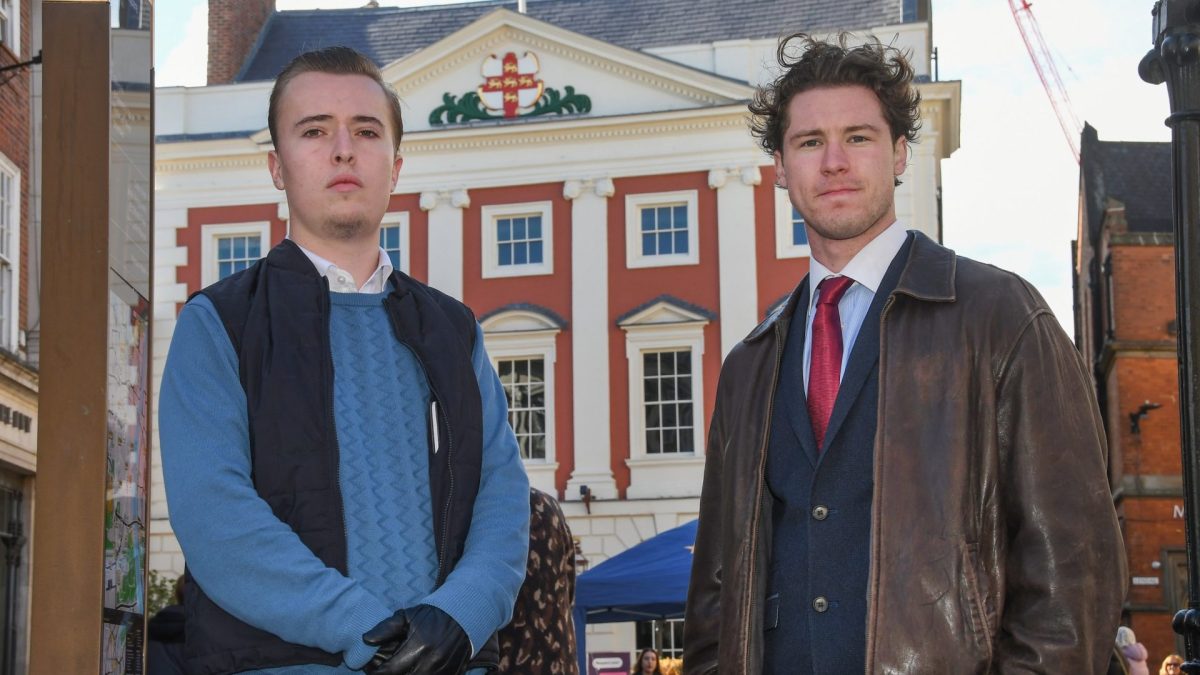
Jared Allman burps loudly, reaches for a bottle of beer and opens it with his teeth. It’s 7pm on a Friday night at the University of York and the first meeting of the new Restore Britain Society is in session. Along with eight present members – I’m told there are 25 in total – I am sitting in a chilly seminar room on campus waiting for Jared, 23, to start proceedings. (That is, a policy discussion followed by the pub.) The attendees, mostly aged 19 to 21, arrive in tweed jackets, cravats, suits, quarter zips and gilets. For the majority, the dress code is aspirational. The founder of the society, Nye Gollings, 20, grew up on a council estate in Leicester, the son of a factory worker, with three siblings and four half-siblings. He tells me he found himself drawn to far-right content in lockdown, aged 14. “The biggest funnel for a lot of young right-wing men is the podcast of the Lotus Eaters, Carl Benjamin. I started listening to that,” he says. He also tried The Rest Is Politics but came to “despise” it. Living at home, isolated from his friends, Nye recalls not really speaking to anyone but his family – none of whom share his political views – during the pandemic. Jared, meanwhile, was born and raised in Suffolk to, in his words, a “classic boomer centrist” dad and a “very centre” mum who have “bickered” with him about his strong anti-immigration beliefs. He says seeing the “failure” of the two-party system during Boris Johnson’s premiership slowly pushed him further to the right. A chance encounter with Nigel Farage in Clacton convinced him that the Reform leader was “slimy” and he says Rupert Lowe, leader of Restore Britain, now has his vote. “He just sticks to his word. That’s what’s so great about him. I just trust him more,” he says. The remaining society members come from working- or middle-class families in Hull, Durham, Preston, and Manchester, except for one outlier, the cravat-wearer, who has a family estate in rural England. I am the only woman in the room until Nye’s girlfriend Alana* arrives late. She hardly says a word for the entire discussion. There are no students of colour here, but “we’ve got some ethnic people,” Jared assures me. As Reform and Restore battle for domination of right-wing politics in Britain, their presence is growing in universities, with student groups proving a powerful way to recruit new members. As of this academic year, 10 of the 24 Russell Group universities now have either Reform or Restore Britain societies on campus, and five of them have been officially registered by their student unions. There are Reform societies – both official and unofficial – at St Andrews, Oxford, Durham, Exeter, Edinburgh, Birmingham, Liverpool, Manchester, Sheffield and Newcastle. They have faced opposition on campus. The political campaigner credited with growing Nigel Farage’s TikTok account, Jack Anderton, has toured several universities over the past 12 months. When he visited York last year, 400 students protested. The University of Oxford’s Oriel College is under pressure over an event scheduled for this month featuring Jason Arday’s accuser Nathan Cofnas, organised by student supporters of Reform UK. Lara Olszowska with Allman, who says English culture is “going through the gutter” and is going through vetting to run as a councillor for Restore Britain (Photo: David Harrison) Restore Britain is barely a nine-month-old political party, but is following Reform’s lead in targeting universities to grow. Nye left York’s Reform Society in 2024 to set up the Restore Society in May, making York the first Russell Group university, and the second university in the country to ratify one. The students I meet here at York could be the politicians of the future. Reform has made headlines for promoting young members to powerful positions, such as George Finch who, at 19, became the leader of Warwickshire County Council in local elections this May. Reform councillor Charles Pugsley was also 19 when he was made a cabinet member for Leicestershire County Council. Pugsley remains in post while completing a computer science degree at the University of Nottingham. This year, two ex-Reform councillors – Jack Goncalvez, 21, of North Northamptonshire Council and Owain Clatworthy, 22, of Bridgend Council – both defected to become Restore Britain councillors. Jared Allman could be next. “I’m in the Mid Suffolk constituency. I’m in contact with the branch managers, and I’m going through vetting to attempt to run for councillor there,” he says. At the Restore event in York, he runs a lively discussion. The society members agree on more nuclear energy, less wind and more fracking in the North Sea. They discuss why pepper spray should be legalised, and why police should have increased access to firearms and be able to stop and search for no reason. Six of eight members vote that England should bring back the death penalty. Jared expresses a particular fear for the future of English culture. He sees Restore’s mass deportation policy as one of the only solutions. “People often misconstrue that as stemming from a hatred for another culture and another race. That’s not the case at all. It comes from a love for one’s own culture and one’s own national identity. And at the moment, it’s just going down the gutter.” He continues: “There are alien cultures coming to our country, becoming dominant and winning entire constituencies. Look at Tower Hamlets. It just doesn’t look like England. Sometimes I get on the tube and I’m the only white man. That makes me feel like I’m not in England, and I just don’t like that,” he says. Jared stresses such policies are not racist. “It’s not specifically people of colour. If it was a bunch of Germans coming over and trying to enforce a bunch of German cultures and wanting to change everything, it’d be the same thing.” Nye and Jared tell me they agree asylum seekers and “illegals” should sleep in tents instead of hotels as temporary accommodation because it will stop them trying to enter the UK. Like many UK cities, York is seeing an increase in racially motivated hate crimes – according to the latest Home Office data, there were 11,150 hate crimes motivated by race or religion reported to the four Yorkshire police forces in 2021. That number has risen by almost 14 per cent this year, to 12,690. A group of 70 students protested the ratification of York’s Restore Society in April and some I speak to are concerned about the airing of anti-immigration views on campus. “I think normalisation of far-right ideology through speech is leading to real, physical consequences for vulnerable communities,” says Mohammad Malik, a Manchester-born community activist and PhD student at York. Before Restore Britain Society was recognised by the York SU, “[It] posted something horrific on Instagram. They were advertising a ‘Detain and Deport’ social [event]. The image was an immigration van,” Mohammad says. “I worked from home that day – I was scared to come onto campus.” Now that the society must adhere to the Student Union’s code of conduct, its online activity has been reined in and offensive posts removed. But students are concerned about what’s happening offline. “They have the opportunity to spread this division, but also to sit in this echo chamber of their own thoughts, behind closed doors,” says Haleluya, a second-year international student. I ask Nye if he regrets the “Detain and Deport” pub crawl. “I don’t regret it. I do recognise it was a touch too inflammatory. ‘Detain and Deport’ is a party slogan, so we thought it would be fine,” he says. He adds: “Our values and principles shouldn’t be making them feel unsafe. They’re just choosing to feel that way.” International student Dominic Stubbs says he has witnessed a fellow student, who was wearing a hijab being told to “‘go back to her country’ – and this is on campus,” he says. With York’s Restore event over, we head for a pint at The Burns Hotel, where 15 more young men are inside waiting for us. I meet Jonathan, who asks not to give his surname, the only non-white member I’ve met today. There were protests over York’s ratification of a Restore Britain Society, but the members of the group insist their policies are not racist (Photo: David Harrison) He found Restore Society on Instagram. Despite his Vietnamese mother coming to Britain as an immigrant, he says “immigration policy has been lax and flawed, reaching excessive levels”. Should Restore get in and enact their remigration policy, Jonathan confirms he would be in favour of the government possibly “remigrating” his own mother back to Vietnam. “Hypothetically, if she were deported and the reasons were just then I would understand,” he says. There is a pause in conversation, and with no music playing in the pub, One young man fills the silence. “When are men not under siege?” he asks the room. I finish my drink and decide not to order another. I wave goodbye to the young men who have hosted me for the evening, and leave with a strange feeling in my chest. I can’t work out if I feel sorry for them, or quietly afraid of what would happen if one of them got the chance to run the country. A spokesperson from York Students’ Union said: “York Students’ Union has a duty to support all students at York, regardless of their views or background, as long as they are lawful. Ratifying both the Reform Party Society and Restore Britain Society is part of upholding that duty. Ratification is not endorsement of any group’s views, and every student group, these two included, is expected to follow our code of conduct and treat others with respect.” When asked about the ratification of the Restore Britain Society, a spokesperson from the University of York said: “The heated debates we have seen at York in recent weeks mirror the outside world – politics doesn’t happen in a vacuum. These debates are reflected in lectures and seminar rooms, in student residences, in bars and cafes, within and beyond campus, in York and elsewhere. “We know that many of the issues being debated as part of this new student society bring fear of harassment, anger and may conflict with the individual values that many hold. That’s a heavy weight for any community to carry. “Our role is to facilitate lawful free speech, in a safe environment. To do so is demanding and challenging, but it’s a legal and a democratic commitment we take very seriously. We also recognise that free speech has limits within the law, and we will not tolerate any expression of hatred or harassment. “Not everyone will agree with the decision to ratify, but supporting the right for our students to join together in societies, to protest peacefully, and to promote lawful, differing views is a fundamental part of a functioning democracy.” *Names have been changed to protect anonymity
‘They’re spreading division’: My day with Restore student society at York uni
Full Article
Original Source
Read the full article at Inews →KhanList aggregates and links to publicly available news content. We do not host full articles from third-party sources. Always verify important information with original sources.