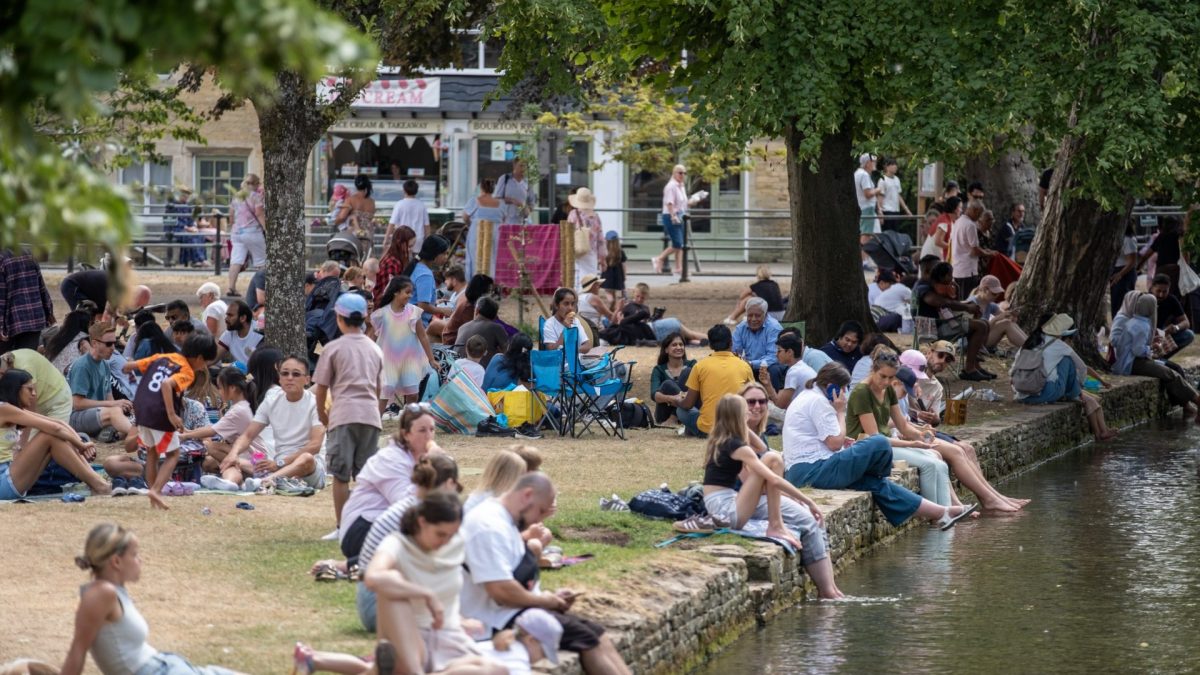
“Our nurses have 10 patients to visit a day, but because of the traffic, they’re only doing four.” Jenny Coaker, an NHS worker, lives in what tourism operators call a “picture-perfect” village. But she tells The i Paper that thanks to coach-loads of visitors heading down the narrow high street, tinted-glass minivans of well-heeled visitors and other day-trippers taking the local parking spots, the staff she manages are stuck. As for the patients, “the carers can’t get to them to dress their wounds or change their pads. People who need insulin could go into a coma, people who are incontinent are sitting in that, and people on end-of-life care are in agony waiting for painkillers”. Soon enough, Jenny’s off, shaking her fist at the driver of a double-parked minibus. Welcome to Bourton-on-the-Water, where, on the banks of the clear and shallow River Windrush, children splash about, families sit in circles on the green, and ice cream sellers outnumber the local Budgens by about 15 to one. It’s a quiet Thursday, locals say. But still, by 1pm, the village green is a teeming Where’s Wally scene.“The problems that we’re having are the families that are coming at 8 o’clock in the morning, bringing deck chairs, picnic tables, their own food and drink, and staying for the whole day,” says Charlotte Joynes, head of Bourton Residents Voice, which was formed to address the issue of overtourism. She adds: “Apart from maybe an ice cream, they’re not here to buy.” Shorts There’s also the issue of littering, and Sue Roberts, who set up a litter-picking group three years ago, shows me photos of beer cans, food packaging, and wrappers. Nappies, she says, are the worst thing she’s had to pick up. Similarly, Darryl Jenkins explains that five years ago, she moved out from the village centre. Overlooking “Chinese tourists being photographed on the bridge in their wedding dresses” wasn’t too much of an issue, but “it all got too much” when she saw tourists “pissing and shitting everywhere. I used to shout at them from my window, but it made no difference”. And as Charlotte guides me down the secluded pathway taking visitors from the car parks to the village, it appears some tourists are taking far more than they give. “We’ve got people taking Cotswold stone home – so they’re picking stones out of the wall.” Indeed, plenty of stones are missing from the yellowy-green-flecked drystone walls flanking the pathway, and the walls are bowing, buckling, and, in one fenced-off portion, entirely removed, ready for reconstruction. Eerily, the model village, a 1930s-built replica of the real village, has its own cordoned-off wreck. Adam Podolski, who manages this prized tourist attraction, guides me to the mini version of the shop Seasalter, its entire roof caved in after “someone leaned on it trying to get an Instagram”. Podolski is broadly grateful for the village’s visitors, though: “Without tourism, there wouldn’t be businesses, there wouldn’t be a hotel. Without all these people who bring money to the village, it would just be a peaceful village, that’s it.” As I explore the cutesy townlet, hazy memories from my last visit, over 30 years ago, return. It was the 50th anniversary of VE Day, and I remember rolling my jeans up to paddle on an unseasonably chilly day. Tourism’s been here for ages, so what’s changed now? Why is one tourism operator site promoting a whopping 98 vehicle-led tours to this tiny town? ‘It appears some tourists are taking far more than they can give,’ writes Sophie Wilkinson, pictured waving (Photo: Gavin Crilly) Iain Cox, a former electrician who runs Made by Cotswolds, a boutique selling local food, clothes, and other tchotchkes, posts daily on social media to promote his shop, and can pinpoint exactly when tourism really took off. “Post-Covid, you’d go on Instagram and you’d go on TikTok, and put in ‘Bourton-on-the-Water’, there’s loads of videos saying it’s ‘the one place you must visit’…” Take a brief look on social media, though, and there are some horrorshow videos — soundtracked with Charli XCX’s haunting song “House” and what’s known as the “epic sax fail” version of George Michael’s “Careless Whisper” — of people visiting the town, only to discover everyone else has had the same idea. Joynes tells The i Paper: “The Instagram people are realising that actually we’re not that Instagrammable unless you come at 6 o’clock in the morning, before anybody has come, and then it’s beautiful.” People are still trying to capture its greatness, though. As I wander around the green, a Canadian family stops me to ask to take a photo of them, instructing me to “get the river and sign in”. Kirsten Ng, who runs the Box Bush tearooms, paraphrases John Dower, the architect who conceptualised the naming of areas of outstanding natural beauty, by saying: “Just looking at the green in its natural form was supposed to be what refreshes your mind and spirit. Everybody bringing their garden furniture and their cool boxes and all the rest of it actually stops the village green being able to serve that purpose.” Plenty of businesses are sympathetic to the tourists. As Iain told me: “You’ve got a lot of families who haven’t got the same disposable income [in a] cost of living crisis, so what do they do? Come here for the day. Why wouldn’t you? You’ve got a lovely river and the green you can sit out on.” ‘Everybody bringing their garden furniture and their cool boxes and all the rest of it actually stops the village green being able to serve that purpose,’ says Kirsten Ng (Photo: Gavin Crilly) Down by the water, as dogs take it in turns to charge into the shallows, an ice cream seller, who does not want to be named, explains: “You can’t just ban things, you can’t just put fences up, you might as well be in a prisoner-of-war camp. We’re lucky we live in a lovely place. Lots of people don’t; they come here and they have nice days here.” In a nearby candle shop, owner Robert Cooper shares this sentiment: “I think [tourists] are being very unfairly dealt with. A lot of them are elderly, and they end up walking the best part of a mile in 90°F heat. Someday, somebody’s going to collapse.” The solution to overburdening tourists with the traipse to the car park is already happening. In my hours along the riverfront, I see over five coaches and plenty of nine-seater minibuses, all of which are, technically, not meant to be here. A local traffic regulation order, introduced in 2012, stops all but service buses from entering the high street, on pain of a £50–£70 fine. However, only police or local council officers can actually enforce these fines. I spot a traffic warden apprehend one of the coaches. “There’s no law against me being here, I’m a bus,” says the driver, as he collects a giddy group of elderly tourists down from the Welsh valleys for the day. “He’s wrong,” the warden says, but he’s sanguine: “We always try to move them on.” The beeping of frustrated drivers makes for an oddly febrile atmosphere in this idyllic countryside village. The warden adds: “Residents and locals here get a bit nastier towards coach drivers mainly, but recently they’ve been going for minibuses and minivans too.” Meanwhile, over the road, a lorry driver delivering food to a local pub has just been ticketed. Local Lib Dem councillor Paul Hodgkinson says tourism is inevitable during such a hot and dry summer. ‘There’s a drought going on, but we have a flood of tourists’ (Photo: Gavin Crilly) With residents snapping at their heels to resolve the issue, local authorities are trying different tactics. Cotswolds Tourism tells The i Paper that in order to handle the “pressures brought by excessive visitor numbers”, it does not “feature Bourton — or other hotspots — on our social media channels”. Instead, “our top priority is trying to encourage a better seasonal and geographic spread of visitors to the Cotswolds.” Meanwhile, a public consultation on parking and transport is running until 6 September. Residents and businesses alike suggest various solutions, including better signage and increased parking costs. Tearoom owner Kirsten is holding authorities’ feet to the fire, saying: “There is a massive need and desire for a place for people to come and picnic and paddle. The village green cannot provide that for the whole nation, but actually, it should be provided for the whole nation.” Local Liberal Democrats councillor Paul Hodgkinson says tourism is inevitable during such a hot and dry summer. “There’s a drought going on, but we have a flood of tourists.” He says the results of the consultation “could be residents’ parking zones, a park-and-ride facility rather than coaches clogging up the village… it’s got to be things which residents feel comfortable with.” A bigger solution could come from up on high. The Government is also running an upcoming Visitor Economy Growth Strategy, designed to encourage tourism across the country, not just in small hotspots. And the Government’s plans to allow councils to impose a tourism tax may be back on the table under new Prime Minister Andy Burnham. But this would only affect overnight visitors, and most residents say they have less of a problem with them than with the day-trippers. Until then, the village will continue to attract more visitors, here to swarm around the old beauty of this honeypot town. As the sun begins to drop, amid the splashing from paddlers, I hear Dutch, Spanish, Hindi, French, German and Urdu. Before I head home, I ask a British-Asian couple what they like so much about Bourton. Between licks of Mr. Whippy, they tell me: “We just love the peace and quiet of it all.”
‘They’re p***ing and s****ing everywhere’: The Cotswolds village drowning in tourists
Full Article
Original Source
Read the full article at Inews →KhanList aggregates and links to publicly available news content. We do not host full articles from third-party sources. Always verify important information with original sources.