
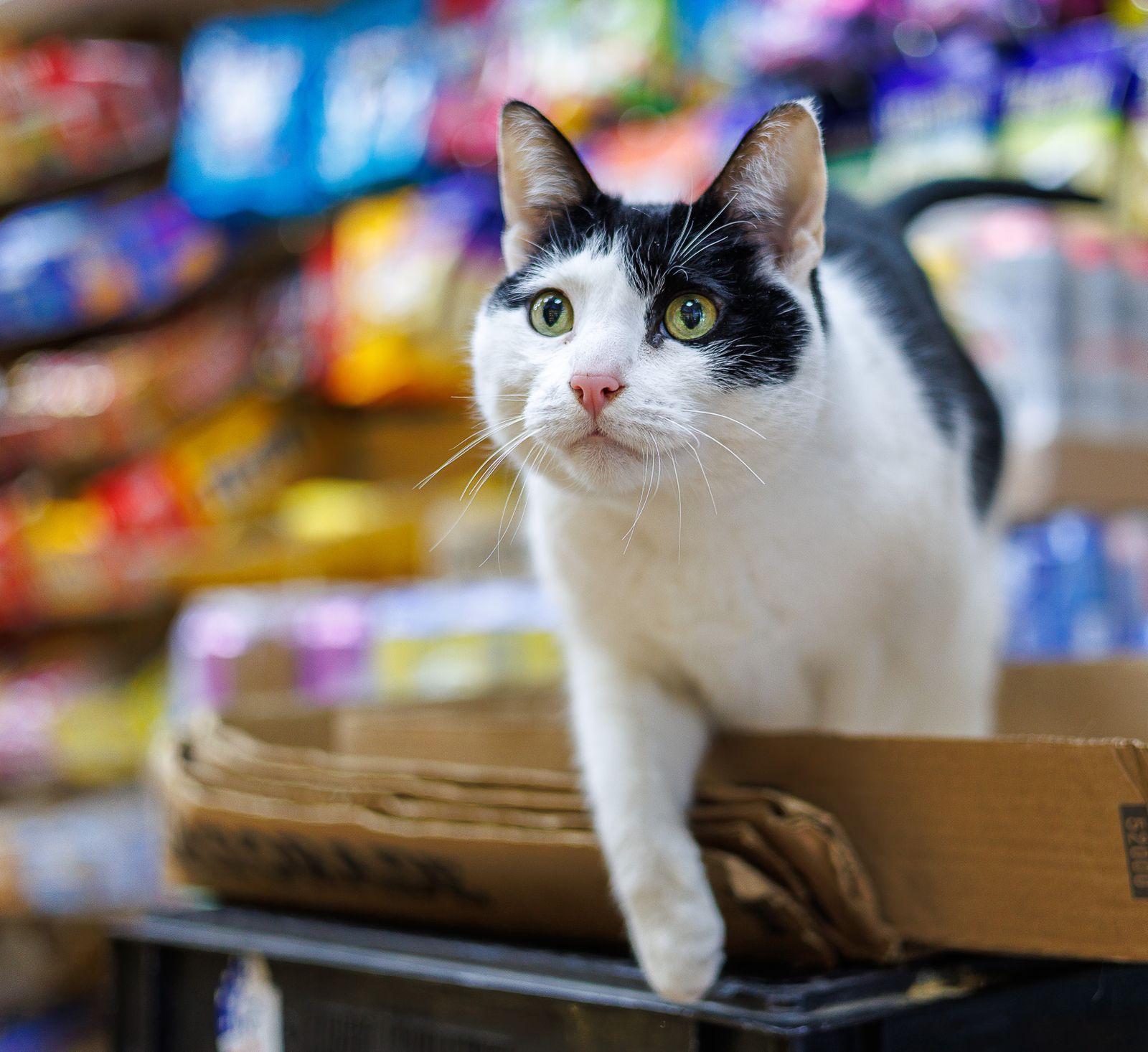
The working cats are fixtures of daily life at corner stores across the five boroughs. Now, a new book is documenting their stories November 18, 2026 3:35 p.m. Over the course of two years, Dan Rimada and Gulce Kilkis captured the stories and photographs of more than 100 cats. Gulce Kilkis / Bodega Cats of New York It was July 17, 2025, and New York City bodega owner Hamood Suliman walked into work on a full night’s sleep. It was one of the first times he wasn’t unlocking the corner store himself since he opened it in Brooklyn’s South Williamsburg neighborhood just a month prior, but he wasn’t expecting anything amiss. He certainly wasn’t expecting a cat. But there she was: a small black ball of fur with a distinctive white stripe down her nose and paws to match. At first, Suliman was skeptical of the sleeping feline curled up on his counter. “I was like, ‘Is this cat sick?’” he remembers. Suliman says Cleo has plenty of dog friends in their Williamsburg neighborhood, and she uses her weekly wages to buy them all treats. Gulce Kilkis / Bodega Cats of New York As it turned out, Cleo, as she came to be known, was part of a litter from a cat that lived at a nearby bodega. With no space for a whole brood, the bodega’s owners released the kittens into the neighborhood—and this one had made her way to Suliman’s market. She had no home to return to, so Suliman decided he would keep her. “That’s when my life changed. Cleo has literally brightened up the store, brightened up my life,” he says. “She’s been so much fun. It’s beyond imagination.” Tony, a mixed Himalayan cat, loves to nap inside the drink refrigerator at his Fordham Heights bodega on hot days. Gulce Kilkis / Bodega Cats of New York It’s been over a year since Cleo first wandered into Suliman’s bodega, and she’s woven herself into the fabric of both the store and the surrounding community. “She’s become literally a beacon of the neighborhood,” he says. They even threw her a “Churus and Churros”-themed birthday party, a play on the name of one of her favorite treat brands, this past July, on the anniversary of the day Suliman found her on his counter. In New York City, Cleo’s story is hardly out of the ordinary. The city is home to thousands of bodegas, many of which feature a furry feline greeting customers at the door and catching rodents in the basement and alleyways. They work around the clock alongside their owners to help fuel the city that never sleeps. Omish, an orange tabby in Park Slope, was the first cat Rimada and Kilkis interviewed for the book. Gulce Kilkis / Bodega Cats of New York Bodega Cats of New York, a new book from two of the city’s avowed feline aficionados, author Dan Rimada and photographer Gulce Kilkis, captures snapshots from the lives of these working cats. Over the course of two years, the pair traveled to all five boroughs, visiting nearly 250 bodegas and capturing the tales of around 120 cats. Sixty of those stories—including Cleo’s—appear in the final product. “There are actually fun anecdotes and little quirks that all these cats have,” Rimada says. “These cats are not here forever. We wanted to document the cats that existed during our lifetime and write down their stories.” The book traces its origins to the early days of the Covid-19 pandemic when Rimada was passing by a bodega in Fort Greene. Distancing guidelines kept him from interacting much with the staff—but the cat pacing around the shop was fair game. He stopped to pet the resident feline, an idea already forming. When he got home, he opened Instagram: @newyorkbodegacats was born. Rimada kept up with the account, and over time, it evolved from a social media spotlight of his neighborhood bodega cats to a full-fledged website chronicling their stories. In 2024, he reached out to Kilkis, an animal photographer whose shots he’d seen online. “I basically told her, ‘I want to start snapping more high-quality photos. I want to take the blog and make it into an official archive where we have more detailed stories and higher quality photographs,’” he recalls. Not long after, a publisher contacted them, interested in turning the archive into print. Jimmy often stands guard in his Upper East Side doorway—an antic that his owner says nets the bodega an extra $300 to $400 a day. Gulce Kilkis / Bodega Cats of New York Equipped with a color-coded excel spreadsheet, Yelp reviews and a Reddit forum where people posted their favorite bodega cats, the pair hit the streets. Over time, they developed a strategy: Once they were fairly certain they had found a shop with a cat, they would visit. There, they split up. Gulce scoured the store hoping to catch the cat in its natural environment while Rimada introduced the project to the bodega’s owner—and hopefully got an interview. “They’re filling Grubhub orders and talking to their customers,” Rimada says, “and then I’m next to them, holding up my iPhone, trying to get this recording on tape so that I could transcribe it when I get home.” Smokey likes to survey his Midwoood bodega from inside a small dark box, a mive his owners have dubbed "the periscope." Gulce Kilkis / Bodega Cats of New York But enough owners were willing to talk, and Rimada and Kilkis captured the stories of more than 100 shop cats—stories that showed just how much love these bodega owners and their customers had for their feline employees. There was Layla, the black-and-tan-spotted cat who was such an effective rat catcher that her owner redid the store’s flooring to match her coat. And Jimmy, a chubby orange tabby whose unstoppable friendliness nets enough customers to generate his owner an extra $300 to $400 a day. One of Rimada’s favorite stories is of Zorro, a dark, fluffy cat who lives in an East Village deli. A health inspector had come to check out the store, and was walking out, satisfied. But before he could open the door, “Zorro reaches out and scratches the health inspector on his arm, from his elbow to wrist, and leaves a mark,” Rimada says. Instead of reprimanding the owner, the health inspector just shrugged and moved on. “It was a New York moment.” When a health inspector came to Zorro's East Village bodega, the tortoiseshell cat gave him a parting gift: a bloody scratch across his arm. Gulce Kilkis / Bodega Cats of New York Still, not every bodega owner was thrilled at the chance to show off their pet—some wouldn’t even fess up to having one in the first place. “There would be a literal cat bed, there would be open cat food on the floor,” Rimada says. But when he introduced the pair and their project, “They would look me and Gulce up and down … and just be like, ‘No, I have no cat. I have never heard of a cat. I’ve never seen a cat in my life. I don’t know what a cat is.’” On Mia Garfield's fan-run Instagram, her range of duties at her Upper East Side bodega are on display: bodega manager, security, personality hire, sidewalk model and UES princess. Gulce Kilkis / Bodega Cats of New York Part of that hesitation may be because, under New York City health codes, it is illegal to have any non-service animal inside retail food service operations, including bodegas. Rimada says this law puts bodega owners in a tricky position. Many of these working cats are former strays that simply wandered into the bodega and took up roost, and they provide valuable services, like rat-catching, that often would cost shopkeepers more than any potential health code violation fines. Did you know? Post-mousers general In the late 19th and early 20th centuries, the United States had a special budget just for cat food. The government had a rat problem in its post offices and turned to felines for help. New York City’s City Hall Post Office employed nearly 100 cats—using them to catch the rats nibbling away at packaging glue. To feed the whole feline workforce, the office received $5 a month, worth nearly $200 today. Health code inspectors often turn a blind eye to these feline workers, says Tanya Copeland, the co-founder and president of Bronx Community Cats, a nonprofit animal welfare organization that helps trap, neuter, return and monitor free-roaming cats. But this legal gray zone may lead to less-than-optimal lives for some bodega cats. Chapo's owner says the brown mackerel tabby has more friends at the Bay Ridge bodega than he does. Gulce Kilkis / Bodega Cats of New York “You have the cats that are prominently featured,” she says. “And then you also have the cats that are a little bit more hidden. They’re in the basement; sometimes, the only time you see them is when people are unloading merchandise into the basement of the store.” New York City also has a feral cat problem: Some estimates place the total population of community cats, a designation comprising both stray and feral cats, as high as one million. The cats that survive kittenhood often only live around two years, though that life span increases with spaying or neutering. Bodegas may contribute to the problem, Copeland explains. Without proper tools or education, bodega owners may not spay or neuter their cats, leading to litters that make their way out into the streets. Midnight is a big black cat with six toes. She was delivered to her Fort Wadsworth bodega three years ago as a gift to the owner. Gulce Kilkis / Bodega Cats of New York As Rimada visited all these bodegas, he noticed this problem—and wanted to help. In 2025, he launched a petition to legalize bodega cats and establish uniform standard of care, providing regular veterinary care, vaccinations, spaying and neutering, as well as adequate food and water and a safe space to sleep away from food production. More than 14,000 people signed it, and lawmakers took note. Later that year, then-City Council Member Keith Powers put forward legislation to override the parts of the New York City health code that prohibit bodega cats. Powers now serves in the State Assembly, where there is a separate bill to establish statewide health and safety standards for cats living in retail food stores. For bodega cats to officially become a legal part of New York City life, both bills need to pass. Currently, the two are in committee review. Cappuccino and Juanito look nearly identical—but their Greenwood Heights owner says the two orange-and-white tabbies aren't related. Gulce Kilkis / Bodega Cats of New York Rimada says this advocacy is his way of giving back to the cats he has spent the past six years chronicling. It’s also a form of care that, he says, is in line with what this project has taught him about the people—and pets—of New York City. “New York has this reputation of being impatient and impersonal … and then you walk into a bodega and find this cat with a name and a routine and a neighborhood that keeps track of it,” Rimada says. “There’s plenty of affection in the city, and it shows up in these unexpected places.” Whenever Pancha goes missing, her Hell's Kitchen neighbors text each other to make sure the 16 year old cat is safe. Gulce Kilkis / Bodega Cats of New York Rimada hopes his book will pique readers’ interest in the fuzzy felines. But he also hopes it will prompt people to consider what the animals mean to the communities that love them. “Even something as seemingly insignificant as a cat that lives in a store, there’s actually a huge story there,” Rimada says. “It’s a story about the cat, about the neighborhood, about the person who cares for the cat, about the people who shop there just to see the cat.” A Note to our Readers Smithsonian magazine participates in affiliate link advertising programs. If you purchase an item through these links, we receive a commission. You Might Also Like Planning Your Next Trip? Explore great travel deals A Note to our Readers Smithsonian magazine participates in affiliate link advertising programs. If you purchase an item through these links, we receive a commission. More about: Animals Books Cats New York City Photography Photojournalism
They’re Not on the Payroll, but Bodega Cats Are Some of New York City’s Most Beloved Employees
Full Article
Original Source
Read the full article at Smithsonianmag →KhanList aggregates and links to publicly available news content. We do not host full articles from third-party sources. Always verify important information with original sources.