
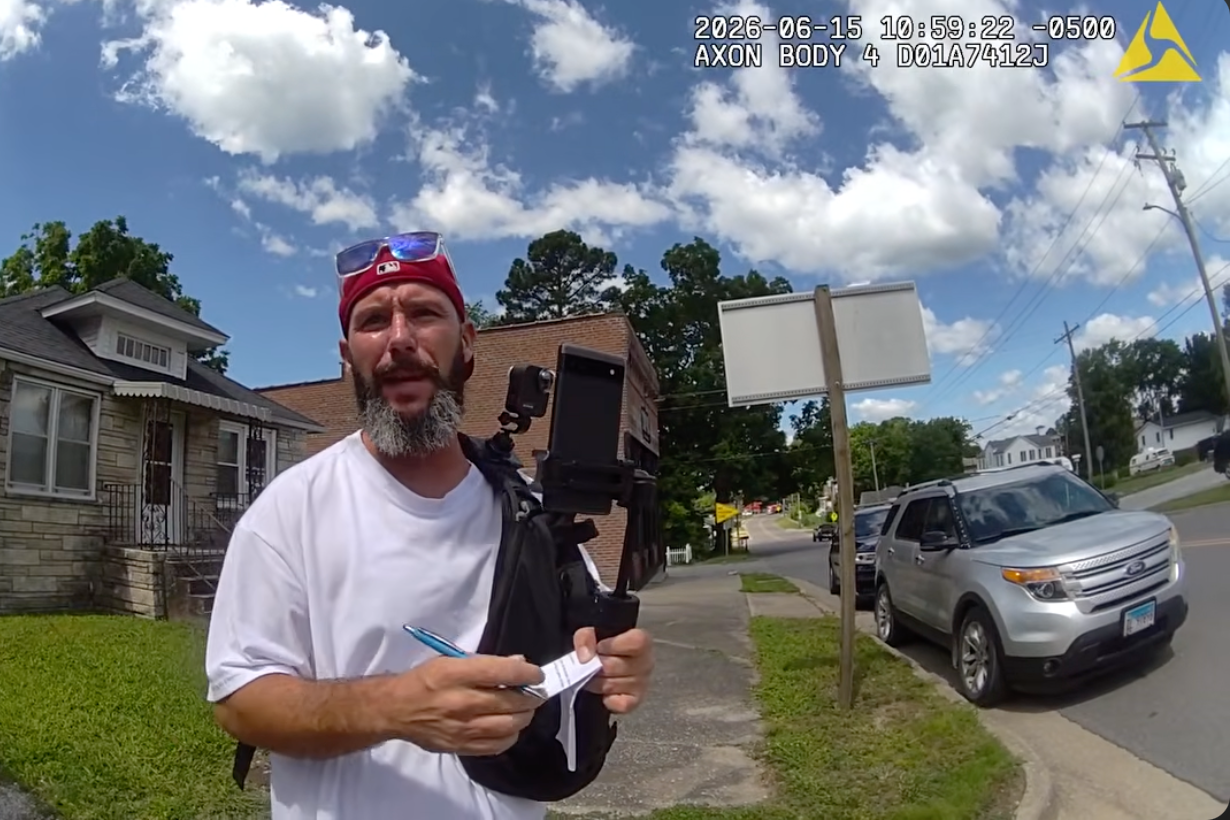
Videos by Southern Illinois Accountability/YouTube Users We the Vloggers First Amendment auditors say they’re fighting for your constitutional rights. But if one shows up at your office—and one very well might—you’re going to want to be prepared. Most people visiting the City of Marion Housing Authority in southern Illinois on the first morning of September are there to drop off rent, chat with the staff, or put in a maintenance request. Jeremy Bartlett isn’t one of them. It’s already 84 degrees a little before 9 a.m., and the bugs are making a racket in the scrubby grass alongside the parking lot, where—unbeknownst to anyone inside—Bartlett’s gearing up for a day of work as an auditor. He clips his phone into a tripod, dons a black tactical vest with a GoPro 360 attached to one shoulder, and affixes a wireless microphone to his cornflower blue T-shirt. If this doesn’t sound like the usual gear an auditor might carry, that’s because Bartlett isn’t an accountant visiting the housing authority to open the books and make sure the numbers add up. He’s a “First Amendment auditor,” one of an extremely online group of people who see their mission as holding the government accountable and defending the public’s right to take photos and videos in public spaces by doing just that—sometimes with combustible results. His YouTube channel, Southern Illinois Accountability, has thousands of subscribers who tune in to watch him and other content creators like him do everything from politely assert their constitutional freedoms to get into scuffles—verbal or even physical—with random passersby. On the day I tagged along with Bartlett, he was wearing a souvenir of a previous “audit”: an electronic ankle monitor poking out from his red-and-blue Spider-Man sock. Lots of auditors record in publicly owned spaces like agency offices, city halls, post offices, libraries, and courthouses. Some of them set up on public sidewalks, their cameras capturing the people passing by—and peering into the windows of businesses, which doesn’t always endear them to the folks inside. Confrontations over filming can get intense; there’s a lot of pepper spray going around in First Amendment world. (Auditors say they’re protecting themselves from assault by people who don’t understand the right to record in public. Critics say they’re trigger-happy YouTubers itching for a fight.) Many auditors turn their cameras toward banks, sometimes walking right up to the windows and peering inside at employees and, if visible, their computer screens. That happens to be how I first found out about auditors, when a friend who works at a credit union in the Pacific Northwest sent me a video in which she inadvertently appeared, cheekily waving and making heart hands at the camera after one of her co-workers noticed the auditor pointing his camera into the building’s windows. “At least I look cute,” she said when she texted me the since-deleted video. The guys behind the cameras (it’s mostly guys) aren’t nobodies. Some of the biggest accounts, like Long Island Audit, Amagansett Press, First Amendment Protection Agency, and Watching the Watchmen, have anywhere from hundreds of thousands to more than a million subscribers. Some of the creators even sell merch: “We the People”–emblazoned baseball caps, tees declaring “Less 1984 More 1776.” And thanks to YouTube’s pay-per-view model, more than a few of them have been able to make a living off this unusual corner of the internet, at least until recently. In our decentralized, post-monoculture world, they’re finding huge communities of followers and offering a window into an authority-questioning, don’t-tell-me-what-to-do worldview that spans political divides and is rapidly becoming the signature posture of our country. The auditors’ devotion to the U.S. Constitution and suspicion of authority might read to observers as libertarian-coded, but the YouTubers I spoke with claim not to have any partisan motivations. Rather, they’re asserting their right to record as a contrived stress test of whether public officials respect that right. Auditors’ MOs run the gamut. Some clearly seem to be goading police officers, government workers, and passersby into engaging with them. Others take a more stoic tack, refusing to answer questions or saying as little as possible. Still others identify as citizen journalists. Sometimes the audits are a laid-back affair, but the ones that rack up the most views are those where people captured in the video lose it, making themselves unwitting stars of a pseudo–soap opera. It’s a distinctly modern situation: creating an incident that necessitates a response to see whether the response will be within constitutional parameters. But auditors have become prominent enough that consultants, academics, and professional organizations have popped up offering trainings and literature on how to handle them. Some people think the whole thing is a sham and a scam. For countless others, it’s the best show on the internet. But whatever you think of them, the auditors are an undeniably of-the-moment combination of in-your-face stylistics and institutional distrust. “Maybe people don’t really like the First Amendment auditors,” said Anna McGarrh, an attorney who wrote about the phenomenon for the Mississippi Law Journal. “But one thing I think people often forget, or just generally don’t realize, is that the Constitution is meant to protect unpopular ideas.” Once inside the housing authority office, it doesn’t take long for Bartlett to draw eyeballs. Strolling around the nondescript lobby (government-issue carpet, the same chairs you’ve seen in every waiting room), Bartlett quietly films the bulletin boards crammed with notices, the waiting areas, the service counter with a handful of staff behind it. He keeps the focus on the employees; Bartlett tells me that in situations like this, his aim is to record the government workers rather than random folks who just happen by. One employee comes out to the lobby to ask if she can help him with something, at which point he asks her for a form to file a Freedom of Information Act request. (Bartlett says that when he visits these offices, he commonly files to get the staff’s names, rates of pay, and dates of hire.) Two rooms with desks sit just off the lobby, and Bartlett walks over to take a look at those too. The first is empty. The second is not, and the woman working inside is initially bemused and then angered by his presence just outside her doorway. “What are you doing?” she asks him with a hint of laughter in her voice. When he informs her that he’s just a member of the public taking a look around, she tells Bartlett he needs permission to record. He responds that he does not. After a short back-and-forth, she loudly shuts her office door. But it’s not long before the unusual sight of a rogue cameraman in an otherwise unremarkable workplace leads her to stride across the lobby and head through an employees-only door. Before too long, the housing authority’s executive director appears to ascertain what exactly is going on. “We have privacy issues here, we have people’s important information,” she tells Bartlett. “Just barging in and going into her office is not acceptable.” Bartlett replies that he didn’t, in fact, go into anyone’s office. This does not have a de-escalating effect. The executive director tells Bartlett people rely on them to protect the personal information that his cameras might capture, to which he replies, “The onus is on you to protect it, not me.” Eventually, the uncomfortable conversation winds its way back to the FOIA form. The office doesn’t have one, but eventually Bartlett is grudgingly handed a blank piece of paper and pen. (The authority’s executive director later tells me she has no comment on the audit.) While Bartlett’s waiting for a copy of his handwritten request, one, then two, then three members of the Marion Police Department arrive. One of them greets Bartlett by name; Bartlett tells me they recently got into it when he was auditing a Department of Children and Family Services office. But on this day, the officers simply talk with the authority’s staff in the back room for a while, then leave without issuing Bartlett any warnings or instructions; the presence of a nosy reporter may or may not have had something to do with that. You can watch this entire spectacle, including a guest appearance by yours truly, helpfully notated with an animated red arrow, on YouTube. McGarrh, the attorney, said that while auditors are generally legally permitted to record in public, there can be reasonable limitations set—for example, in places with sensitive information, like courtrooms or tax assessors’ offices—creating a “really muddy” area of law. Still, she said, many auditors she’s watched display a strong knowledge of the law: “They generally know where the line is, and they walk right up to it.” It’s a formula for good content. At a time when governmental agencies and political actors have displayed a willingness to push boundaries and violate norms, some auditors see their mission as helping keep the little guy aware of what’s really going on around them. Their haters, on the other hand, see them as emblematic of the erosion of civil discourse. Not to mention common decency. The First Amendment audits that now flood YouTube go back a decade or so, with one scholar identifying the first video as being from 2013. The early videos are simple affairs. Some document speed traps in rural Florida, one features a surprisingly cordial conversation with Department of Homeland Security agents outside a local field office, another a not-so-cordial conversation with employees at a transit station. But the roots of the idea are far older. In the 1960s, the Black Panther Party launched the practice of copwatching, ensuring that law enforcement officers weren’t themselves breaking the law. That practice saw a resurgence in the 1980s and ’90s, with a network of copwatchers still active today and a plethora of videos of fatal police interactions that fuel the push for racial justice in the U.S. And while many people might cringe, roll their eyes, or get angry at an auditor like Bartlett, a lot of those same people are likely grateful for the cavalcade of documentary evidence generated by everyday people during the harsh immigration crackdowns in places like Minneapolis and Chicago. “That documentary evidence is a huge thing, and it’s changed the world to a certain degree,” said David R. Dewberry, a professor of communication at Rider University, in New Jersey, who focuses on the First Amendment and free speech issues. Nick Blumberg Although First Amendment auditors may have different motivations and tactics, Dewberry considers them an evolution of copwatchers. He sees them as part of a long tradition of holding government accountable through challenging authority, despite the hostility they can bring. “Nice, pleasant people with pleasant ideas don’t need their speech protected,” Dewberry said. “It’s the people who challenge things. … Even though we may not like it because sometimes they’re just kind of, like, well, they’re assholes. But being an asshole is not illegal, right?” Auditor Mike Norton, who posts under the handle KULT News, particularly enjoys filming at banks, which, he told me, are “virtually all extremely corrupt, extremely dishonest.” (He cites Bank of America’s $72 million settlement with victims of Jeffrey Epstein and Wells Fargo creating millions of fake customer accounts, for which it eventually paid $3 billion.) “It’s important to shine a bright light on unethical behavior, whether it’s the banking industry, whether it’s city government,” Norton said. “We are at a point in American history where the government has become very, very emboldened to do things that they might not have dreamed of doing five years ago or 10 years ago, and now it’s second nature.” Norton was living in the Phoenix area, working as an insurance claims adjuster, when the COVID-19 pandemic forced everyone to work from home. He took advantage of the flexibility that offered, first moving to Denver, then to Ohio, and meeting his now wife online. When his company later told everyone they’d have to start showing up in person one week a month, Norton knew it was the beginning of the end of his time in the insurance business. He’d been watching First Amendment audit videos for a few years and decided to give them a whirl as his new means of employment. “Your very first audit you do, you’re a nervous wreck,” he said. “I learned very quickly that it’s not something to be nervous about. I’m in public, taking pictures. There’s no crime there.” Norton sees his mission not only as warning public officials and big corporations that people are watching them. He also wants to educate viewers that there generally isn’t a presumption of privacy in public spaces, and that their right to document what’s going on around them is protected by the First Amendment. KULT News has netted him a solid following of some 129,000 subscribers to his 230-plus videos, which feature eye-catching titles common to the genre; recent uploads include “EL PASO COP BEHAVES LIKE A TODDLER” and “PSYCHIC DIDN’T SEE US COMING.” He and his wife, Stacey, now crisscross the country in their 26-year-old RV with their dog in tow; Norton estimates they’ve seen all but 10 or so states in the contiguous U.S. In that time, he’s spent a night in jail on what he calls bogus charges that were quickly dropped and been physically attacked by someone who didn’t take kindly to making an on-camera appearance. He was, according to his account, recently cited for disorderly conduct for telling a police officer in Montana to “fuck off.” But on occasion, interactions between an auditor and authority can have an even more surprising outcome. One night in West Virginia, the Nortons were on the hunt for the site of a bridge collapse that, according to author and ufologist John Keel, were tied to the first sightings of the cryptid known as the Mothman. (Even staunch Constitution defenders need a hobby.) As it grew darker, they pulled into the parking lot of a big company to examine their map when a security guard came over. “As soon as he saw me, his eyes lit up. He goes, ‘It’s you!’ ” Norton said. “I’ve never been to West Virginia in my life, and now there’s a security guard out in the middle of BFE that recognized me. And then we go into town, and another guy pulls up in his truck and he goes, ‘KULT News! I heard on the scanner, they said somebody’s out taking pictures of the bank, and I’m like, I’ll bet that’s KULT News.’ ” Norton’s videos are well produced, with his wry humor on full display both in his live narration and interactions with the often-befuddled featured players and in the captions he adds later. (A video shot in Boston that teed off a bystander suggests that perhaps “his discomfort is from the stick up his ass.”) Until just recently, Mike and Stacey Norton were able to support themselves by producing audit videos on YouTube, telling me they could net $10,000 to $12,000 in a month. But after a sweeping move from the platform, auditors’ ability to live off their videos is being upended. The YouTubers, they claim, are being silenced. Aug. 31, 2026, may well go down as First Amendment audit Armageddon. That’s the day a slew of some of the most popular auditing channels got the notice from YouTube that their accounts were being demonetized—i.e., the creators would no longer be making money when people clicked on their videos. Sean Paul Reyes took to the barricades in a video posted the very next day. With more than a million subscribers and over 2,000 videos on his account Long Island Audit, Reyes is an A-lister in the auditing community. “This was not random,” he told his viewers, positioned in front of his mic in a power stance, clad in a black polo and black baseball cap inscribed with the words We the People in ye olde-timey Constitution font. “I believe this was a coordinated attack on the First Amendment auditing and government accountability community. But understand this: We the people will not be silenced, and we will not be stopped.” YouTube sees things differently. A spokesperson told me in a statement that while the company values “citizen journalism and public interest content, creators in the YouTube Partner program must follow our Creator Responsibility policy, which protects our community both on and off the platform. Accordingly, we’ve suspended monetization for channels that dedicate a significant portion of their content to filming people in a way that provokes, harasses, or instigates conflict.” Nick Blumberg Reyes has a more complex theory: He posits that one of his channel’s regular villains, the Suffolk County Police Benevolent Association (read: union) president, Louis Civello, led the charge in cutting the auditors off from the YouTube Partner program. Civello is no fan of auditors, having slammed “all of that YouTube nonsense” as “lies” and “a con job,” using choice epithets like “keyboard cowards” and “vile, vile people.” Reyes thinks that Civello is in cahoots with U.S. Attorney General Todd Blanche; in his video, he shows a photo of the two of them at the National Association of Police Organizations’ 2026 convention. He also believes that Civello made his anti-audit case to Blanche that week, and the federal government subsequently leaned on YouTube to help make the auditors go away, or at least go broke. (A spokesperson for the U.S. Department of Justice told Slate that “this allegation is completely false,” and neither Reyes nor the Suffolk PBA responded to requests for comment.) The fact is, a lot of people don’t like the auditors. A scan of recent news coverage easily turns up a wealth of dustups. A Florida sheriff’s deputy was briefly put on administrative duty after a shouting match with an auditor; a 62-year-old man, also in Florida, was arrested for allegedly hitting an auditor with his car outside a church where the auditor was filming; an auditor was slapped with probation in Northern California for pepper-spraying a man outside a Costco. Norton told me he saw the demonetization wave on the horizon when videos started popping up of masked auditors traveling in packs, aggressively chasing down and harassing people going about their business, rather than simply posting up in public and hitting the Record button. Some communities have moved to limit where auditors can film. Earlier this year, the Village Council of North Palm Beach, Florida, approved a measure aimed at regulating where people can and can’t record in public buildings. “This ordinance is intended to set reasonable guidelines that clearly define public areas versus employee workspaces, in line with established First Amendment principles,” Village Manager Chuck Huff said in a statement. But just how established are those principles? Clare Norins, who directs the First Amendment Clinic at the University of Georgia School of Law, told me that the Supreme Court has yet to address “head-on” the right to record in public, leaving it in the hands of federal circuit courts. Norins cited an unpublished, nonbinding opinion from the 11th U.S. Circuit Court of Appeals from earlier this year “that said somebody who wanted to record in a tax assessor’s office did not have a right to record there, because it’s a limited public forum where people are there to file their taxes, pay their taxes. It’s not a forum that’s been opened up for speech.” Norins’ clinic offers trainings aimed at helping officials avoid cracking down on legally permissible recordings—as well as avoid the costly lawsuits from auditors that can follow, like one that a Georgia city settled for $55,000. The trainings advise clear regulations about what’s allowed in a given space, and a calm, de-escalatory approach. The clinic started in 2020 “to defend and advance expressive freedoms,” said Norins; Norins began offering trainings after getting requests from public officials seeking guidance on what to do if an auditor arrives. “It’s kind of awkward when you’re doing your job and somebody’s there with a video camera, and none of us would really enjoy that,” Norins said. “But the law says being uncomfortable isn’t really an objective interference with your job.” That discomfort can have a purpose, supporters say, when it’s applied properly—less masked dudes chasing random people to their cars and filming their VIN, more ensuring that police officers with extraordinary power in society adhere to the law. Being argumentative, crude, even aggressive is part of the territory for auditors. The Constitution allows it all. Jeremy Bartlett’s future hinges on persuading the state to take his side. He told me that a woman he doesn’t know, whom he happened to record inside a business from a public sidewalk in Sesser, Illinois, filed stalking charges against him. (Court and state business records indicate that it was the owner of a local day spa.) It’s the kind of video that, while many people might find it intrusive, should be legal if the auditor remains on public property. Bartlett said he wasn’t even aware there was a warrant out for his arrest until he was out shooting another video, in his hometown of West Frankfort, and the local police chief informed him of the warrant. After that, Bartlett turned himself in. He spent 23 days behind bars before being released on electronic monitoring. His next appearance before a judge is set for Jan. 7. Bartlett told me his attorney is confident the charge is bogus, but the time behind bars and away from his video equipment is a setback. Still, Bartlett hasn’t been demonetized, and while his YouTube channel is relatively small compared to some of the others, with about 6,700 subscribers, he’s determined to continue the work. He hopes to grow his channel and do more audits beyond Illinois—but not too far beyond. “It’s our civic duty to check up on government employees, whether it’s the governor, the president, anyone,” Bartlett said. “I’m not trying to go up to the government or the president, because obviously that’s a little above my reach, but yeah, I try to do the government offices and just make sure they’re doing their job, make sure they’re acting right.” It’s not all opposition he faces out in the field—at the second location we visited, a city-owned recreation center, Bartlett chatted amiably with the employee who showed us around and talked with us about the proliferation of pickleball over the past few years. “A lot of [people] still get ticked off at being recorded in public, but I think a lot of the big auditors … have woke up a lot of Americans, showed people that it’s not only OK to record government, but it’s our right and our responsibility. It’s our civic duty to check up on our government,” he said. Checking up on the housing authority was, at least for this reporter, a deeply unusual and off-putting experience. Journalism often means asking pushy questions and sometimes being in uncomfortable situations. But a reporter’s job isn’t to create the scenarios. I dig in the dirt for truth—but I always have reason to believe it’s fertile first. But despite instigating what the office staff clearly felt was an intrusion, Bartlett maintained a Zen-like calm throughout. “I do some meditating before I go there. It’s important to keep calm, because it’s just a job,” he said. “I do get riled up sometimes, but I just try to breathe and remember that it’s nothing personal.” Constitution Law Social Media YouTube Illinois
They’re Controversial, Invasive, and Hugely Popular Online. If One Shows Up at Your Office—and One Might—You’ll Want to Be Prepared.
Full Article
Original Source
Read the full article at Slate →KhanList aggregates and links to publicly available news content. We do not host full articles from third-party sources. Always verify important information with original sources.