
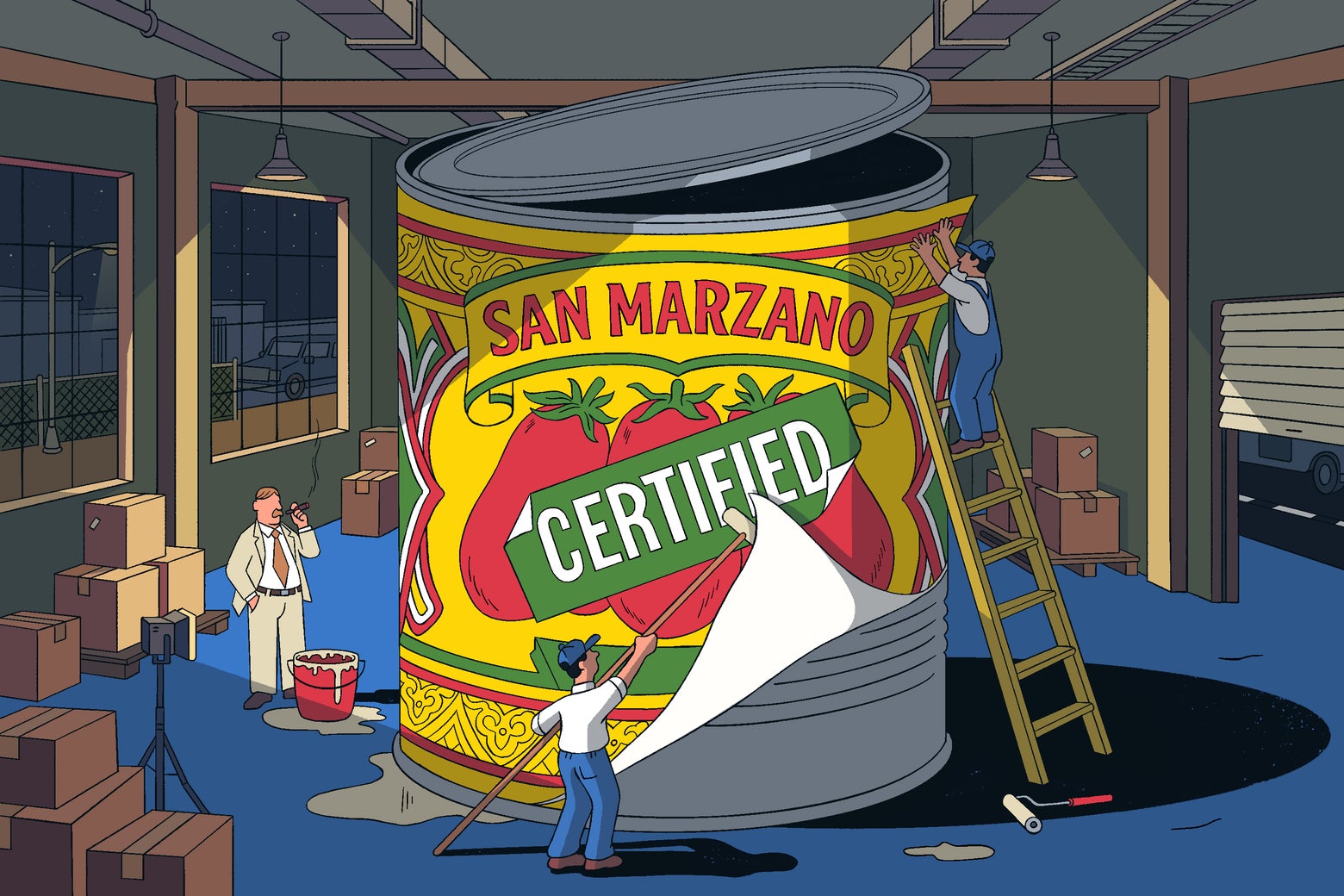
Food Sans Marzano? One of the leading fine food brands has been sued for “tomato fraud.” I sliced off the lid to find out what’s really going on. So you’ve decided to make homemade pasta sauce. Good for you, chef! First stop: browsing the supermarket for the best canned tomatoes for your future marinara. Now you’re deciding between Hunt’s, Mutti, Bianco DiNapoli, Cento, DeLallo, and those nondescript cans of tomatoes from The Bear filled with wads of cash. You’re considering brands, price points, and whether to buy your tomatoes whole-peeled, crushed, or diced, or hmm … maybe that jar of Rao’s would be easier? Then, just when you’re about to give up, two little words on a label stand out: San Marzano. You’ve heard that phrase before somewhere—the Food Network? Ina Garten? That’s supposed to be primo stuff, right? Probably can’t go wrong with tomatoes that are actually from Italy. They’re a few dollars more expensive than the domestic options, but you spring for a can or two anyway. Surely getting the real thing will be worth the hassle and cost once that first forkful of al dente pasta and perfect sauce hits your lips. San Marzano tomatoes are indeed considered the good shit. They’re cherished for their low water content (think naturally saucy, thick tomatoes), their sweetness, and their deeply savory flavor—all qualities that can make or break a marinara. And they are certainly Italian: San Marzano tomatoes come from the Agro Sarnese-Nocerino region of southwest Italy, home to the fertile land surrounding Mount Vesuvius, the volcano which once destroyed Pompeii but whose ashy eruptions, settling over time into a nutrient-dense soil, now more helpfully produce the prized fruits in question. Authentic San Marzano tomatoes are regulated—at least in Europe—by the Consorzio di Tutela del Pomodoro San Marzano dell’Agro Sarnese-Nocerino DOP, which I will be shortening to “the Consortium” so we don’t all go insane. And the Consortium is serious about its job. According to its regulations, true San Marzanos must have an elongated shape that usually measures between 6 and 8 centimeters and demonstrate that classic balance of sweet and tart flavor. The thin skin peels off easily, enclosing dense, fleshy pulp with very few seeds. They must possess something called an axis ratio of no less than 2.2 + 0.2, or contain limited presence of “placental voids,” which means the seed cavities are filled with gelatinous tomato gel and pulp, rather than empty space. In short, they’re the jackpot if you are looking to make an unforgettably robust sauce or lip-smacking soup, and the Consortium exists solely to be this marvelous tomato’s protector. There’s a reason these elite tomatoes are so tightly controlled. They can only be grown in a tiny region of the world—fewer than 1,000 acres of eligible volcano-adjacent land are currently cultivated—so they’re in very short supply. Or at least they ought to be. A skeptic might ask how the hell such prestigious produce ended up available in bulk at your local Ralphs or Whole Foods. Are all the brands touting the name actually San Marzanos? Is that even possible? According to a recent lawsuit, the answer is … not necessarily. In fact, some of them are almost certainly fake. It’s been called “tomato fraud,” and it’s a real problem in the U.S. Fraud may seem like a dramatic word to apply to a tin of tomatoes, but given the considerably higher cost of cans labeled “San Marzano” (recently between $6 and $8 compared to between $3 and $5 for a normie 28-oz. can in my local market), where there are fakes, honest consumers are being ripped off by companies looking to profit from a legendary culinary reputation that isn’t theirs to claim. And tomato snobs aren’t taking it lying down. Over the past 10 years or so, lawsuits accusing brands of tomato deceit have become quite ordinary. Take, for example, the highly entertaining San Merican lawsuit. The short version is that a company named Simpson Brands in Pennsylvania labeled its cans “SMT,” and in exquisitely sneaky fine print, the text by each letter spelled “San Merican Tomatoes,” instead of San Marzano. Though the plaintiff ultimately dropped the suit (and Simpson denied the allegations), I think their claim—that a reasonable person could easily confuse these impostors with the genuine article—is certainly fair. (Oh, and by the way, those San Merican tomatoes are trash. Not even close to San Marzanos. San Mericans are watery and sour Roma tomatoes, not the thick, sweet San Marzano variety. How to tell? Squeeze one of the San Mericans in your hand, and it’ll burst everywhere like you just unloaded a shotgun on a jar of Prego.) While you do see “San Marzano–style” tomatoes sold quite frequently, as this verbiage merely refers to the botanical genus of the tomato and passes muster in the U.S. (somewhat like the general cheese term “Parmesan” vs. Parmigiano-Reggiano, which has its own official minders), straight-up labeling something San Marzano that isn’t would seem to run afoul of false-advertising prohibitions and leave violators open to litigation. (The Consortium might not like it, but it has no power this side of the Atlantic.) So you’d think companies would, you know, avoid doing that. Just stand behind the tomatoes you’ve got. But there’s one well-known brand that may have thrown caution to the wind. It’s one you’ve definitely seen on your grocery store shelves, one that’s available in both old-school Italian delis and high-end grocers alike. And it may have succeeded in duping everybody—at least according to the folks suing it for $25 million in damages. In the eyes of these litigants, the dignity of the Rolls-Royce of tomatoes—and the integrity of America’s food system—is on the line. The questions they raise about product quality, corporate transparency, and the weight of authenticity could shape what we stir into our pots and spoon into our mouths for years to come. In early May, a lawsuit was filed against Cento Fine Foods, Inc., claiming that the company’s iconic yellow cans of tomatoes sold as San Marzano can’t possibly be the real deal: Cento Fine Foods, a New Jersey–based company, versus Natalie Gianne of Los Angeles and Mike Aldrich of Whittier, California. The crux of the suit is that authentic San Marzano tomatoes possess physical characteristics that render them superior to other tomatoes, and so what’s in Cento’s cans are simply not that. The filing alleges that Cento’s tomatoes “lack the taste, consistency, and other physical characteristics associated by consumers with certified San Marzano Tomatoes.” Thus, they were deemed “unsatisfactory” to the plaintiffs, who never would have paid a premium for them had they known the truth. And naturally (this is America), they’re seeking millions of dollars in flavor harm. In a statement to Slate, Cento said that it “refutes all of the inaccurate and wrongful claims” in the complaint, calling it “entirely without merit.” The company added that it is seeking a “prompt dismissal” of the suit. The Weston Firm, the lawyers representing the plaintiffs, did not respond to requests for an interview. If this all sounds kind of hard to prove in court, I’d say you’re right—taste is subjective. But that’s where the Consortium is supposed to come in. In 1996, the European Union granted the Consortium the exclusive right to certify and approve San Marzano tomatoes, empowering it to stamp authentic cans with a DOP/PDO label (meaning Product of Designated Origin). When you see that seal, you are being promised that what’s inside is verified. And Italians live to protect their products. They protect their cheese with DOP labeling, and they even have their own pizza rules: See the AVPN (the True Neapolitan Pizza Association), which aims to tell you what a Neapolitan pizza is, and more importantly, what it isn’t. In their case, the AVPN, which approves true Neapolitan pizzerias through a rigorous application process, even goes so far as to dispatch secret agents to later spy on pizzerias. If they aren’t meeting the organization’s high standards, they’re delisted. The Consortium, meanwhile, also inspects, approves, and occasionally delists tomato purveyors with the same critical eye. So Italy has made rules for their San Marzano tomatoes, and Europe enforces them, at least in theory. Over there, you can’t just 3D-print some tomatoes, put them in a can, and call them San Marzanos. If you did, you would be the subject of police or judicial raids (which, as we’ll see, Cento may know something about). Here in the U.S., however, those rules don’t apply: There is technically no legal protection of that term as such, which is why alleging false advertising or consumer fraud—not getting the product you think you’re paying for—would be a shopper’s only avenue for justice against perceived trickery. This Gianne/Aldrich lawsuit argues that the Consortium is the only entity which can certify and approve San Marzano tomatoes grown in Italy, and here’s the thing: Cento is not acknowledged as a legitimate producer by the Consortium. Meanwhile, the company doesn’t even hedge and label its tomatoes San Marzano–style. Cento seems to be saying, “Bitch, these are San Marzanos,” and then raising its fist in the hope you’ll flinch. How do they do it? Well, according to the lawsuit, Cento goes around the Consortium completely and has a third party certify its tomatoes (a process that, for its part, the company defends in detail on a dedicated webpage—one that clarifies, in very small print, that their certification partner is not affiliated with any consortium). It’s why their cans read “Certified,” but don’t feature the official DOP seal. Feels shady, no? Why did Cento sidestep the Consortium to begin with? If their product is authentic, why not just obtain that official seal to avoid such headaches? The answer is where things get real juicy: Cento used to be a participant in the Consortium, but over a decade ago they were reportedly ejected from the organization for what certainly looks like—you guessed it—tomato fraud. In 2010, according to the current lawsuit, “police in Salerno obtained a criminal search warrant and raided Cento’s Italian operations.” What they found was 144,000 cans of intentionally mislabeled tomatoes. Manager Giuseppe Napoletano was busted for distributing tomatoes bearing counterfeit DOP labeling. Napoletano was also found to have “forged the signatures of tomato farmers” and to have “repeatedly committed fraud in order to obtain false certifications.” In 2019, an Italian court found Napoletano and his father, an accomplice, guilty of criminal fraud, for which they received fines and were given 26-month suspended sentences. What’s not clear is whether Napoletano did these things at Cento’s direction, or if he acted alone. In my research, I found no evidence that Cento has ever commented on the incident directly, though it has characterized its exit from the Consortium as voluntary. Moreover, when I emailed the company to get a comment on Napoletano and the fraud, I heard nothing back. But San Marzano tomatoes are a moneymaker, a prestige purchase for foodies everywhere. Cento clearly couldn’t lose its cash cow. After exiting the Consortium, though, claiming it was hawking authentic San Marzanos would be tricky. The solution, according to the lawsuit: Get its tomatoes blessed by a “third-party certifier” called “Agri-Cert.” “The hell is Agri-Cert?” I asked while reading the official court documents. Soon I found myself obsessing over the organization’s comings and goings, their staff, their operations. Near as I can tell, the organization (also known, and findable online, as Bioagricert, which I’ll use going forward) seems to have one gig and that gig is certification. It stamps products as organic, vegan, regenerative, and the like. But it also certifies traceability, meaning it traces an ingredient to its source. The lawsuit against Cento claims that Bioagricert doesn’t “possess the capabilities” to ensure Cento’s products meet the same specifications as those overseen by the Consortium. Nonetheless, the plaintiffs have submitted photographic evidence of labels and website copy from Cento that call out Bioagricert (styled “Agri-Cert”) as its third-party certifier by name. So what’s the deal with this mysterious outfit? After weeks of attempting to make contact, I finally got a response from the organization that may have sliced this can wide open. Technical manager Salvatore Sergi explained their relationship to Cento via email, which … well, read it for yourself. “We do not certify Cento products,” Sergi wrote. “Rather, we certify an Italian company exclusively for the ISO 22005 standard (supply chain traceability). The peeled tomatoes are sold in the United States by our certified company inside unlabeled cans. These products are accompanied by a certificate that makes no reference to San Marzano tomatoes, as they are protected by PDO status throughout Europe. Cento applies its own label to the anonymous cans directly in the U.S. (where there is no protection for PDOs), due to the lack of a mutual recognition agreement with the EU.” He summed it up in one sentence: “In conclusion, our certification is valid only in Italy for our company.” To recap, Bioagricert certifies the traceability of the tomatoes—where they come from, yes (which might be important in, say, an outbreak of foodborne illness), and in this case, Cento’s assertion that they are grown in the correct region. Bioagricert does not, as Cento arguably insinuates with its labeling, certify that these are true San Marzanos with the same detailed Consortium characteristics (though Cento does claim to adhere to some of them, such as length, independently). And they don’t certify that because they literally can’t. That’s the Consortium’s territory. What’s more, Sergi says that the cans arrive in the U.S. unlabeled. It is only in America that Cento apparently applies the “San Marzano” and “Certified” labels. (Cento’s site claims the company has a “production facility” in “Campania’s San Marzano growing region.”) In any case, you, chef, should not have to be concerned with tracing the international supply chain. You are in the pasta aisle. You pick up one of those yellow cans. There’s no DOP/PDO label; instead, a green ribbon with the word Certified struck across it. Confusing? Yes, but as with a lot of products sold in America—from honey to olive oil—our government says you, the consumer, are required to read the fine print. Again, this shouldn’t be an issue: An entire organization exists to protect San Marzano tomatoes. Alas, the U.S. Food and Drug Administration doesn’t play by Europe’s rules, and vice versa—according to an investigation by the Italian news station RAI 3, Cento’s “San Marzano” tomatoes wouldn’t actually be able to be sold in Italy. It would be illegal to label them as such. Back across the Atlantic, will Cento finally pay the piper? Andrich et al. v. Cento Fine Foods, Inc. is still undecided, but I should note that a much more scathing lawsuit from 2019 was thrown out. That one claims that the “Find My Field” tracker on the back of each Cento can—which you can use, CIA-style, to locate the exact coordinates your tomato came from—takes you to the same four fields over and over again. “It is implausible that [the] defendant can sell more San Marzano tomatoes than all other companies in the U.S., combined, and do so by cultivating only four fields,” the suit read. Implausible indeed, but a New York judge dismissed the case, citing that your average person wouldn’t expect San Marzanos to be labeled with the Consortium’s DOP seal: “Here, while there may be ‘some few consumers’ who expect that a San Marzano tomato must be certified by the Consortium, the Court concludes, drawing upon common sense and common experience, that the vast majority of reasonable consumers expect no such thing. It is much more likely that consumers expect tomatoes grown in a region of Italy.” Perhaps. But one rule I live by is that you should never assume your audience is dumb. While your average person might be unaware of tomato fraud, people who care about food care about what they’re buying. And with each passing lawsuit and news story, it’s getting harder to buy that we’re getting true San Marzanos at all. In fact, the whole thing has me second-guessing my entire tomato reality. At this point, you might want me to answer: Which brands of San Marzanos are trustworthy? We could consult the Consortium, of course, but I’m starting to think that may not be the right question. That, instead, might be: At the end of the day, when you’re just trying to get dinner on the table in your own kitchen, does any of this alleged tomato fraud even matter? Who, if anybody, is hurt by it? Well, for starters, I would say that the farmers in the Agro Sarnese-Nocerino are deeply affected. These are generations of San Marzano growers. Many of the farmers are handpicking the tomatoes without using machines. A San Marzano tomato isn’t only its genus; its identity is fully wrapped up in the process of growing and harvesting—the region, the soil, and the methods of the farming itself. So long as San Marzano imitators exist, then the work of these hardworking farmers will be undervalued. In addition, Italian brands like Gustarosso, Casa Marrazzo, and Flora, which all adhere to the Consortium’s rules, are undercut by fakes. But personally speaking, I find myself with a moral dilemma. Because friends, in my opinion as a food writer and avid pasta-maker, I have to confess: Cento’s “San Marzano” tomatoes are actually excellent. They are, near as I can tell, the best available tomato at the most supermarket chains. I’ve praised Cento in similar terms in the past, before undertaking this head-spinning journey into the gelatinous placental void, but, even knowing what I know now, the fact remains that Cento’s tomatoes are sweet, savory, deep, and saucy. They are perfect for a red sauce. And I’m not the only one who thinks so. “Before I opened SheWolf, I tried over 50 cans of tomatoes,” says Anthony Lombardo, chef and owner of acclaimed Italian restaurants Medusa and Shewolf in Detroit, “and Cento was the best.” That’s high praise not only because of Lombardo’s expert taste as a professional, but also because he has gone further than most in trying to capture that San Marzano essence here at home. “It’s not like cheese or wine or salami,” he says, “where the DOP or DOC has real validity because it has to be this grape, has to come from this species of animal, or be this exact milk to be called this cheese.” Lombardo’s point is that tomato seeds are easily grown in other climates. Hell, I just saw a sign for “San Marzano tomatoes” at the Santa Monica farmers market, and a woman walking past exclaimed to her partner, “Oooh! San Marzanos!” Lombardo may or may not have recently smuggled some San Marzano seeds back directly from Italy, which he may or may not grow at an urban farm in Core City, a few miles outside of Detroit’s downtown area. He shows me a picture of green plum tomatoes growing on a vine, which he has dubbed “Detroit San Marzanos.” “Literally the opposite of a volcano,” he says of their terroir. I ask Lombardo, who has ventured to Italy numerous times, if his Detroit varietal tastes the same as true, Consortium-certified San Marzanos. “They do not,” he says. So, will the tomato police come for Lombardo? Probably not, because of the 80-some tomato plants he has, which are thriving, none of the fruit will be labeled and served as San Marzano tomatoes. Smart man. “I get why [the Consortium] are pissed. This is like their thing,” he admits. “But what do I call this tomato that is clearly the shape and size of a San Marzano?” It’s a great question. San Marzano–style? Sans Marzanos? Marzano di Detroit? Is the distinction even important when we live in a country where so many things are mislabeled? Italians argue that it’s not just their genealogy that makes their prize fruits San Marzanos, but also their terroir. Their land. It’s that sweet, sweet volcanic soil, and the lore that comes with it, that everyone is so horny for. But more than that, it’s the culture of Italy that is worthy of being protected. Their very identity is wrapped up in these tomatoes, and when nefarious operations find a loophole, well, it can feel like they’re crushing that identity in the palms of their hands like an Italian nonna making red sauce. I get all that. And yet … I’ll say it again: Cento is currently selling the best can of tomatoes—widely available, anyway—here in the U.S. While arguably not up to Italy’s standards, the tomatoes are still wonderful in flavor and texture. These are fleshy, elongated fruits dunked in a viscous sauce, with a deeply savory flavor one would expect of, gulp, San Marzanos. I pick one up, squeeze it softly and let the plum tomato break apart gently in my palm. It doesn’t burst with water. It just sort of dissolves. I eat a piece right from the can. It’s thick and sweet, and perhaps that judge was right: It’s so good that I can’t find it in me to care about where exactly it comes from. And ultimately, I feel a little ashamed about that. But should I? I understand the value of cultural heritage and, in my heart of hearts, I wish we lived in a world that cared about authenticity, or even just the concept of a shared reality. But I don’t have to tell you that’s not where we are. Do I hope Gianne and Aldrich win their lawsuit? If their claims of fraud are true, then yes, justice should be served. I’m tired, nay, exhausted to be living in a country where we’re constantly questioning what’s real. Where the people in charge have us second-guessing our good sense. I will concede that if this all comes down to a simple taste test, then Cento’s tomatoes are quite good. But I’d be fully willing to trade that quality for some goddamn clarity. For some honesty. For something tangible and trustworthy that I can pick up and hold. Without that, it’s hard to enjoy how good the food may taste. So, I will simply ask Cento one thing: If the produce in the yellow cans are not bona fide San Marzanos, just drop the ruse, man. Drop the wishy-washy “Certified” label, and let the tomatoes do the talking—they can definitely speak for themselves! That way, we can all shut up, stop clogging up the courts, and get back to the thing we want to do most: making some damn pasta. Cooking Food Law Italy Farming United States
They’re Being Sued for Millions for “Tomato Fraud.” I Went on a Juicy Quest to Find Out What’s Really Inside Their Cans.
Full Article
Original Source
Read the full article at Slate →KhanList aggregates and links to publicly available news content. We do not host full articles from third-party sources. Always verify important information with original sources.