
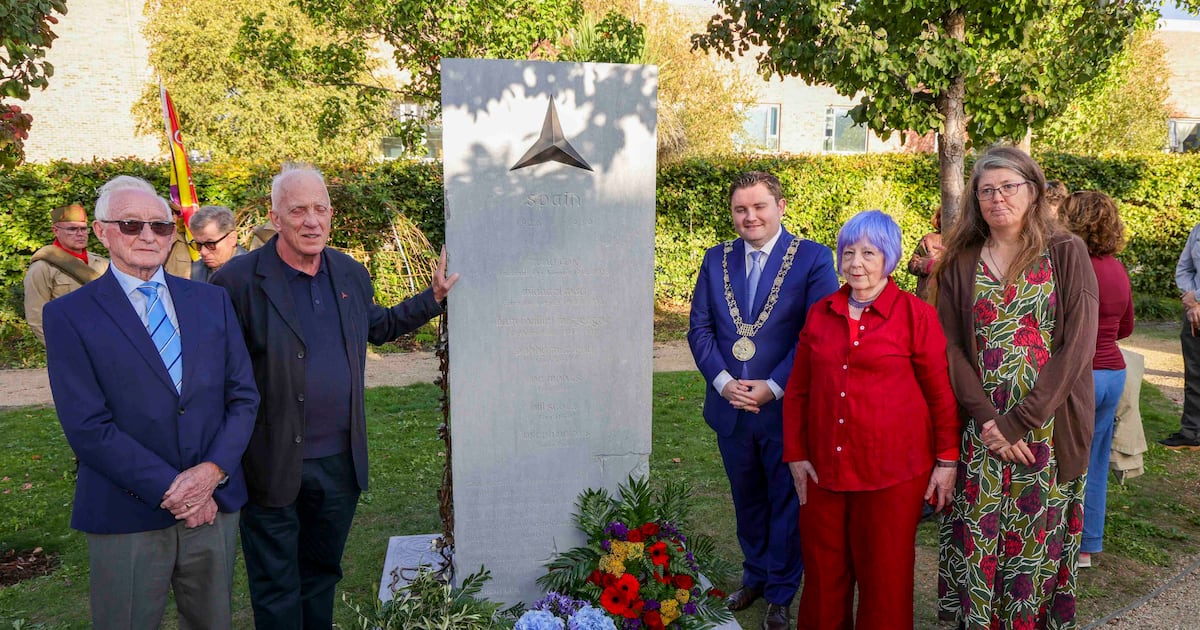
Seven Dubliners who fought against Franco’s fascist army in the Spanish Civil War have been honoured with a memorial at Richmond Barracks, Inchicore, the community from which they all hailed.Finglas man Noel McEvoy (63) was instrumental in securing funding for the sculpture, which was unveiled on Saturday. His mother’s first cousin, Michael May, was part of the first contingent of Irishmen who volunteered to fight for the Spanish Republic. He travelled to Spain in December 1936 to join the International Brigades, alongside Frank Ryan and was killed in Córdoba less than two weeks later. “Up until my late mother died, she used to get very, very upset about Michael,” McEvoy said. “I think she was mostly upset about him because she felt she had to keep a secret. Conservative Ireland at the time was very church-driven. It didn’t want to know about any leftists who were over in Spain.”READ MOREMay travelled over with a schoolfriend, Tony Fox, and the pair died in the same rearguard action. He was attempting to provide covering fire for his comrades as they withdrew from an engagement with fascist forces. Both he and Fox were around 20 and both are commemorated by the memorial.“They were young lads at the time,” McEvoy said. “They’d come from a republican background.”Shaped by its railway works, which once employed 2,000 people, Inchicore’s history is closely tied to trade unionism, socialism and the working class. Three of the seven locals who made the journey to Spain died in the conflict. The memorial at Richmond Barracks commemorates seven Inchicore men associated with the International Brigades and Ireland’s connection with the Spanish Civil War. Photograph: Johnny Bambury/Fennell Photography May came from a family of bakers, some of whom were involved in the 1911 Dublin bakers’ strike, which pre-empted the 1913 Lockout. His father wound up fighting and dying in the first World War, mirroring the end of James Plunkett’s novel Strumpet City, in which the British army became the only source of employment for defeated workers at the end of the labour dispute. When May died, McEvoy said, a local priest told his grieving mother that he would “burn in hell”. He described the comment as a “sword in her heart”. “This [memorial] stone, as far as I’m concerned, is the gravestone for the International Brigades of all the Irishmen who went over to fight,” McEvoy said. “It just happens to be in Inchicore, where seven of them came from the local neighbourhood and went off with Frank Ryan, but it has a greater significance. A greater resonance.” [ Spain to formally pardon 53 women who were locked up by Franco regimeOpens in new window ]The memorial was unveiled by Lord Mayor of Dublin Daryl Barron on Saturday, in honour of May, Fox, Joe Haines, Paddy McElroy, Liam McGregor, Joe Monks and Bill Scott. Their names are inscribed beneath the three-pointed red star that was the primary symbol of the International Brigades. Musician Christy Moore, who wrote Viva La Quinta Brigada in honour of the Irishmen who fought in the Spanish Civil War, and actor Fionnuala Flanagan, whose own father was a volunteer in the International Brigades, were in attendance.Actor Fionnuala Flanagan and musician Christy Moore at the unveiling of the memorial. Photograph: Johnny Bambury/Fennell Photography McEvoy said Richmond Barracks, which housed thousands of suspected rebels after the 1916 Rising, was an appropriate location for the sculpture. He was pleasantly surprised by the willingness with which Dublin City Council facilitated his request for the memorial, assisted by the Friends of the International Brigades in Ireland. He said it represents the sea change in the discourse around the Volunteers that he has witnessed over the decades. “People have much more knowledge about it [now],” McEvoy said. “When I was in school and I mentioned it, people hadn’t a clue.”A range of religious beliefs were accepted in Inchicore historically, McEvoy added, informing the ethos of many of its residents. Those who fought against Franco were doing so based on beliefs that constituted “a mixture of socialism and communism”, he said. General Francisco Franco in 1936. Photograph: Hulton Archive/Getty Images “[They had] a different way of looking at how Ireland should be run. They were all followers of James Connolly. They were the guys that would have been in the Irish Citizen Army. They weren’t fierce people.”Kristina McElroy, who grew up in Dublin city centre, was in Inchicore on Saturday to celebrate her great-uncle, Paddy McElroy, who moved to England after his stint fighting for the Spanish Republic. He died in Croydon, London, in 1993.“I’m feeling very emotional today because these people who put their lives on the line like they did,” she said. “They also put their lives on the line dreaming about a better Ireland.”There was “tremendous pressure” on the McElroy family, who were left-leaning republicans and trade union activists, she said. A number of them were active with the IRA in the earlier revolutionary period, and Paddy McElroy was a member of the Communist Party of Ireland, as was his sister Maisie and, indeed, Michael May.McElroy (73) said she was conscious of the significance of the memorial. Her father, who was named after his uncle Paddy, was employed at the Inchicore railway works before carrying on the family’s strong opposition to fascism by fighting in the second World War. Paddy McElroy (back centre) moved to England after his stint fighting for the Spanish Republic. He died in Croydon in 1993. “[During the war], he actually got on better with people from, say, Liverpool, because they had that same kind of industrial background that he would have known,” she said. “Even now to this day, I think [with] people from Inchicore, there’s a real sense of solidarity.”[ Franco: a spectre from the past in SpainOpens in new window ]
‘They weren’t fierce people’: Memorial unveiled for Dubliners who fought fascism in Spain
Full Article
Original Source
Read the full article at Irishtimes →KhanList aggregates and links to publicly available news content. We do not host full articles from third-party sources. Always verify important information with original sources.