
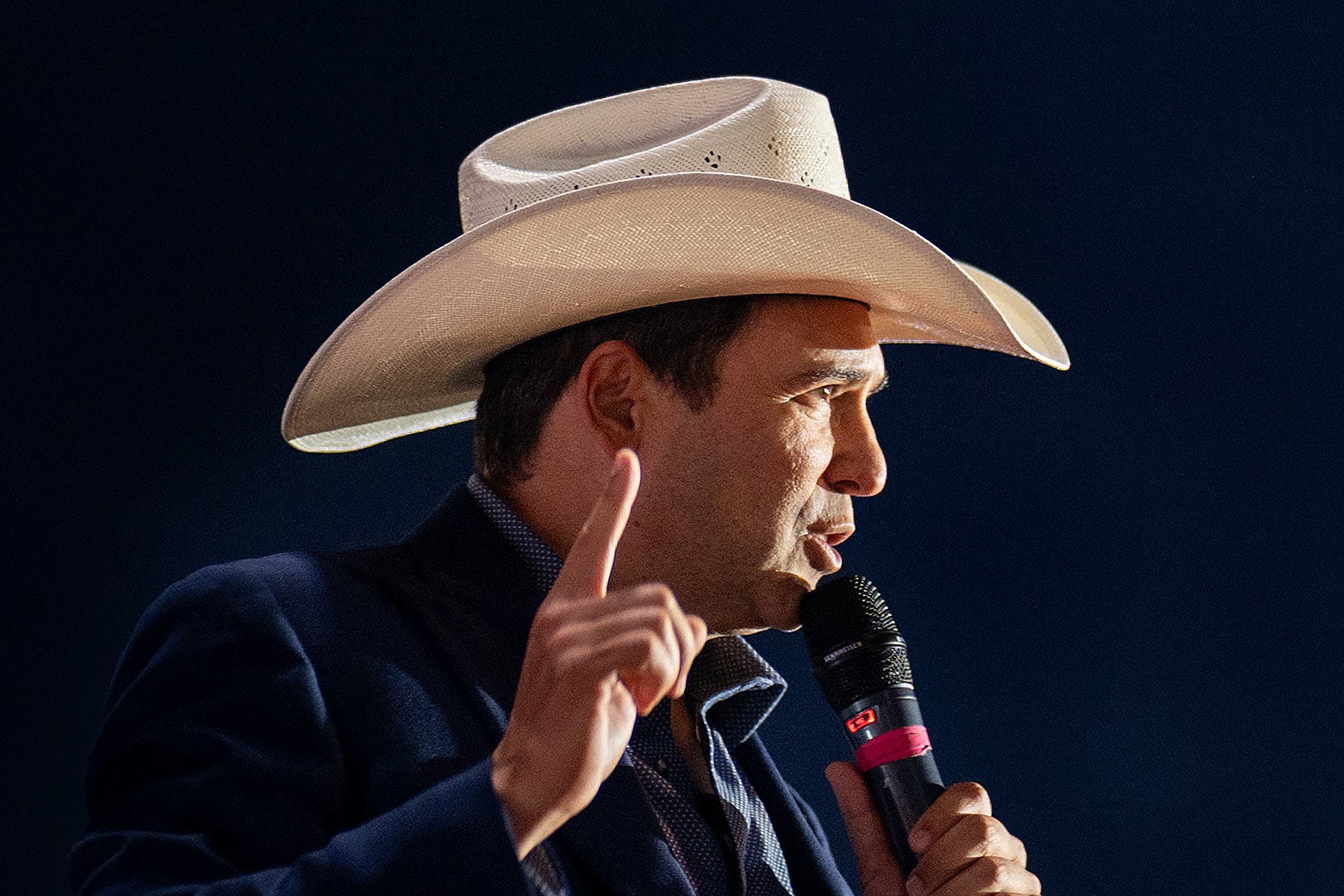
Politics In Texas, Even the Backlash Against Republicans Is Bigger Republicans looked set to turn the Rio Grande Valley red for a generation. Then, Donald Trump 2.0 happened. Democratic candidate for U.S. House Bobby Pulido. Brandon Bell/Getty Images Sign up for the Slatest to get the most insightful analysis, criticism, and advice out there, delivered to your inbox daily. The Rio Grande Valley is not like anywhere else in the United States of America. This isn’t to say that there aren’t similarities. The clean subdivisions springing up around McAllen could be in any prosperous suburb in Florida or Arizona. The abject poverty in a rural colonia could be something out of the most dire hollow in Appalachia. But taken as a whole, this stretch of South Texas, starting at the mouth of the Rio Grande and stretching over a hundred miles along its north bank is just different. It has its own culture, its own music, and its own fast-food chains. Spanish is as commonly heard as English in a region where over 90 percent of residents are Mexican American. But it also is still fundamentally rooted in American culture as well. Like any other Texans, residents still gather for high school football on Friday night and scarf chicken wings while watching the Dallas Cowboys on Sunday. (In Donna, Texas, the logo of the Donna Redskins is proudly emblazoned on the town water tower even if it’s considered problematic on the Potomac). The politics of the Rio Grande Valley are also different. Even as much of the rest of Texas shifted toward the GOP in the past half-century, the Rio Grande Valley remained loyal to the Democratic Party. From local offices up to the top of the ticket, it remained a Democratic bastion. At least until Donald Trump appeared on the scene. It wasn’t immediate. Unlike the voters at Rust Belt diners who consumed the national imagination (or at least those of editors on national desks) after the 2016 election, the Rio Grande Valley didn’t really shift to the right in the race between Donald Trump and Hillary Clinton. However, first in 2020 and then in 2024, the valley’s voters veered hard toward the GOP. Perhaps the most stunning political transformation happened in Starr County, a deeply impoverished county that is the most heavily Hispanic jurisdiction in the country. Hillary Clinton won nearly 80 percent of the vote there in 2016. Eight years later, Kamala Harris won the support of just under 42 percent of voters. Republicans acted like the shift was permanent. They promptly passed a mid-decade redistricting that was designed to shift five seats in Texas to their column. Their hope was that the lone Republican representing a Rio Grande Valley district, Monica De La Cruz, would soon be joined by two others members of her party, who would unseat longtime Democratic incumbents Henry Cuellar and Vicente Gonzalez. It turned out that they were overambitious. It’s not just continued economic woes that have plagued Republicans across the country this cycle. It’s a fundamental miscalculation by the Trump administration on its signature immigration policy. Just because voters were fed up with Joe Biden’s lax border policy, it didn’t mean they were willing to embrace the brutal and indiscriminate tactics of Border Patrol commander Greg Bovino either. For many of these voters, 2024 was a rejection of a Democratic Party that was more interested in catering to white Brooklyn progressives than Hispanics on the border in Progreso, Texas. But it turns out they are not particularly happy with the Republican Party of 2026 either. The resulting backlash could not just cost the GOP a plethora of races in Texas; it could arrest, or reverse, a nascent political realignment in the Rio Grande Valley. Three weeks before Election Day, Speaker Mike Johnson came to McAllen, Texas, to rally Republican faithful in a hotel ballroom only a few miles from the Mexican border. There was an open bar with beer and wine, chicken wings, and burgers for the crowd of over 100. They’d come to see Johnson appear with De La Cruz and two Republican challengers: Tano Tijerina, a much vaunted recruit running against Cuellar, and Eric Flores, the GOP hope for unseating Gonzalez. On the way in, it was hard to avoid free swag from the De La Cruz campaign, which gave out baseball hats, T-shirts, and pens. The crowd appeared to be roughly evenly divided between Anglos and Hispanics in an area where Hispanics make up an overwhelming majority of population. And the message they heard was overwhelmingly clear. The polls were all wrong. Johnson took the stage telling the crowd, “The polls say that these guys aren’t going to win. That’s not true, is it?” to loud noes from the loyal Republicans in the room. He added, “Do not believe the polls right now. I’m telling you, they’re wrong. They’re wrong.” This was weak tea compared with De La Cruz who told the hollering crowd, “I don’t care what the polls say because my God is bigger.” The next day, congressional Republicans pulled their funding for Tijerina, effectively giving up on the race against Cuellar. Republican Rep. Monica De La Cruz. Alex Wong/Getty Images Republicans are struggling in most races this year across the country, but what is happening in the Rio Grande Valley is, like the region itself, unique. It’s also exemplified by the Democratic standard bearer against De La Cruz, Bobby Pulido. A 53-year-old Tejano singer who had a number of hits in the genre in the 1990s, Pulido was one of the most prized recruits for Democrats this year. He’s running in a district that Donald Trump won by 18 points in 2024 and has since been further gerrymandered to stretch from the border over 250 miles north into the rural areas between Houston and San Antonio. However, the bulk of its population is in the Rio Grande Valley, and both candidates live there. Pulido’s celebrity gives him instant universal name ID in the district. It also has been the basis for much of his campaign. After De La Cruz gibed that the race “isn’t about who you want performing at your niece’s quinceañera,” the Democrat said he was open to playing anyone’s quinceañera in the district. Thousands of invitations rolled in for a singer whose hit song “Desvelado” can still be sung by generations of Tejanos in the Rio Grande Valley. However, there is a dark side to the celebrity. De La Cruz has repeatedly attacked Pulido for problematic social media posts across his career, as well as his association with Frankie Caballero, the singer’s former accordionist who is a registered sex offender for indecent contact with a minor. This has been one of the centerpieces of her campaign. After all, who could ever imagine anyone in the Rio Grande Valley supporting a problematic celebrity? De La Cruz’s campaign office is a former restaurant space on a state highway in Weslaco, a sprawling town just east of McAllen. The entrance of the dingy space includes a display of “Faces of South Texas,” which includes Selena, Nolan Ryan, Tom Landry, and some war heroes. She’s having an event for voters to pick up campaign signs, and about 50 people have crowded in to see their congresswoman and pick up her swag at 5:30 on a Thursday afternoon. Burgers are available, with accompanying plastic bags that include lettuce, tomato, and pickle, to allow attendees to individually dress their sandwiches. There are coolers of generic cola and name-brand beer. The older crowd mostly avails themselves of the first and not the second.Next to the congresswoman, the star attendee is a student at Sam Houston Elementary School who dressed up for school as her role model, who happened to be Monica De La Cruz. Dressed in a white blazer and red skirt, she recites De La Cruz’s biography as the real congressman looks on with a glowing smile. When the student is done, De La Cruz hugs her and presents her with an American flag pin and a personalized Monica De La Cruz challenge coin. Before the attendees grabbed their signs, which included standard yard signs as well as pink-shaded Spanish-language signs saying, “Mujeres Para Monica,” they could stand in a photo line for a picture with the congresswoman. Bruce Springsteen’s “Atlantic City” blared in the background. The room appeared to be entirely Hispanic. It included an older woman who spoke broken English but made clear her disdain for immigrants who lack permanent legal status. Also present were Luis Rosa and Luisa Collin, a couple who praised De La Cruz for her constituent services. Rosa had been a Republican and had brought over Collin, who had previously described herself as “a Democrat by tradition” and now was a fervent conservative listening to right-wing podcasts. They both were loyal Trump supporters. “We love him,” said Collin. De La Cruz, though, needs to appeal to more than Trump die-hards to win reelection. Speaking to Slate in her office the day before, she often deflected criticism of administration policies on key issues—noting that she raised concern with key stakeholders. “I had those tough conversations with the administration,” she said about Trump’s immigration policies. “ICE enforcement should focus on the criminals and on the cartels, not hardworking immigrant families trying to navigate this extremely complex immigration process.” However, she acknowledged, “the reality is the White House is the one that dictates enforcement.” She also touted various bills for immigration reform that she had introduced and backed in the House, even though none have, or will, receive a vote in a Republican-controlled Congress. The incumbent waived off criticism that she had not backed a discharge petition on an immigration reform bill that was one signature away from forcing a floor vote on Capitol Hill. “Never in the history of America has true immigration reform been done through a discharge petition,” she said. (A discharge position famously resulted in a vote on the release of the Epstein files earlier this year.) It was the same on Trump’s trade policy, which is particularly resonant in a district on the border. “It’s a discussion that I’m a part of with the trade ambassador, Ambassador Greer, and the White House. I’m going to keep having these conversations as we continue the trade policies,” she said, as she insisted businesses in the district were benefiting from Trump’s tax cuts regardless of any issues with tariffs. She was even reluctant to notably distance herself from the president on easy issues. When asked after the Johnson event about Trump’s decision to buy diesel fuel from Russia, which was denounced by a number of elected Republicans, she dodged. In her view, “I’m going to tell you that the president is thinking outside the box, and sometimes we’ve got to think outside the box to get something done.” But as to whether doing business with Vladimir Putin was not just outside the box but beyond the pale wasn’t a question she wasn’t willing to answer when pressed. De La Cruz’s contempt for her opponent, though, was not disguised. “He’s a silver-spooned celebrity that has never held a job in his life. He had a couple of nice hits back in the ’90s, but he’s a show horse.” She viewed him as a product of the “compadre system,” the political machines that once dominated South Texas politics. She tied Pulido’s past employment of the pedophile accordionist, Frankie Caballero to his political pull as “the product of one of the most corrupt political families in this area. … His uncle was the DA, which let this child sex offender out of jail. Basically, gave him a get out of jail free card, put him back on the streets to molest children.” Both Pulido and his uncle have denied that Caballero received any special treatment, and the Democratic candidate has insisted that he never knew that his accordionist was a registered sex offender when they performed together at a local middle school. De La Cruz isn’t distancing herself from other Texas Republican candidates, including some of the least popular. A number of prominent Republicans in Texas have made clear that they will not vote for the party’s Senate nominee, Ken Paxton, who has been plagued with scandals, or Bo French, the GOP’s candidate for railroad commissioner, who has a long history of racist posts online. “It’s important that people go all the way down ballot,” she said. “I would pray that they go all the way down ballot and that they vote Republican.” Pulido wasn’t just playing quinceañeras on the campaign trail. Less than three weeks before the election, he held a concert at a local arena with around 8,000 people. It wasn’t a campaign event; it was his farewell show. “La Última Desvelada” as he billed it, a reference to his biggest hit song. Attendees came from all over Texas and were motivated far more by Pulido’s celebrity than his candidacy. Amy Gayosso drove eight hours from Nacogdoches, near the Louisiana border, for the concert. She and her brother grew up loving Pulido’s music. He took his own life, and for her, going to the concert was a way to honor her late brother’s memory. There were long lines both for Pulido T-shirts that cost up to $55 and for beer and cocktails at concession stands throughout the arena. Politics was almost entirely absent from the concert until right before the last song, when Pulido spoke, reading off a teleprompter buried by the stage lights. He not only thanked his family and his friends for their support throughout his music career but gave a stump speech pitched for a nonpolitical audience. “We’ve forgotten that we’re neighbors, and that we’re family, and that we’re supposed to care and have each other’s backs. I don’t care whether you’re a Democrat or Republican. We’re fed up with both parties. I’m not team red. I’m not team blue. I’m team you.” At a rally the night before, Pulido struck a different tone. It was in a vacant industrial building out in the country where cars parked the grass, kids played in a bounce castle, and their parents watched while taking advantage of a well-stocked open bar. It felt almost as if Chuck E. Cheese had replaced its animatronic band with several real-life Tejano ones. Pulido said of De La Cruz, “She’s not a good representative. She’s my representative in Edinburg and she’s terrible. And I’m going to tell you why: Because she’s a puppet for Donald Trump.” Pulido went on to further deride his opponent as a partisan shill. “Monica has not made a case for herself. Her case is to try to say, ‘Vote for me because I’m a Republican.’ And I’m telling you, ‘Don’t vote for me because I’m a Democrat. I want to earn your vote. Vote for me because I’ll do what’s right in your interest, and I don’t care about the party.’ ” Speaking to Slate at a juice bar near his house, Pulido kept up his combative tone. He was wearing a campaign button-down shirt with his name emblazoned on it while sipping a cup of matcha (to protect his vocal chords, the two-time Latin Grammy Award–winning singer doesn’t drink coffee). Pulido scoffed at the narrative that South Texas had gone Republican. “No, it didn’t,” he argued. “There’s no elected Republicans here countywide—zero, not one, and there never has been.” Democrats consistently win local races with well over 60 percent of the vote. Instead, he said that the Democratic Party at the federal level had not simply been running the right kind of campaign in the Rio Grande Valley. “Recently when they’ve run congressional campaigns here, that number goes down to 55 percent. So it’s like 7 or 8 points difference when you don’t run a retail campaign and you just put up signs and put up commercials. It’s not how you run it here,” he said. “The saying ‘all politics is local’ really rings true.” However, he made clear that running as a leftist wouldn’t cut it. To succeed as a Democrat, in Pulido’s view, “you’ve got to run on your values and conservative values.” “Believe it or not, we’re all pretty much Blue Dog Democrats here,” he said. “There’s tons of conservative people that are still Democrats. They absolutely aren’t socialists.” Pulido noted that Republicans “always paint every single Democrat as the absolute leftist person, Starbucks barista, with pink hair, and a nose ring. That’s what they want everybody to think that the Democrats are. … They paint this caricature of what a Democrat is, and I’m here to tell them and show them that that’s not the case. I wear boots and a cowboy hat, right? It’s not a fucking costume for me.” In his view, national Democrats abandoned the area in every possible way. “They stopped investing. They took this area for granted. They thought it’d always be Democrat. They got really heavily focused on social justice and other issues, and not so much on economics. They failed on the border, and the Biden administration was terrible. And more importantly, like, it goes back to the economic message, I think that’s the biggest one. You can’t run on a platform down here attacking the rich when everybody here wants to be rich and aspires to be rich.” When asked if Kamala Harris should run again, Pulido said, “It’s a free country “ He added, “I think it’d be a tough sell here, but that’s just my own personal opinion.” He had particular scorn for De La Cruz’s attacks on him and her claims that he was the product of the compadre system. “You know who says that? People with no friends say that.” Pulido’s voice dripped with disdain as he simply asked rhetorically, “What are you talking about? You have that fucking picture with Trump enriching himself, and now you’re the fucking—you’re the like the anti-corruption person. Like, whatever. The guy made $2 billion on fucking cryptocurrency and trading, and he’s traded 10 billion times more than Nancy Pelosi has. Yeah, and all of a sudden you’re like this anti-corruption?” The stakes in this race though aren’t just about one out of 435 seats. It becomes a big indicator of how real the political realignment is among Latino voters. After all, East Texas was once filled with socially conservative voters who stayed loyal to Democrats out of habit, tradition, and economic populism. It’s now blood red. If the Rio Grande Valley follows the same trends, it would doom Democrats’ hopes of winning the Lone Star State for another generation. This has meant the region has become one of the crucial battlefields not just for control of Congress but control of the Senate. Both the campaigns of Democratic state Rep. James Talarico and Republican state Attorney General Ken Paxton have invested in the region. Democrats need not just win here but win decisively to have a path statewide in Texas. It means that national groups are playing in the Rio Grande Valley as well. Somos PAC, a progressive group that seeks to boost Latino turnout held an event in the parking lot of Pulido’s final concert. There were musical performances, free food, and a chance to win tickets to the sold-out show. Melissa Morales, the head of Somos, said the event was part of a wide-ranging effort to convince Latino voters to support Democrats this year after they broke so heavily for Trump in the previous election. “I think anybody who tells me that the shifts in Latino voters weren’t real or didn’t exist in 2024 is kidding themselves,” Morales said. “I like to call Latinos the last real swing voters. They really could have gone either way, which is why we’re talking to soft Republicans.” These are the voters like the parents of Fred Del Barrio, the Republican mayor of Palmhurst and a prominent businessman in the Rio Grande Valley. “They’ve become more conservative, and the older people, a lot of them have changed. They see the values of the Republican Party. They see the conservative values, which I think a lot of us have and the influence of [Alexandria Ocasio-Cortez], those very left-leaning, extreme left Democrats. I don’t think they fit in here.” Certainly Pulido couldn’t be mistaken for a socialist, nor could Cuellar or Gonzalez. (Though Republicans were trying, and billboards saying Gonzalez supported taxpayer-funded sex changes for minors were ubiquitous throughout South Texas.) But what matters in 2026 isn’t so much the flaws of the Democratic Party, it’s frustration with Trump’s GOP. Tariffs have walloped a region where cross-border trade is a regular institution in daily life, and the abuses of ICE have caused a serious backlash among a Latino community that was aghast at Biden’s lax border policies but are just as upset, if not more so, at Trump’s overreaction that has led to separated families and racial profiling in South Texas. Trump has squandered many of the gains that Republicans made here only two years ago, but then again, even Democrats are ceding generational support in the Rio Grande Valley. Pulido was reflective on what his race might mean.”I don’t know if I’m going to win, but I think it’s real simple,” he said. “If I win, and if I win with a good margin, probably if that were to be 5 points or better, I think a big message has been sent that people here did not like what was going on with Trump, and our message resonated. “If I don’t win, then obviously we just didn’t do a good enough job. It’s just that simple. And then I guess maybe if that were to happen, then maybe the negative campaigning was the way to do it.” No matter what happens on Tuesday—whether Pulido gets his big win or goes home with regrets—the Rio Grande Valley will continue to be contested territory for both parties for the foreseeable future. But if Democrats don’t make big gains there this year, it’s hard to see their future in the region looking particularly bright. Democrats House of Representatives Latinos Republicans Texas 2026 Midterms
They Were Some of MAGA’s Newest Converts in 2024. Now They’re Jumping Off the Trump Train En Masse.
Full Article
Original Source
Read the full article at Slate →KhanList aggregates and links to publicly available news content. We do not host full articles from third-party sources. Always verify important information with original sources.