
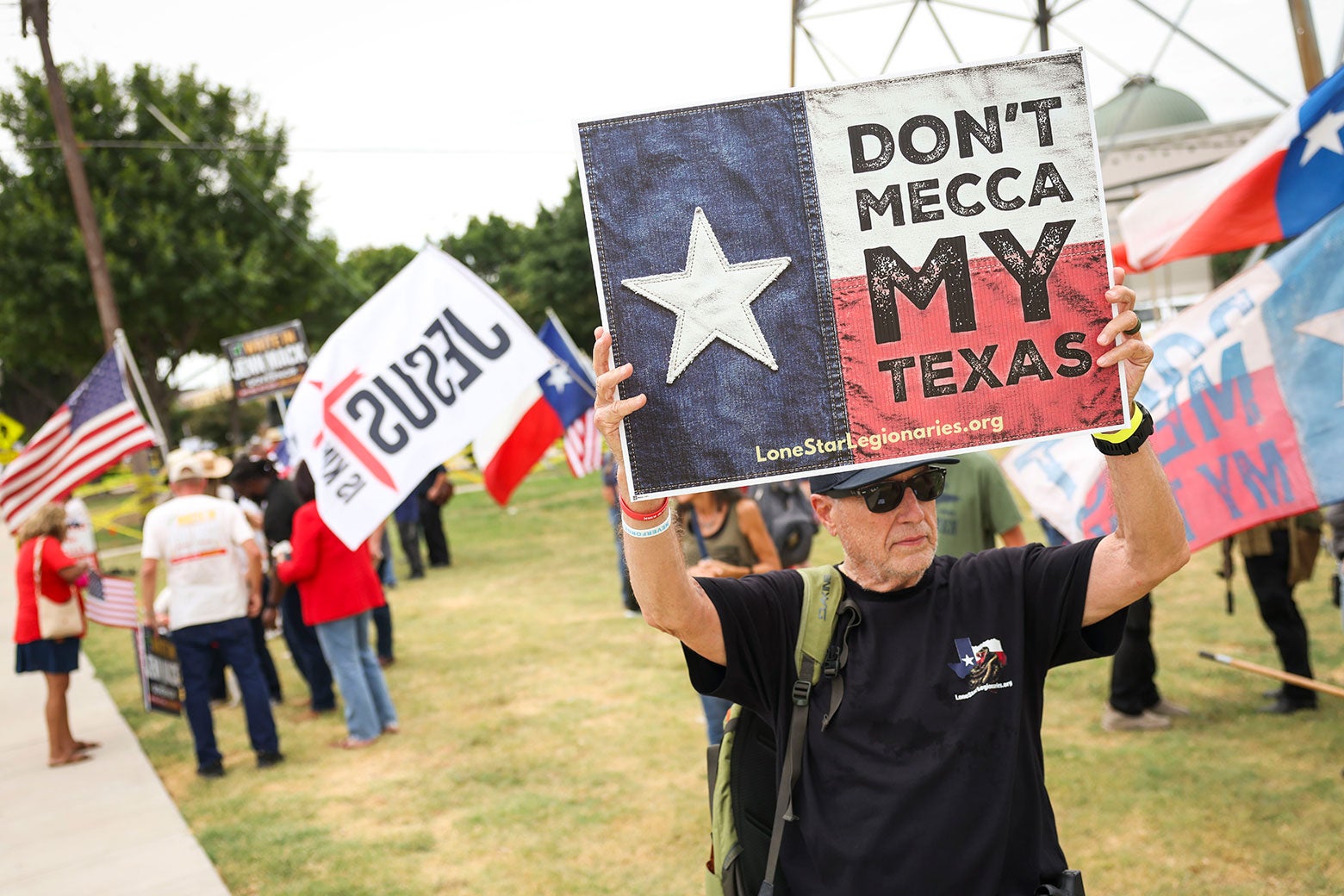
Politics By Enter your email to receive alerts for this author. Sign in or create an account to better manage your email preferences. Unsubscribe from email alerts Are you sure you want to unsubscribe from email alerts for Shirin Ali? Nov 02, 202610:00 AM Protesters outside the Islamic Association of Collin County in September in Plano, Texas. Shafkat Anowar/The Dallas Morning News via Getty Images Sign up for the Slatest to get the most insightful analysis, criticism, and advice out there, delivered to your inbox daily. In today’s GOP, it would be next to impossible to find a Republican ready to stand behind the statement “Islam is peace,” words uttered by none other than Republican former President George W. Bush just weeks after 9/11. That’s because in the subsequent 25 years, the Republican Party has decided that scapegoating the Muslim community for the country’s problems is a way to galvanize white Christian voters to elect Republicans. Nowhere is that strategy more evident than in the state of Texas. Politicians there this election cycle have been even more vicious than usual in proudly peddling Islamophobia. What these actions reveal is a deepening desperation within the Texas GOP as they face down once-in-a-lifetime political headwinds that suggest Democrats are on the verge of flipping Texas. But it’s no longer 2001, and American Muslims have been asserting more and more political clout. There’s actually a decent chance that Texas Republicans’ extreme Islamophobia backfires by alienating the one group that was shaping into a growing GOP demographic: Muslims. “It’s especially bizarre for the Republican Party to do it because it’s supposed to stand for conservative values, religious freedom, all of that. That’s not what they’re doing,” Mohamed Hussein, a self-described conservative Texan and a practicing Muslim, recently told me. While attending a GOP convention in Houston over the summer, he says he was told to convert to Christianity or leave the country. “It was shocking, because I wasn’t at a religious convention, to be told to convert. It kind of came out of left field,” Hussein said. He attended a Judeo-Christian seminar where attendees were told that non-Christian immigrants will create problems for America and that Muslims were lying to win political power. This was a version of the Republican Party that Hussein did not recognize; “I don’t think that had this convention occurred a year ago, it would have been this nasty toward Islam and Muslims.” Clearly, a lot has changed since 2025. Americans went from having a Democratic president to a Republican one, suddenly finding themselves at war with Iran, facing record high gas and diesel prices, skyrocketing healthcare costs, and immigration agents knocking down their doors. It has made the 2026 midterms an especially consequential election cycle, and in Texas, Republicans have decided Muslims could be their ticket out of the backlash to the mess created by President Donald Trump. As I am an American Muslim myself, and have plenty of family and friends in Texas, it is a phenomenon I was curious to explore. So I took a trip to Houston, home to one of the country’s largest Muslim populations, to see what it’s like for Muslim Texans, especially those who may have voted GOP in years past but were now looking at a party they didn’t recognize. Though Muslims only make up about 1 percent of Texas’ total population—roughly 300,000 people—the state is home to the fourth-largest population of Muslims within the U.S. and the largest in the South. And Islam has long been considered one of the fastest-growing religions in the country, with Pew Research estimating that by 2040, Muslims will replace Jews as the nation’s second-largest religious group after Christians. By 2050, Muslims are projected to account for 2 percent of the total U.S. population, compared to the 1 percent they currently represent. Muslims’ growth is especially pronounced in Texas, where the Muslim voter population grew 35 percent from 2016 to 2020, which translated to an additional 80,000 registered voters, according to the Muslim civics group Emgage. Yet, state Republicans, this cycle at least, seem not to want anything to do with these voters. Since at least last year, they have been aggressively inciting anti-Muslim rhetoric and policies, starting at the top with Gov. Greg Abbott, who is currently locked in a surprisingly tight race for reelection. He went to war with EPIC City, an Islamic development project that sought to build a K–12 school, mosque, retail space, and housing units, and it took over local headlines. Abbott went so far as to sign a law banning EPIC City from moving forward, characterizing the developers as “bad actors” who would subject occupants to “Sharia law,” whatever his definition of that might be. His fellow Republicans were taking notes. Soon enough, Attorney General Ken Paxton, the Republican nominee for a Texas Senate seat who’s also locked in a tight race against Democrat James Talarico that could determine control of the U.S. Senate, followed up with a lawsuit against EPIC City, while Texas Rep. Keith Self also called on the Justice Department and IRS to investigate the developers. Then Abbott struck again, this time sabotaging plans for a celebration of Eid, one of the holiest Islamic holidays celebrating the end of 30 days of fasting, that was supposed to take place at a local water park—a venue that the community had used for the past two years with no issue. Suddenly, Abbott was threatening to pull over half a million dollars in state funds from the city of Grand Prairie if they allowed the Eid swim party to proceed. It worked, and the city canceled the Eid celebration. Soon the slogan “Don’t Sharia My Texas” was taking over the state, inspired by an anti-Muslim propaganda film that features conspiracy theorist Alex Jones and right-wing former national security adviser Michael Flynn. Sharia is a set of religious and worldly values for Muslims to follow and is entirely separate from Islamic law, though Republicans have rarely—if ever— attempted to explain what it is they are fearmongering against. “Like racism, Islamophobia can be adapted to align with the political and economic interests of those in power,” Khaled Beydoun, a professor of law at Arizona State University who studies Islamophobia, told the Dallas Morning News. Islamophobia may have hit its peak in America immediately following 9/11. President Bush declared a “war on terror,” and, again, failed to clearly define terrorism, which made the concept borderless and timeless, as explained by the Bridge Initiative at Georgetown University. This oversimplification created two sides: terrorists versus everyone else, with Muslim Americans becoming targets of both the state and the general population. This period gave way to controversial policies like the National Security Entry-Exit Registration System, the Terrorism Screening Database, and even the establishment of Guantanamo Bay. It would take decades for the public to learn that Bush’s wars were utter failures, and slowly but surely it became normalized to publicly criticize American foreign policy. Eventually, Muslim Americans were empowered to be a part of America’s shifting governance, while also changing the narrative around Islam. Voters began electing Muslim candidates to Washington, and today, Michigan Rep. Rashida Tlaib, Minnesota Rep. Ilhan Omar, and New York City Mayor Zohran Mamdani are some of the most recognizable political figures in the country, and are also practicing Muslims. In Michigan, Abdul El-Sayed is hoping to make history as the first Muslim American to serve in the U.S. Senate (while also facing perhaps the most bigoted campaign in recent memory). Notably, each of these figures are Democrats, as their party has largely embraced a diverse coalition of voters. Meanwhile, Republicans have decidedly gone the opposite direction, reinvigorating an especially pernicious element of the culture wars of the early aughts. In fact, it was Texas Rep. Chip Roy who cofounded Congress’ “Sharia-Free America Caucus.” He’s also running in a competitive race for Texas AG, and in the process “has posted from both his campaign and official accounts about Muslims, Islam, or ‘sharia law’ more than 244 times since January—the most of any member of Congress,” according to a Washington Post analysis. In the run-up to Texas’ March primary, blatantly anti-Muslim ads were running rampant across the state on behalf of Republican campaigns that baselessly tied Islam with terrorism and crime. All of it was considered “solid gold” by one Republican strategist, who told CNN: “It is playing as well as anything I have ever seen with Texas Republican voters.” Why would overt bigotry that pits fellow Texans against each other be resonating with voters? Perhaps because Republicans themselves have spent decades perpetuating the very Islamophobia the rest of America has been trying to heal. Equality Labs, a South Asian–focused civil rights group, found that Texas led the country in promoting Islamophobia-related disinformation in 2025, largely driven by online posts suggesting Muslims were invading the U.S. and attempting to impose Sharia law. Consider Bo French, a longtime far-right activist who’s currently running for Texas Railroad Commissioner. In September, he characterized a photo of a group of South Asian University of Texas students celebrating the school’s football team’s win: “Like body-cams exposed criminals, social media is exposing how many Americans have been displaced by foreigners. It’s everywhere and far worse than any of us could imagine.” French’s comment quickly went viral and ignited a national conversation about blatant bigotry against minorities. Equality Labs also found that nationwide, Republicans are largely responsible for spreading Islamophobic content, as opposed to Democrats and independents. This phenomenon is particularly insidious in states like Texas where Republicans hold a supermajority, because “the primary electorate becomes the decisive contest, and candidates have to appeal only to a very small sliver of their own electorate,” Brandon Rottinghaus, a political scientist at the University of Houston, told the New York Times. All of this is having a discernible impact nationwide, as Pew Research found U.S. adults’ attitudes toward Islam have worsened since 9/11. In 2002, six months after the al-Qaida attacks, 25 percent of U.S. adults said Islam is more likely than other religions to encourage violence, but when asked the same question in 2026, that figure had more than doubled to 51 percent. Republicans and independents who lean toward the GOP were far more likely than Democrats and Democratic leaners to say Islam encourages violence—76 percent versus 29 percent. Particularly In Texas, this puts hundreds of thousands of Muslims in an untenable position. People like Hussein are actively being disenfranchised by a political party whose conservative values they typically align with. Khalid Hamideh, spokesman for the Islamic Association of North Texas, told me: “We’re more aligned with the values of the Republican Party when it comes to abortion, same-sex marriage—on all of the social issues, we’re very conservative. We’re very aligned with the people that hate us most.” As they’re left with no other option, Hamideh believes the recent GOP attacks on Texas Muslims have pushed many toward the Democratic Party unwillingly. Jida Nabulsi also holds conservative values, but doesn’t identify herself as either a Democrat or a Republican. “You could say that I would have aligned more with the Republican Party. But given the current state of things, there’s just no sympathy from the Muslim community,” she told me. Nabulsi is the Texas state director for Emgage, a group that has been supporting Talarico’s candidacy. She believes there are plenty of Muslim conservatives in Texas who share her perspective. “The conversations I’m having with my community and other community members, they are telling me that even though they identify with Republicans, nobody should be voting Republican. Nobody should be aligning with that.” Because they are obsessed with perpetuating anti-Muslim hate, Nabulsi believes Texas state lawmakers are forgoing talking about the actual issues voters care about. “Their top priority as a group is not affordability, bringing down prices or making life easier for us, but to target one community,” she said. ”It does not make sense.” Democrats aren’t necessarily viewed more positively than Republicans right now, but Nabulsi believes they’re at least signaling an open line of communication with a message she interprets as “We are not here with hate.” Just a few weeks ago, Talarico’s campaign met with local Muslim officials and community members in Dallas, where he emphasized a bill he filed that would include Muslim imams as legally recognized marriage officiants. One October poll found Talarico leading Paxton by nearly 17 points among Asian American and Pacific Islander voters, though it’s challenging to carve out Muslim voters here as they can fall under the listed “Asian,” “South Asian,” “Middle Eastern,” and “African” ethnic groups, all of which also include other religions. Nonetheless, getting Texas Muslims on board could be the windfall Talarico needs to get him over the line against Paxton. Given the serious risk Texas Republicans face right now of losing their ruby-red grip over their state, it might make strategic sense for them to widen their tent, particularly to voters who are already inclined to support them. Muslims are especially primed for the taking, as they’ve increased their voting power over the past 10 years. The Institute for Social Policy and Understanding found that in 2016, 60 percent of eligible American Muslims reported being registered to vote, and by 2025 that figure had jumped up to 85 percent. And since 2024, Muslims have been shifting away from Democrats over their handling of Israel’s war in Gaza, which culminated in tangible action with the “Uncommitted” movement that galvanized voters who were unhappy with the Biden administration’s Israel policy to refrain from voting for either Joe Biden or Kamala Harris. Plenty of ink has been poured over whether the Biden administration’s Israel policy cost them the 2024 election, but the data suggests there has been a clear shift. Exit polling conducted by the Council on American-Islamic Relations, the largest Muslim civil rights group, found in 2020 that Biden earned 69 percent of the Muslim vote, compared to Trump’s 17 percent. Four years later in 2024, Harris earned only 20 percent, while Trump received 21 percent and third-party candidate Jill Stein notched 53 percent. That is a lot of voters ripe for the taking. The shift in Muslim voters’ politics is comparable to that of America’s Hispanic electorate, who were considered solidly Democratic until Trump arrived. In 2024, he captured 42 percent of the Latino vote as discourse around immigration doomed the Biden and Harris campaigns. Ironically, Latinos now may swing back to Democrats in 2026, thanks to Trump’s deeply unpopular mass-deportation agenda. The current vitriolic rhetoric being spewed in Texas by Republicans could similarly push Muslims right into Democratic hands. This doesn’t surprise Hussein, who senses that Texas Republicans’ true loyalty always goes back to White Christian nationalist voters. “I think it probably appeals to a portion of the base. I think it’s also a distraction from other things that matter to Texans,” he told me. “It’s a reliable boogeyman to blame Muslims.” This time around, they may just be shooting themselves in the foot. Donald Trump Politics Republicans Senate Texas Islamophobia Islam 2026 Midterms
They Were a Key Voting Bloc Trump Made Progress With in 2024. Republicans Have Done Everything to Reverse That.
Full Article
Original Source
Read the full article at Slate →KhanList aggregates and links to publicly available news content. We do not host full articles from third-party sources. Always verify important information with original sources.