
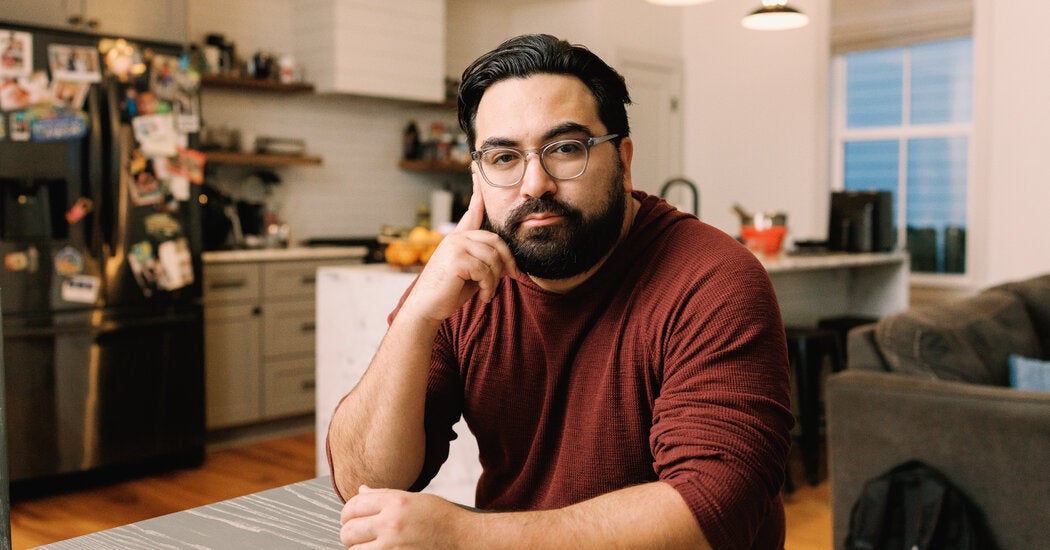
AdvertisementSKIP ADVERTISEMENTThis year, the first class of medical students will begin their journey to becoming physicians under new rules limiting how much they can borrow for school.Bryan Torres is trying to finish medical school but has met the lifetime limit — $200,000 — for federal student loans for professional students.Credit...Bryan Tarnowski for The New York TimesNov. 15, 2026, 5:01 a.m. ETBryan Torres didn’t meet many doctors growing up. It wasn’t until he was 15, when his mother was hospitalized with respiratory failure, that he realized he wanted to be a physician.Mr. Torres, who grew up in Maryvale, Ariz., and is of Mexican and Colombian descent, would translate between his mother and her doctors. They didn’t speak enough Spanish “to comfort my mom,” he recalled, and “didn’t look like me.”Though Mr. Torres, now 33, said his mother received quality care, he felt “alienated, hopeless and helpless” while in the hospital with her.“That’s kinda when I decided I wanted to dedicate my life to making sure that no one has to ever feel the way I felt in that moment,” he said.After receiving his bachelor’s degree in biosystems engineering from the University of Arizona, he spent six years taking the medical school admissions exam five times, earning a master’s degree and working across the health field as a pharmacy technician, a medical assistant, an E.R. scribe, a molecular biologist and more.In 2021, he was accepted to the Tulane School of Medicine with the intention of becoming a reconstructive plastic surgeon.Now, in his last semester, his plans are in jeopardy.Before his final semester, Mr. Torres received an email from Tulane telling him he was no longer eligible to take out federal loans to pay for medical school.Under President Trump’s sweeping policy bill passed last year, professional students, like those in law and medicine programs, are not allowed to take out more than $50,000 a year in federal loans, with a total cap of $200,000. Federal loans for graduate programs like masters and Ph.D. programs were capped at $20,500 per year and a total of $100,000.Education costs that are not covered by federal loans must be paid for using other funds. Most students use private loans, which often charge higher interest rates, have less flexible repayment options and fewer forgiveness options.Mr. Torres was enrolled in medical school before the bill’s conception. But because he has already taken out over $257,500 in loans, he has reached the lifetime cap for federal borrowing.Rather than take out private loans, Mr. Torres started a GoFundMe page and raised over $30,000 of the $50,000 he estimates he’ll need to finish school. When he’s not in clinical rotations, he has been driving for Uber and working for Rover, a pet care company.Some of the money will help cover the cost of flights to about 20 cities for in-person interviews for residency programs across the country.Despite these setbacks, Mr. Torres said he was still committed to becoming a doctor, though he said the loan caps could create wider disparities in representation in the field.“Now it’s like, if you don’t have the money, and you don’t come from an affluent background, then therefore this profession is not meant for you,” he said.ImageMr. Torres has been working for Uber and Rover, a pet care company, to earn money to help him pay for his final semester of medical school.Credit...Bryan Tarnowski for The New York TimesForced to Find New OptionsThis fall, a new class of medical school hopefuls is facing new rules on how much they can borrow for their educations.The Department of Education cited the rising cost of college programs with “minimal or negative return on investment” as a reason for putting in place the loan caps signed into law. It added that “unrestricted borrowing has enabled institutions to raise tuition and fees without sufficient constraint, contributing to rising student loan debt.”But schools are unlikely to lower their tuition rates simply because of loan caps.Justin McAllister, the chief financial officer of the West Virginia School of Osteopathic Medicine, said it would be “impossible to be able to drive tuition down with inflation and the cost.”Dr. Eva Aagaard, vice chancellor and vice dean for education at Washington University School of Medicine, agreed.“There’s a misunderstanding broadly about how much it costs to train medical students and that medical schools could just reduce their tuition,” she said. “If we reduce our tuition, that money has to come from somewhere else.”Dr. Aagaard and Mr. McAllister said their schools were trying to find ways to support students affected by the loan caps. Dr. Aagaard pointed toward the school’s scholarship program as an example. Nearly three-fourths of incoming students had full-tuition funding in 2025, but Dr. Aagaard acknowledged well-funded scholarships were not always available at every medical school.Mr. McAllister said West Virginia formed partnerships with private lenders like AACOM by Sallie Mae, Citizens and SoFi to offer loans that didn’t require a co-signer, loans that had lower interest rates or loans that could be deferred through residency.SoFi, for example, offers uncapped loan amounts with interest rates that vary between 2.99 percent and 15.33 percent (the interest rate for federal loans is 8.07 percent for graduate and professional students).Mr. McAllister said loan caps “forced us to find our own options and create our own options.”The Department of Education did not respond to a request for comment.‘I’m Gonna Grin and Bear It’When Kiley Cleland was 19, she worked in clinics treating human trafficking survivors and “saw all these patients slipping through the cracks of how terrible our health care system was.”“It was heartbreaking,” she said.Her path to becoming a doctor has been difficult. She attended a community college initially because she didn’t have the grades to get into a four-year university. After transferring to the University of California, Davis, she was diagnosed with cervical dystonia, a neurological condition affecting the brain and nerves that left her with chronic pain, forcing her to drop out.After getting her health back on track, she re-enrolled in her undergraduate program and finished with strong grades. She went on to receive her masters in bioethics at Johns Hopkins.Now 27, Ms. Cleland is $85,000 in debt — a grant-funded program that she had planned to use toward her medical education fell through — and she has limited options. Though her medical school application is mostly ready, she delayed submitting it for another year because she said she felt financially insecure because of the loan caps.To Ms Cleland, the government’s decision to apply the caps says: “If you’re rich, pursue medicine, be a doctor. And if you’re not, stop. Give up, go away.”She doesn’t want to take out private loans but will consider them.“I am the most relentless, hopeful, resilient, stubborn person there is,” Ms. Cleland said. “Which means I’m gonna grin and bear it.”ImageKiley Cleland is $85,000 in debt. She said she feels financially insecure and that the loan caps on federal student loans have caused her to delay applying to medical school.Credit...Andri Tambunan for The New York TimesA Physician ShortfallResearches have studied the long-term effects of loan caps on the field of medicine and health care system.Dr. Tarun Ramesh, a research fellow at the Department of Population Medicine at Harvard Medical School, conducted a study published in 2025 examining how medical school costs had changed over time, and the potential impacts from capping education loans.Dr. Ramesh and his team used data from the national postsecondary student financial aid survey and the Consumer Price Index to understand how much debt medical students were taking on, and how they were paying it back. He found that nearly half of medical students exceeded $50,000 in annual federal loans in 2020, and the annual cost of attendance, which includes tuition, fees, housing and food, had increased significantly over the prior decade.That trend hasn’t slowed. College Tuition Compare, a website for tuition data, found that the average annual cost of attendance this year for medical school was almost $100,000.Dr. Ramesh said that it’s unlikely students could afford medical school on $50,000 per year in federal loans, and that poorer students were more likely to exceed the lifetime cap.The United States is projected to be short of up to 86,000 physicians by 2036, with almost half of those open roles being for primary care physicians, according to a report from the Association of American Medical Colleges, or AAMC.Primary care, along with pediatrics, are among the lowest-paid specialties in medicine. Dr. Ramesh said specialties like these were at bigger risk for a worsened shortage.“I’m concerned that the O.B.B.B.A. restrictions may disincentivize medical students from engaging or going into primary care specialties,” he said, referring to Mr. Trump’s policy bill.Kristen Earle, director of student financial services at AAMC, wrote in an email that she was “deeply concerned” the bill would “create significant financial barriers for medical students — especially those from low-income, rural and nontraditional backgrounds.”Aquila Ali, a math major in her last year at New York University, grew up taking care of her younger brother. As he grew older, she noticed a behavioral shift in him.After many doctor visits, and misdiagnoses, Ms. Ali’s brother was diagnosed with autism. She said her experience “seeing how doctors diagnose autism in children, especially Black children” was the start of her interest in becoming a physician-scientist.Her original plan was to save up money during gap years and take out federal loans for medical school. But since Ms. Ali discovered she’d have to take out private loans to afford the full cost of medical school, she said she put those plans on the back burner.“The more research I did, the more I realized that it would probably not be very realistic for me to go to medical school within the time frame that I wanted to,” she said. “Just because I just wouldn’t have enough money.”Ms. Ali said she was planning on pursuing her Ph.D., but she still wanted to be a physician one day.“I know that there’s still a place for me whether or not the federal government thinks so,” she said.Related ContentAdvertisementSKIP ADVERTISEMENT
They Want to Be Doctors. Student Loan Caps Are Complicating Their Dreams.
Full Article
Original Source
Read the full article at Nytimes →KhanList aggregates and links to publicly available news content. We do not host full articles from third-party sources. Always verify important information with original sources.