
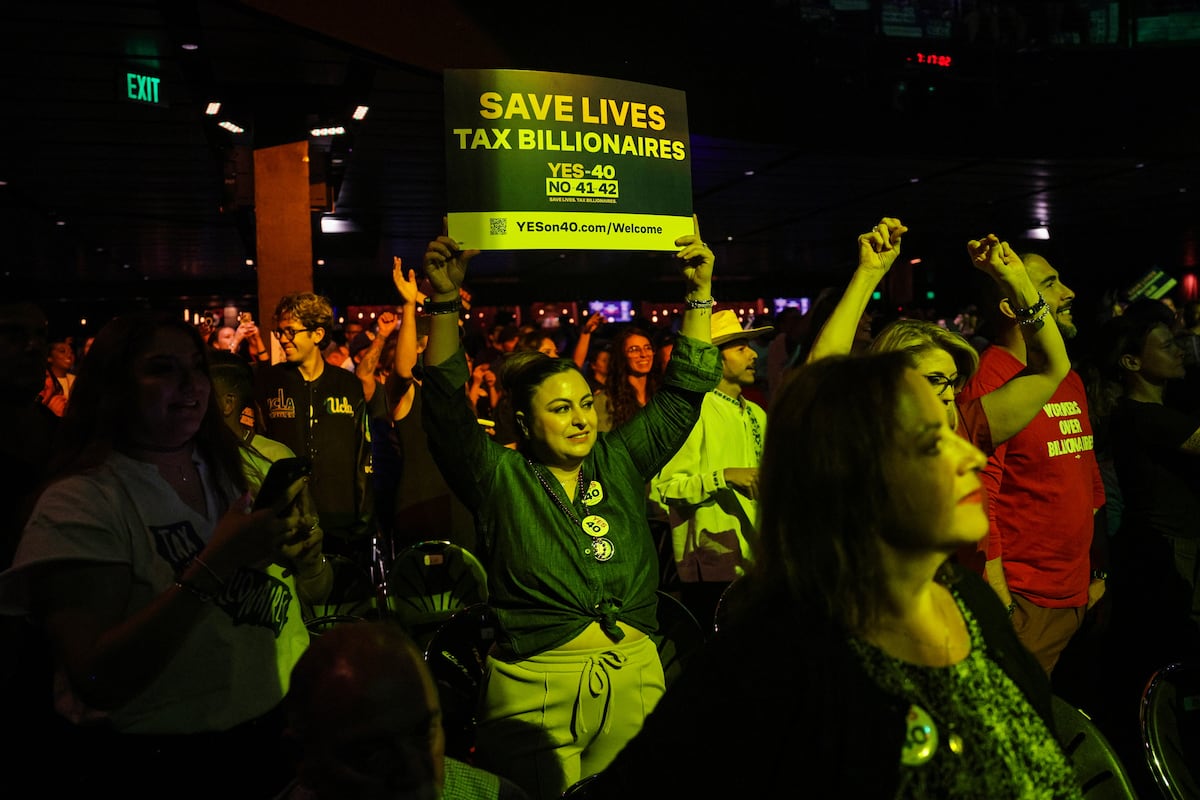
Citadel is one of the most visited shopping centers in Los Angeles. But in these lean times, few customers browse its clothing, bag and shoe stores. On this hot October afternoon, Rocío López is here, treating herself to “a luxury” amid the cuts her family has made to blunt the impact every time they fill the car’s tank or do the grocery shopping. The pressure on her finances became clearer with her latest tax return: she and her husband were shocked to find they owed $8,000 to the IRS.“The more you work, the more you pay,” says the Mexican immigrant, visibly angry, who lives in Garden Grove, 28 miles from Los Angeles. López believes the playing field is not level for everyone. She has a point: California’s wealthiest pay around 0.2% of their total wealth each year in state income taxes — about $3.2 billion — according to an analysis by the National Bureau of Economic Research.With that inequality in mind, López, who became a U.S. citizen 15 years ago, recently voted in favor of Proposition 40. The measure would introduce a one-time tax of 5% on the total wealth of California tax residents whose net worth is $1 billion or more. Backers expect to raise about $100 billion, to be used mainly to fund the public health system that serves low-income people.“They should pay more than the poor,” says López, who earns a living caring for people with special needs — work that, at the entry level, is often paid at minimum wage. “The rich take advantage of the situation, and that’s not fair,” she adds.Proposition 40 is presented as a social-justice initiative intended to force billionaires who live in California to contribute more through the tax code, as some leading economists have proposed. But polls show the measure divides voters. Backers attribute that lack of consensus to an aggressive ad campaign funded by large donations from some of Silicon Valley’s wealthiest businesspeople, and to the absence of support from the Democratic establishment.‘Five percent is very little’Kaelynn Pérez, 19, studies medicine at the University of Southern California (USC). She learned about Proposition 40 through social media and says she will take time to hear both sides before voting. Although the young woman, who lives in Downey — a predominantly Hispanic suburb 13 miles southeast of Los Angeles — believes the wealthy should pay more into the tax system, she still has doubts about whether the initiative is well crafted and whether, if approved, it would benefit the community as much as it could. “Maybe it should be reworked and put on a different ballot,” she says.“I think asking them to pay 5% is too little. There are a lot of people looking to make a lot of money from this, and that’s fine, but I don’t think it’s enough,” says the young woman, who is preparing to vote for the first time in a federal election.Among the billionaires who could be affected by the proposition, the first who comes to her mind is Mark Zuckerberg, owner of Meta, the parent company of Facebook, WhatsApp and Instagram — the latter one of the social networks she uses most. “It would be good to put the rich in a position where they can help the community,” Kaelynn says. “I’ve never seen media coverage saying Mark Zuckerberg has donated X amount to students or given opportunities to people who need support,” she adds.Polls show a narrow lead for yes on Proposition 40. Forty-six percent of voters surveyed during the second week of October said they backed it, versus 43% who opposed it, according to a Citrin Center–Politico poll. In mid-September, another survey by the Public Policy Institute of California (PPIC) put support at 52%, just above the threshold needed for the initiative to pass. A University of California poll published at the end of September found 45% would vote in favor.“This contradicts everything I thought I knew about political science,” said Jon Gould, dean of the School of Social Ecology at the University of California, Irvine (UCI), during a recent forum analyzing the initiatives on the November 3 ballot in the state. “I thought voters would say, ‘My God, we need the money. It will go to education and health care and it also affects the multimillionaires. Count me in.’ But for now, it seems that’s not the case,” he said.‘They don’t pay what they should’There are differing views among Democrats as well. While Vermont Senator Bernie Sanders supports taking a share of the largest fortunes in California, outgoing Governor Gavin Newsom questions the measure’s structure and argues that a tax of this kind should be applied nationally.Campaign financing to defeat Proposition 40 is proportional to the size of the pockets that would be affected. State financial reports show more than $340 million has been raised, mostly from tech billionaires. The largest donor is Google co-founder Sergey Brin, who has contributed at least $102 million.That spending spree shows up in the aggressive political marketing flooding traditional and social media. “When the money runs out, Sacramento will come back with another tax,” warns one ad.Juan José Estrada, 19, studies mechanical engineering at a public university in San Diego, on the California–Mexico border. He says he prefers to ignore campaign advertising to avoid being influenced. On Proposition 40, whose ads keep appearing on his phone, he has a clear stance and recently cast his ballot by mail. “Billionaires don’t pay what they should,” he says. “They should pay more.”Sign up for our weekly newsletter to get more English-language news coverage from EL PAÍS USA Edition
‘They should pay more than the poor’: The battle to make California’s richest give up 5% of their fortunes
Full Article
Original Source
Read the full article at English →KhanList aggregates and links to publicly available news content. We do not host full articles from third-party sources. Always verify important information with original sources.