
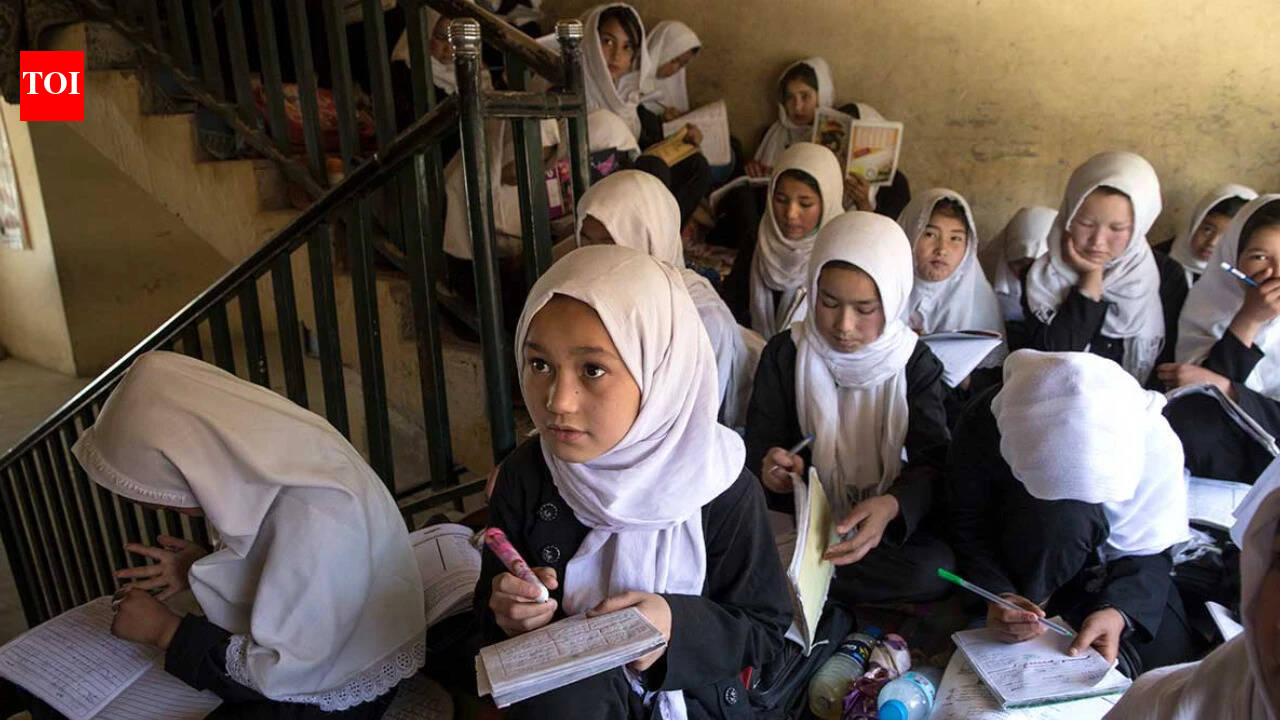
They promised girls the right to study up to university level, women the freedom to work and an Afghanistan where their rights would be protected.Five years after returning to power, the Taliban's promises lie in stark contrast with the reality. More than 2.6 million adolescent girls have been denied secondary education since 2021, women remain barred from universities, and 53 per cent of Afghanistan's primary school-age children are now outside formal education.A joint report by UNESCO and UNICEF, titled Afghanistan Education Situation Report 2026, raised concerns over the deteriorating quality of education in the country. Citing a national assessment of more than 55,000 Grade 4 students across all 34 provinces, the report found that fewer than half had achieved minimum proficiency in language at the Grade 3 level, while only one in four met the corresponding proficiency level in mathematics.It further found that fewer than one in 100 children aged three to four participate in early childhood education programmes.The Taliban's return to power came amid the withdrawal of US and Nato forces after nearly 20 years of military presence in Afghanistan.The withdrawal followed the February 2020 Doha Agreement, signed between the Trump administration and the Taliban, under which Washington committed to withdrawing its forces in exchange for security commitments from the group and its pledge to engage in intra-Afghan negotiations.As foreign forces withdrew, the Taliban launched a rapid offensive, capturing provincial capitals before entering Kabul on August 15, 2021, as then-president Ashraf Ghani fled the country. The US completed its military withdrawal on August 30, 2021.What the Taliban promised Afghan women and what they got insteadJust two days after capturing Kabul, on August 17, 2021, Taliban spokesman Zabihullah Mujahid sought to reassure Afghans and the international community that the group's return to power would not mean a reversal of women's rights.Addressing the first press conference after the takeover, he said women would be allowed to work, study and participate in society, provided they followed the Taliban's interpretation of Islamic law. He also said the group would not discriminate against women.In a separate interview with Sky News on the same day, Taliban spokesman Suhail Shaheen made an explicit promise that Afghan women would be allowed to pursue education up to university level and continue working. He said the group was committed to women's rights, education, employment and freedom of speech under its interpretation of Islamic rules.However, the assurances were followed by a series of restrictions that progressively excluded women from education, employment and public life.In September 2021, when secondary schools reopened, boys were allowed to return to classrooms while most girls were kept at home.From school closures to a wider crackdown on women's rightsThe first major reversal came on March 23, 2022, when the Taliban abruptly cancelled the reopening of secondary schools for girls, despite earlier indications that they would be allowed to resume classes.Girls who had arrived expecting to return to school were sent home, with the authorities saying reopening would remain suspended until a decision was made on uniforms in accordance with their interpretation of Islamic law. The restriction effectively barred girls from formal education beyond Grade 6.The restrictions subsequently extended to women's employment and freedom of movement. In December 2022, the Taliban barred Afghan women from working with national and international non-governmental organisations (NGOs), while also announcing a ban on women's attendance at public and private universities.In April 2023, the prohibition on women's employment was extended to Afghan women working for the United Nations in the country.Five years after the Taliban takeover, restrictions on Afghan women have extended far beyond education, affecting their employment, freedom of movement, access to healthcare and participation in public life.According to UN Women's assessment published on August 12, 2026, Taliban authorities have issued more than 100 decrees affecting women and girls since returning to power. The agency found that more than half of women surveyed leave their homes only once or twice a month, while nearly three-quarters feel unsafe going out without a male guardian.The restrictions have also affected women's access to healthcare. Shortages of female health workers, restrictions on women's employment in the health sector and limitations on their movement have made it harder for many to access medical services. UN Women estimated Afghanistan's maternal mortality rate at 638 deaths per 100,000 live births in 2024.The Taliban's August 2024 Law on the Promotion of Virtue and Prevention of Vice further formalised restrictions on women's public conduct, clothing and movement. The law also imposed restrictions on women's voices being heard in public.
They promised Afghan women freedom, delivered bans: Inside five years of Taliban rule
Full Article
Original Source
Read the full article at Timesofindia →KhanList aggregates and links to publicly available news content. We do not host full articles from third-party sources. Always verify important information with original sources.